



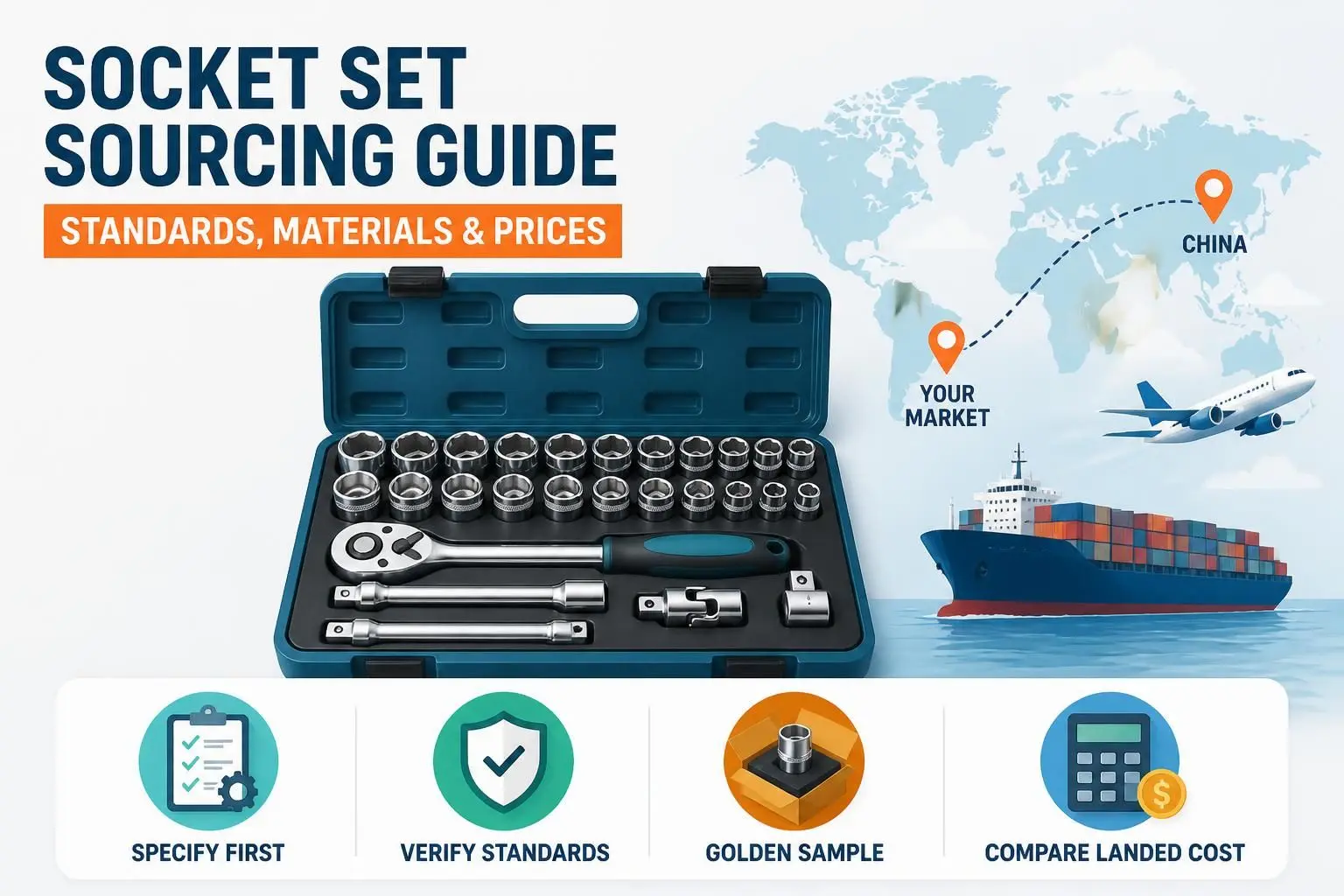
Buying a socket set for resale takes more than comparing the number on the box. One factory’s “108-piece” set may contain fewer useful sockets, a different drive mix, or a cheaper case than another. The lower quote may describe a different product.
This guide gives importers a practical way to write the specification before they ask for prices. It covers hand and impact sockets, CR-V and Cr-Mo terminology, standards evidence, sample inspection, and quote comparison. It also includes an RFQ checklist that can go straight to a factory.
The official links below identify standards and regulations a buyer may need to evaluate. They are starting points, not proof that a supplier or SKU complies. Before naming a standard in a purchase order, confirm the current edition, scope, test method, and destination-market obligations with the manufacturer and a qualified reviewer.
Key Takeaways
- Compare complete configurations, not piece counts: drive size, profile, socket range, ratchet, case, and accessories all change value.
- ISO 3315 and ISO 1174-1 are useful starting references for hand-operated square-drive socket tools; a torque wrench needs separate ISO 6789 review (ISO, accessed 2026).
- A credible wholesale price requires the same specification, MOQ, currency, packaging, and Incoterm across at least three dated RFQs.
- Request a golden sample and pre-shipment inspection before the order leaves the factory.
What should a buyer specify before requesting a socket-set quote?
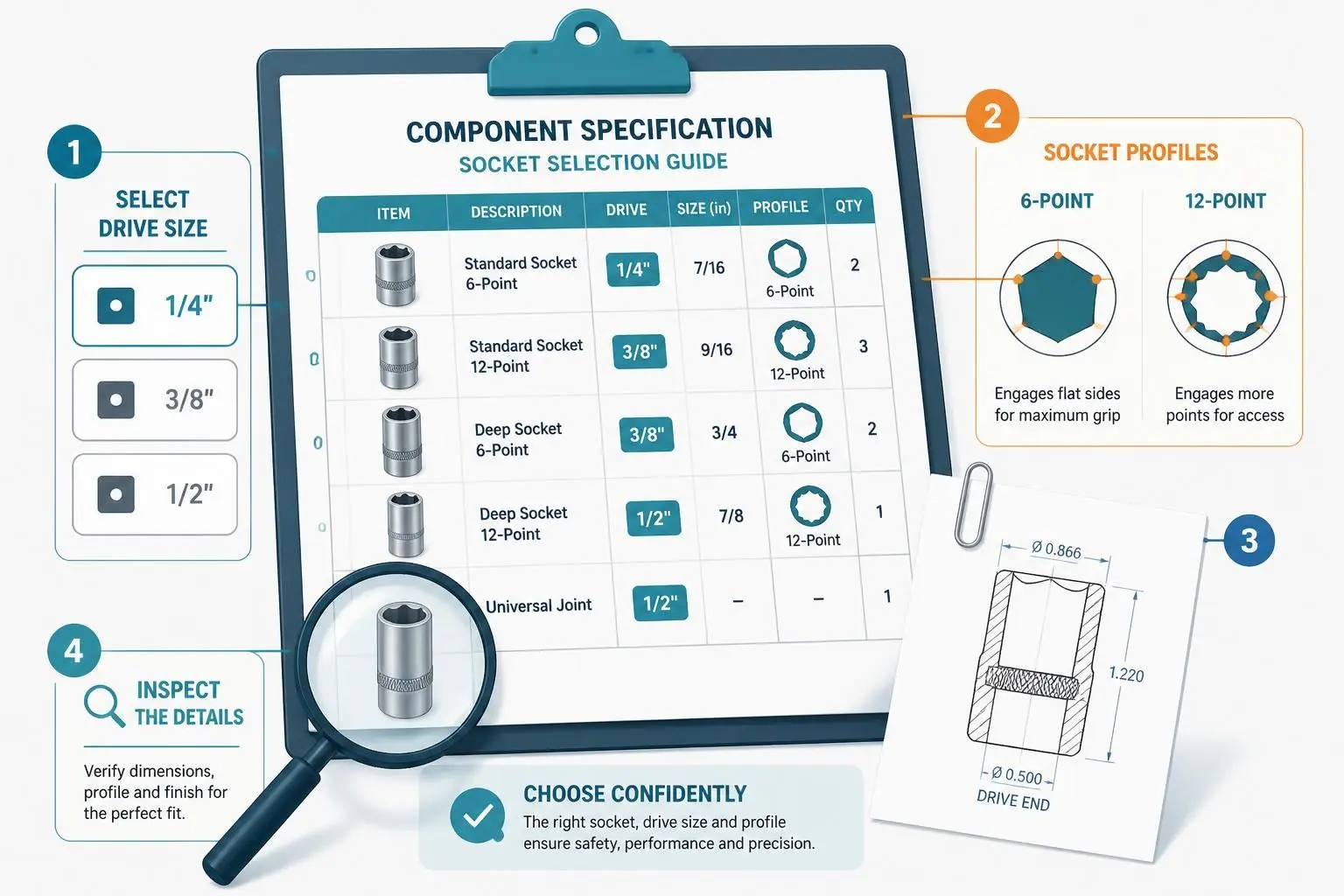
Socket-set quotes become comparable only when the product specification is controlled. At minimum, state the intended use, drive sizes, measurement system, socket profile, size range, material, finish, tool count, case, branding, MOQ, destination, and Incoterm. ISO 1174-1 is a useful reference for square-drive connections, but the factory must confirm the exact scope for your SKU (ISO 1174-1, accessed 2026).
The phrase “socket set” leaves too much open. Before contacting a supplier, write a short product brief with these fields:
- Application: hand use, workshop use, automotive service, or impact-wrench use.
- Drive sizes: 1/4 inch, 3/8 inch, 1/2 inch, or another combination. Do not assume the advertised drive size applies to every piece.
- Measurement system: metric, SAE, or a mixed set. List every socket size.
- Profile: six-point, twelve-point, deep, shallow, spark-plug, bit socket, or specialty profile.
- Included tools: ratchets, extensions, adapters, universal joints, bits, spinner handle, and case.
- Markings: size format, logo, country-of-origin marking, laser or stamped marking, and packaging language.
- Commercial terms: target quantity, private-label needs, destination country, preferred Incoterm, and required documents.
Why piece count is a weak comparison
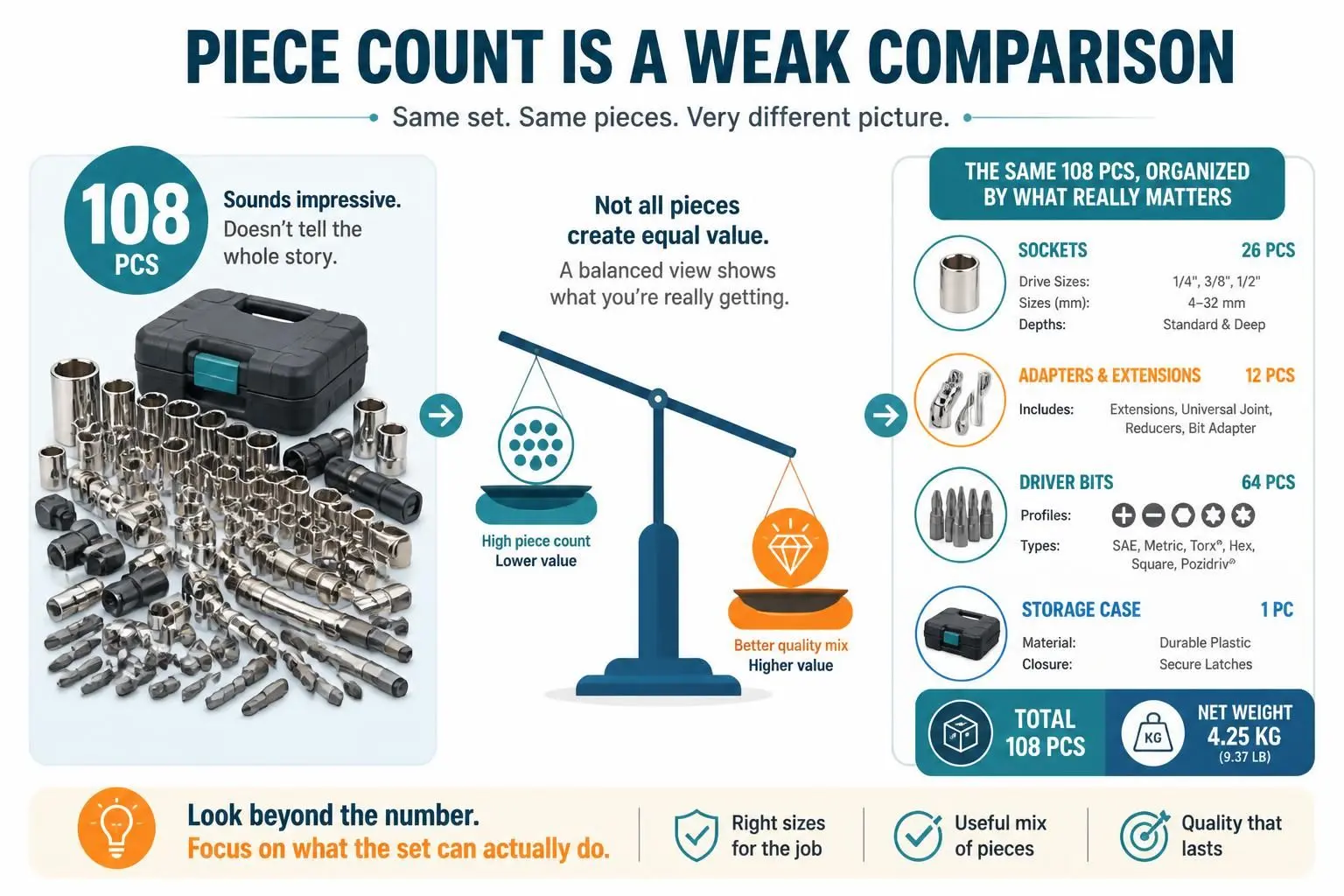
Piece count can include a plastic case, adapters, bits, and duplicate sizes. Two 108-piece sets can therefore have very different selling value. Ask for a numbered component list, a photograph of the open case, and the net weight of the complete set. If the supplier cannot reconcile the list, photograph, and packing quantity, pause the quote comparison.
For a buyer importing into a new market, connect the product specification to your landed-cost plan. You can estimate order quantity with the MOQ reference and model purchasing expenses with the sourcing cost calculator.
Which socket-set materials fit hand use and impact use?
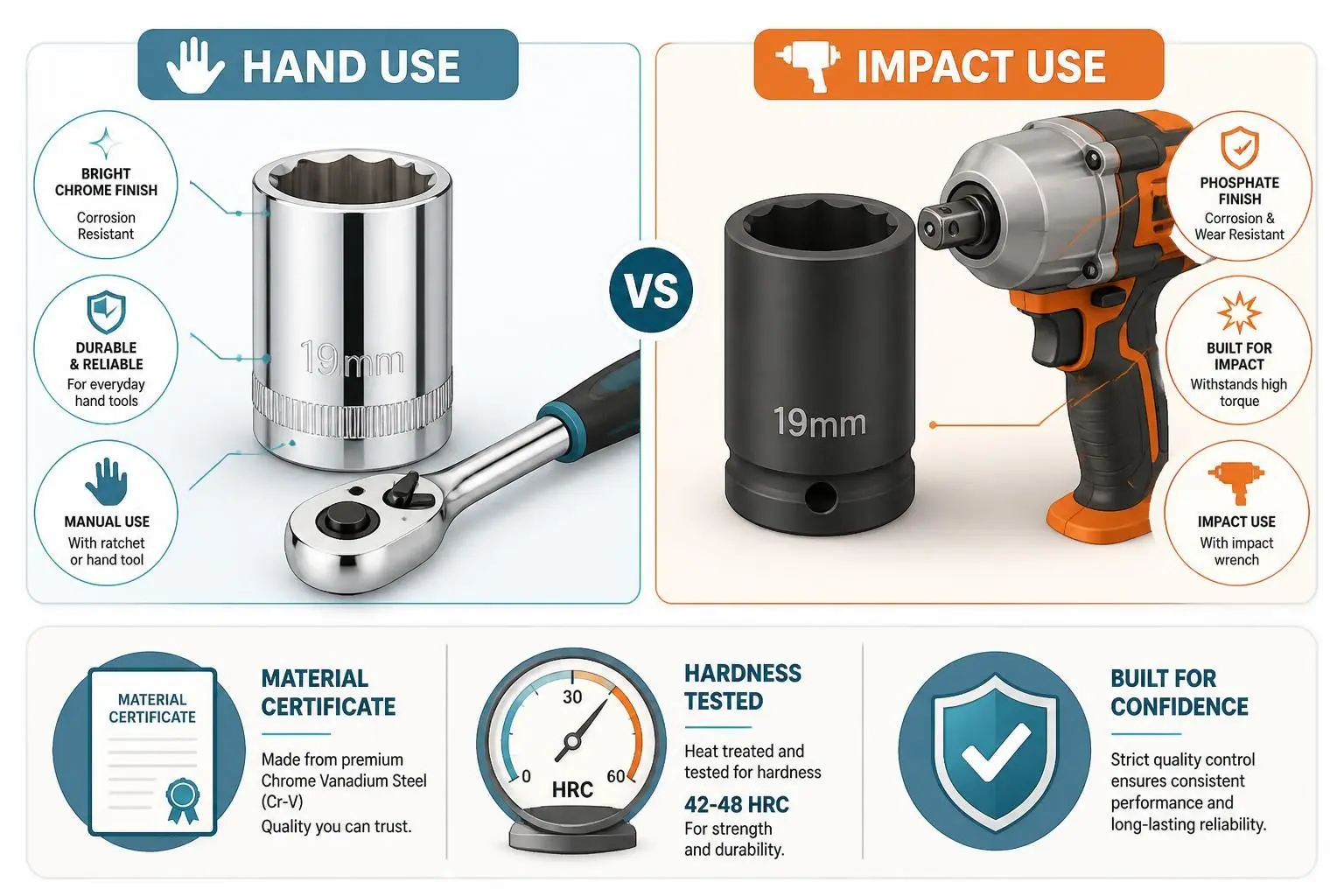
Material names must be read with application, heat treatment, and finish. Supplier catalogs often use CR-V terminology for hand-tool sockets and Cr-Mo terminology for impact-socket lines. Those labels do not prove that a finished socket meets your requirement. Request the SKU’s material statement, heat-treatment specification, and test evidence before approving production.
The practical starting point is tool type:
Hand sockets
Hand sockets are used with manual ratchets, breaker bars, and extensions. They are often sold with a bright chrome or satin finish. The finish helps with cleaning and corrosion appearance, but it is not a substitute for a material or dimensional specification. Confirm the drive interface, socket profile, size markings, and ratchet compatibility.
Impact sockets
Impact sockets are designed for powered tools that deliver repeated shock loads. They are often supplied with a dark phosphate or oxide-style finish. The buyer should require the factory to identify the socket as impact-rated and to state the applicable design or test criteria. A hand-socket material label should not be used to approve an impact range without evidence.
CR-V, Cr-Mo, and lower-tier claims
Chrome vanadium steel and chrome molybdenum steel are useful terms for narrowing a specification, not shortcuts around testing. Ask the factory to provide the exact grade or internal material code, heat-treatment process, hardness test method, and acceptance range. If a supplier only writes “high quality steel,” the product is not specified tightly enough for a private-label order.
Six-point and twelve-point sockets serve different access and fastener-fit needs. The right choice depends on the fasteners your customers use and the tool system they expect. State the required profile in the RFQ instead of allowing the factory to substitute it.
For a documented material review, ask for a redacted material certificate and a sample test report. Remove supplier-sensitive information if you publish the example. Link the inspection process to your quality inspection and warehousing service rather than making a broad performance promise.
Which standards and documents should an importer request?
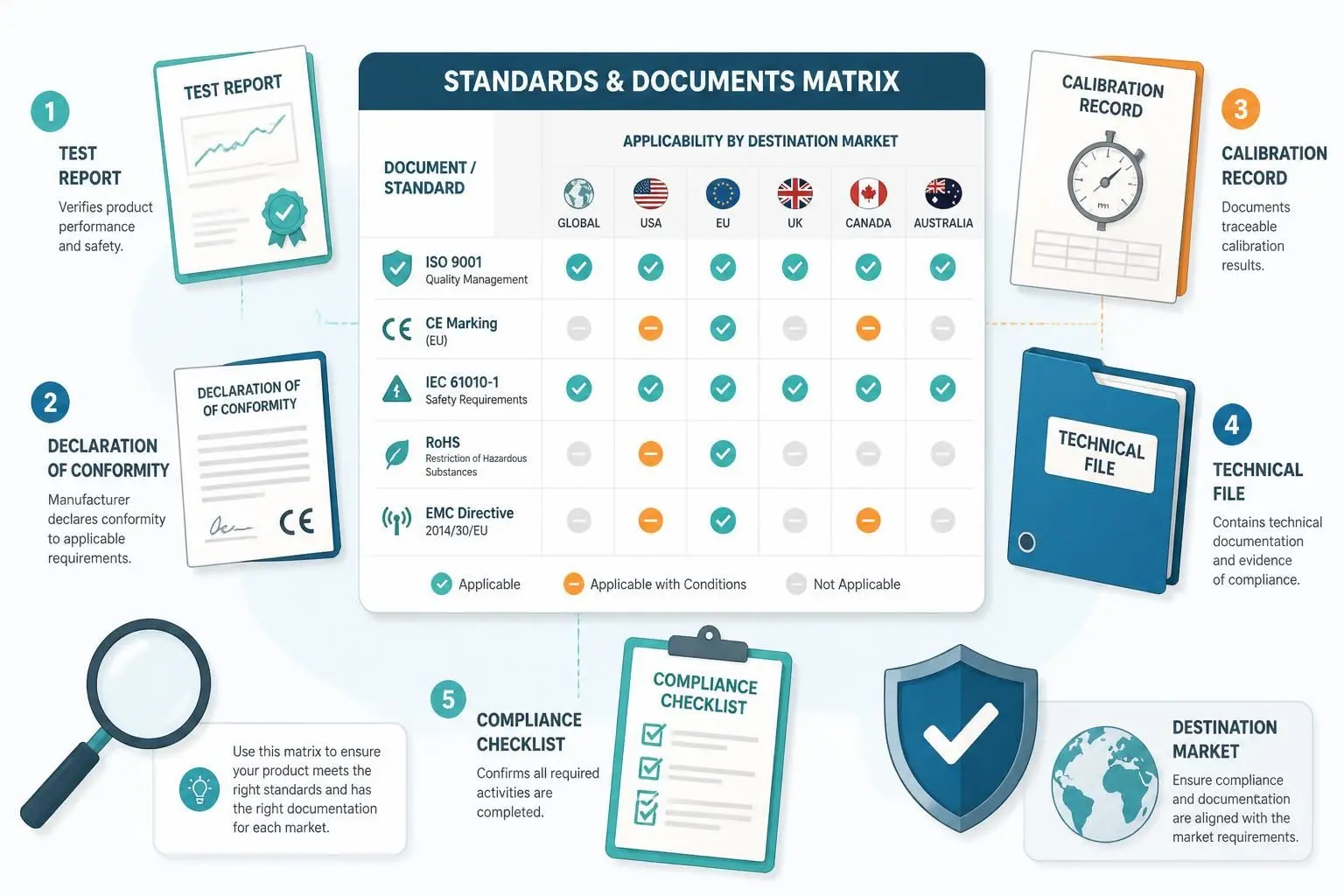
Standards help when they are tied to the exact component and supporting evidence. ISO lists ISO 3315 and ISO 1174-1 among its assembly-tool standards. If a kit includes a torque wrench, review ISO 6789-1 and ISO 6789-2 separately. Before adding any of these references to a purchase order, check the current edition, scope, and evidence required for the SKU (ISO 3315; ISO 6789-1, accessed 2026).
Use a document matrix during sourcing:
| Product element | Reference to investigate | Documents to request |
|---|---|---|
| Hand socket and drive interface | ISO 3315 and ISO 1174-1 scope | Dimensional or performance test report, supplier declaration, product drawing |
| Ratchet and accessories | Product-specific specification | Component list, function-test record, sample approval |
| Torque wrench included in the set | ISO 6789-1/-2 | Calibration record, test method, traceability information |
| EU consumer sale | GPSR, REACH, and other applicable rules | Technical file inputs, traceability details, substance/compliance review |
| Private-label packaging | Destination-market labeling rules | Artwork proof, language review, carton markings |
For EU consumer sales, obtain a destination-specific compliance review before production. The EU GPSR, REACH, and RoHS texts are relevant legal starting points, but whether and how they apply depends on the finished product, materials, sales channel, and economic operators involved. Do not assume every hand-tool set needs the same declaration (EU GPSR, REACH, RoHS, accessed 2026).
What a supplier document review should check
Check the company name, SKU or model, document date, test laboratory, sample description, standard edition, and whether the document covers the complete set or only one component. A certificate for a similar-looking socket is not proof for your private-label configuration. Keep the document with the approved sample and purchase order.
If the set includes a torque wrench, treat it as a separate risk item. A torque wrench is not validated merely because it appears in a socket-set photograph. Request calibration evidence and define the acceptance point in the purchase specification.
How should buyers evaluate factory quality before placing an order?
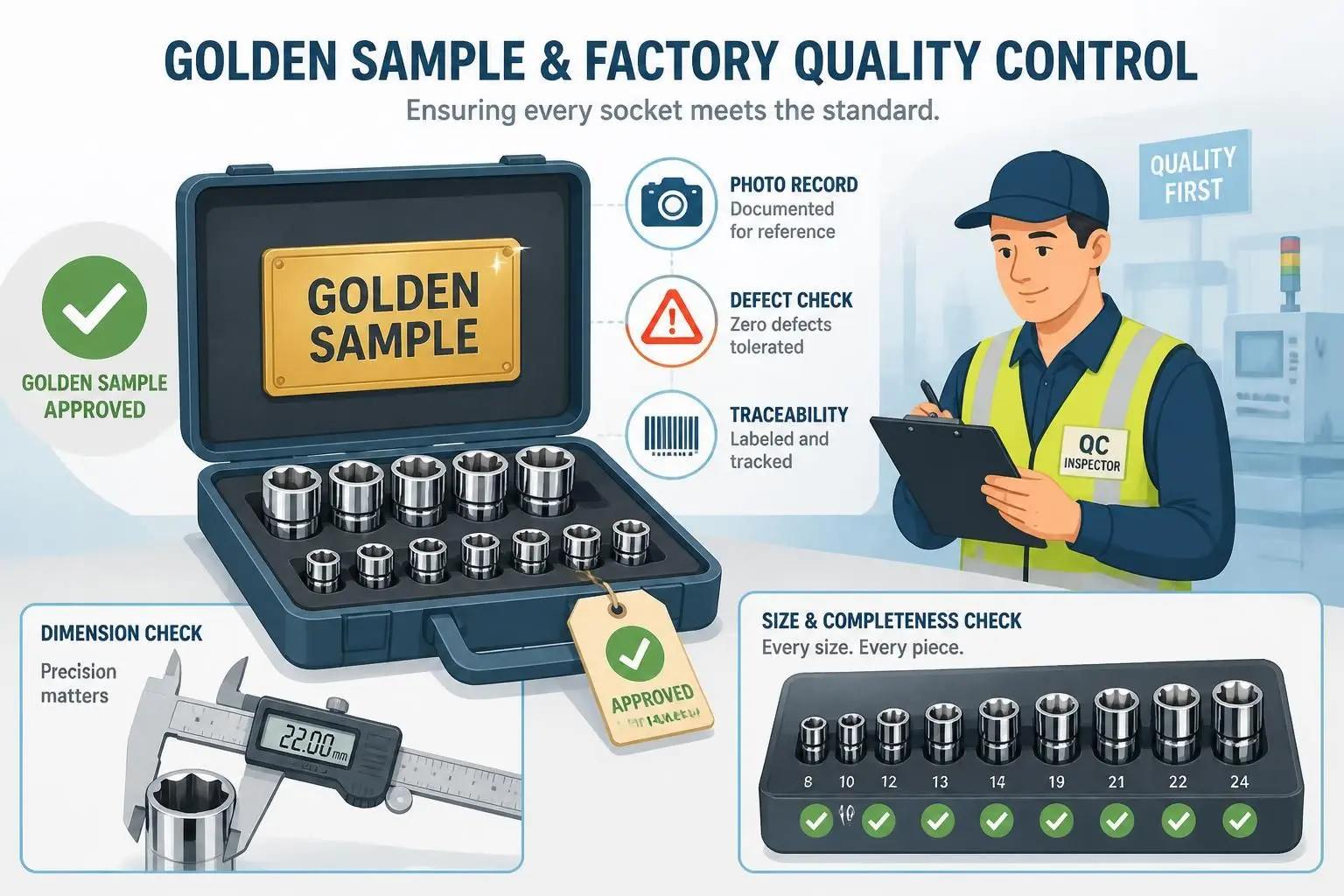
Quality control starts before production. Give the factory a golden sample, an itemized bill of materials, and written acceptance criteria. At final inspection, check size completeness, markings, drive engagement, finish, ratchet function, case fit, packaging count, and the agreed documents. Approve the inspection plan before production begins.
Before ordering
- Request factory identity, product photos, component list, and material information.
- Review a physical sample or a controlled pre-production sample.
- Match the sample to the proposed packaging and case layout.
- Confirm private-label artwork, carton marks, and destination-language requirements.
- Record the acceptance standard in the purchase order.
During production
Ask for production photos that show the actual components, not only catalog images. Check whether the supplier has changed the case, ratchet, socket profile, or plating source. If the factory subcontracts heat treatment or plating, record the subcontractor and define who owns corrective action.
Before shipment
The final inspection should reconcile the approved sample, component list, cartons, labels, and shipping marks. If you use an AQL plan, state the inspection level and defect definitions in advance. For a smaller order, a full count of kit contents may be more useful than a generic sampling phrase.
Record inspection findings in a format a buyer can audit: inspection date, SKU, sample scope, finding, agreed corrective action, and reinspection result. A missing size, case-count mismatch, drive-fit issue, or finish defect is useful only when the factory’s response is recorded. Do not publish a defect rate unless the sample and method are disclosed.
The reliable Yiwu supplier guide can support the supplier-verification stage. Keep product inspection and supplier due diligence separate: a good sample does not prove production consistency.
What determines a wholesale socket-set price?
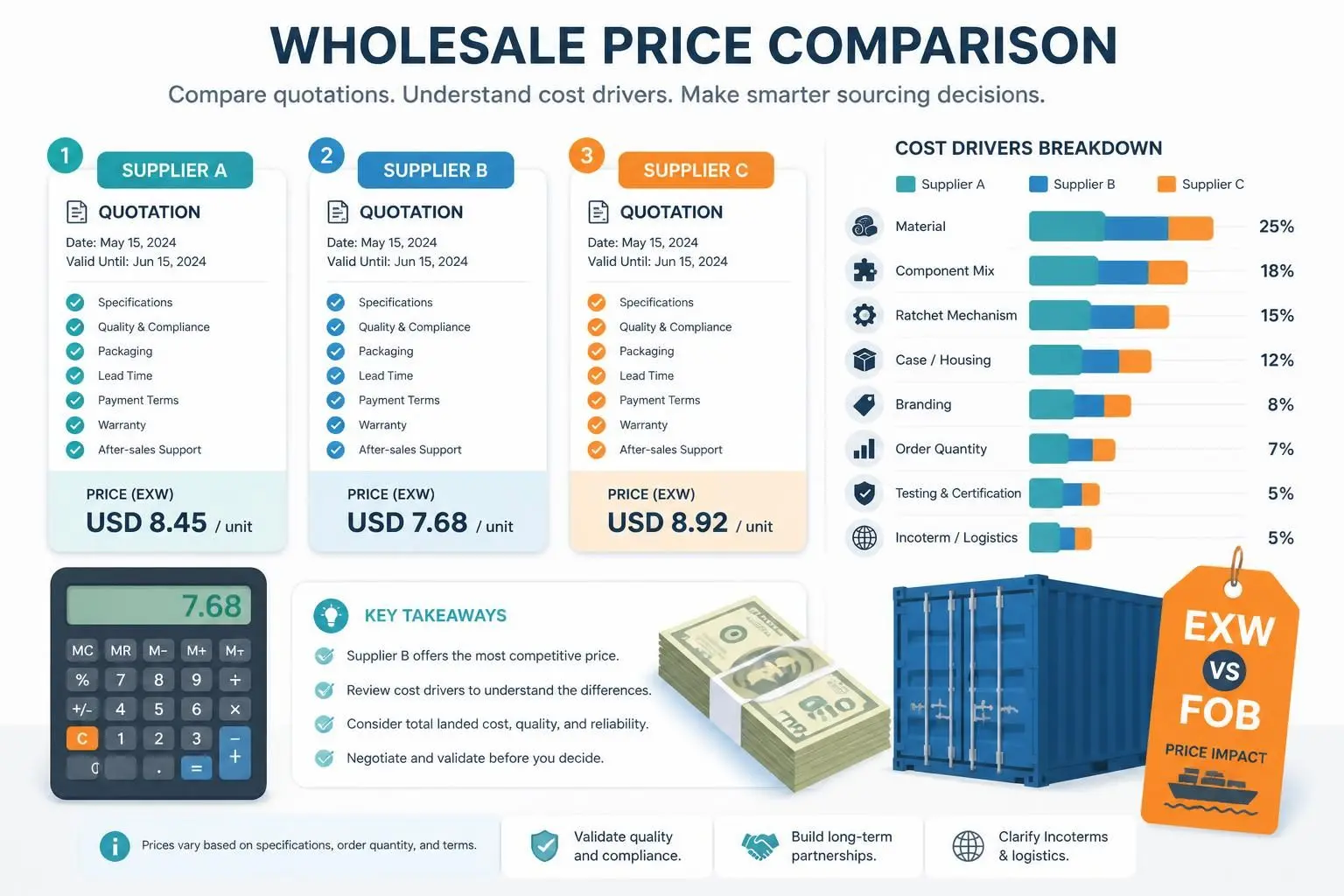
Wholesale socket-set prices should be compared only after normalization. Material and heat treatment, actual tool mix, case, branding, order quantity, testing, packaging, and delivery terms all affect the quote. EXW or FOB is not a landed cost: freight, insurance, duty, customs, destination handling, and local delivery can remain outside the factory price.
The main cost drivers
| Cost driver | Questions for the supplier |
|---|---|
| Material and heat treatment | What grade, process, and acceptance evidence apply to each socket? |
| Component mix | How many usable sockets are included? Which pieces are adapters or duplicates? |
| Ratchet | What mechanism, drive sizes, finish, and function criteria apply? |
| Case and packaging | Is the case included? What are the inner-box and master-carton specifications? |
| Branding | Which components carry the logo? What are the artwork and plate costs? |
| Quantity | Is the quote based on one MOQ, a trial order, or a repeat volume? |
| Inspection and testing | Are laboratory tests, sample charges, or third-party inspections included? |
| Incoterm | Is the price EXW, FOB, CIF, or another term? What charges are excluded? |
How to build a defensible price range
Use one benchmark configuration. For example, define the drive mix, metric or SAE range, piece count, material, finish, case, logo, packaging, order quantity, currency, and FOB port. Request at least three dated factory quotations. Record what each price includes and excludes.
Do not average unlike quotes. A quote for a 94-piece CR-V hand set in a basic case cannot be used as the “average” for a 108-piece mixed-drive set with private-label packaging. If a supplier changes one variable, create a new comparison row.
| Quote field | RFQ 1 | RFQ 2 | RFQ 3 |
|---|---|---|---|
| Configuration and piece count | Confirm | Confirm | Confirm |
| Material and finish | Confirm | Confirm | Confirm |
| MOQ and repeat quantity | Record | Record | Record |
| Price basis and currency | Record | Record | Record |
| Incoterm and port | Record | Record | Record |
| Branding and packaging | Included/excluded | Included/excluded | Included/excluded |
| Inspection and documents | Included/excluded | Included/excluded | Included/excluded |
| Quote date and validity | Record | Record | Record |
You can estimate shipment volume with the CBM calculator, model transport with the freight estimator, and review destination duties with the import duty tool. These tools do not replace a customs classification decision.
How can a buyer compare suppliers on more than unit price?
The lowest unit quote can become the most expensive option once rejected components, late samples, missing documents, carton damage, or inconsistent set contents enter the order. A supplier scorecard keeps the decision auditable. Score price, sample quality, production capability, documents, communication, packaging, inspection cooperation, and delivery risk against your market’s priorities.
Use blank weights rather than copying a universal formula. A discount retailer may weight price and carton efficiency heavily. A professional tool brand may give more weight to material evidence, ratchet performance, warranty handling, and packaging quality.
Suggested scorecard fields:
- Specification accuracy after the first quotation.
- Sample match against the written component list.
- Material, heat-treatment, and test evidence.
- Factory capacity and subcontractor disclosure.
- Response speed and clarity when specifications change.
- Private-label packaging capability.
- Inspection access and corrective-action process.
- Quote transparency and Incoterm accuracy.
Ask one revealing follow-up question
Ask the supplier: “Which part of this specification would you price differently if we changed it?” A capable factory should identify the cost impact of the case, logo, material, drive mix, testing, or quantity. A vague answer suggests the quote may be based on a standard catalog set rather than your actual request.
What should a socket-set RFQ include?
A usable socket-set RFQ names the exact set contents, drive sizes, measurement system, material and finish, branding, packaging, quantity, destination, required documents, quality checkpoints, and preferred Incoterm. “Please send your best price” is not an RFQ because the supplier cannot know which product to price.
RFQ Template
Socket Set Sourcing Request
Send these details to a factory or sourcing agent before asking for a wholesale quotation. The more specific the request, the easier it is to compare suppliers on the same product.
Buyer note: Replace each bracketed item with your requirements. Attach a product drawing, spreadsheet, reference sample, or packaging artwork wherever possible.
Before sending the RFQ
- List every socket size instead of relying on the total piece count.
- State whether the set is for hand tools or impact tools.
- Separate product price from branding, packaging, inspection, freight, and duty.
- Ask the supplier to mark any deviation from your specification.
- Request a sample or golden sample before mass production.
Have an existing product sample or drawing? Attach it with this RFQ so the quotation is based on the same specification.
Get a Free QuoteSend an existing product sample or drawing when appearance and fit matter. Request the factory to mark all deviations in writing. For a private-label launch, ask for a packaging proof before printing cartons.
When your specification is ready, use Get a Free Quote and attach the component list. A sourcing team should review the product definition before promising a price.
When should a buyer use a sourcing agent for socket sets?
A sourcing agent can help when a buyer needs several factory comparisons, sample coordination, QC, warehouse consolidation, or export preparation. The service is worth considering only when the agent can show what it checked, what it rejected, and how the final shipment matches the approved specification.
Before choosing a sourcing agent, ask for its written scope for sample coordination, supplier comparison, inspection, warehouse handling, and export preparation. A company’s stated experience or warehouse capacity does not guarantee that every socket-set order will meet a particular standard. Confirm the assigned QC scope, inspection report, and commercial terms for your project.
For a first order, clarify who will:
- collect and compare samples;
- verify the factory and production specification;
- approve artwork and packaging;
- arrange pre-shipment inspection;
- consolidate cartons and report warehouse receipts;
- quote freight and identify excluded destination charges.
See the Yiwu sourcing agent service and sourcing services overview for the process. Ask for a written scope before placing a deposit.
Socket-set sourcing checklist
Use this checklist before approving a factory or comparing a wholesale quote:
- Application is defined: hand or impact.
- Drive sizes and measurement system are listed.
- Six-point, twelve-point, deep, shallow, and specialty sockets are identified.
- Every piece is named; adapters and case parts are not hidden in the count.
- Material, heat treatment, finish, and marking requirements are written.
- Sample, drawing, and golden-sample approval are documented.
- Applicable standards and destination-market obligations are reviewed.
- Material certificates, test reports, and calibration documents are requested where relevant.
- Branding, case, labels, inner box, and master carton are priced separately.
- MOQ, currency, quote validity, Incoterm, port, and exclusions are recorded.
- Inspection plan and defect definitions are approved before production.
- Freight, CBM, duty, and destination charges are estimated separately.
The checklist is deliberately practical. If a field is blank, the quote is not ready for a fair comparison.
Frequently Asked Questions
What material is best for a socket set?
There is no universal winner. Supplier catalog terminology varies by tool type and market. Choose by application, then request the exact material, heat-treatment requirement, finish, and test evidence for the SKU. Before naming ISO 3315 in a specification, verify that its current edition and scope apply to the component you are buying (ISO, accessed 2026).
Are CR-V sockets suitable for impact wrenches?
Do not approve them from the material label alone. An impact-wrench set needs an impact-rated product specification and supporting evidence from the factory. Confirm the design, drive size, finish, markings, and test criteria. A supplier’s “CR-V” description does not automatically establish suitability for repeated powered impact use.
What standards apply to socket sets?
The exact components and destination market determine which references apply. Review the current scope of ISO 3315 and ISO 1174-1 for socket and drive components; if the set includes a torque wrench, review ISO 6789-1 and ISO 6789-2 separately. Confirm the edition and test evidence with a technical reviewer before import.
How much does a wholesale socket set cost in China?
The honest answer depends on configuration, quantity, packaging, testing, and Incoterm. Build a price range from at least three dated RFQs using one identical benchmark. Record currency, MOQ, quote validity, and exclusions. A catalog listing is not a reliable wholesale benchmark because it may omit branding, inspection, packaging, freight, or duty.
What should I inspect in a socket-set order?
Inspect the complete component count, size markings, drive engagement, socket profile, finish, ratchet function, extensions, case fit, carton quantity, labels, and agreed documents. Compare production against the approved sample. If a torque wrench is included, verify the required calibration evidence separately instead of treating it as another ordinary socket.
Can I add my own logo and packaging?
Usually, yes, if the factory supports private labeling and your quantity meets its MOQ. Price logo locations, case marks, inner boxes, sleeves, and master cartons separately. Approve artwork and a physical or controlled digital proof before printing. Keep the branded sample with the purchase order so the inspection team has a clear reference.
Conclusion: specify first, then compare price
The safest socket-set purchase begins with a controlled specification, not a low unit quote. Define the use, drive sizes, profile, material, finish, complete inventory, case, branding, documents, inspection plan, and delivery term before asking factories to compete.
Use official standards as references, not as blanket certification claims. Ask for SKU-level evidence. Normalize at least three comparable quotations, then separate factory price from freight, duty, and destination costs. Finally, approve a golden sample and inspect the order before shipment.
If you are ready to source a private-label or wholesale set, send the RFQ checklist and component list to our team. For the next step, review the hardware and hand-tools sourcing guide and prepare your target market, quantity, and destination.