


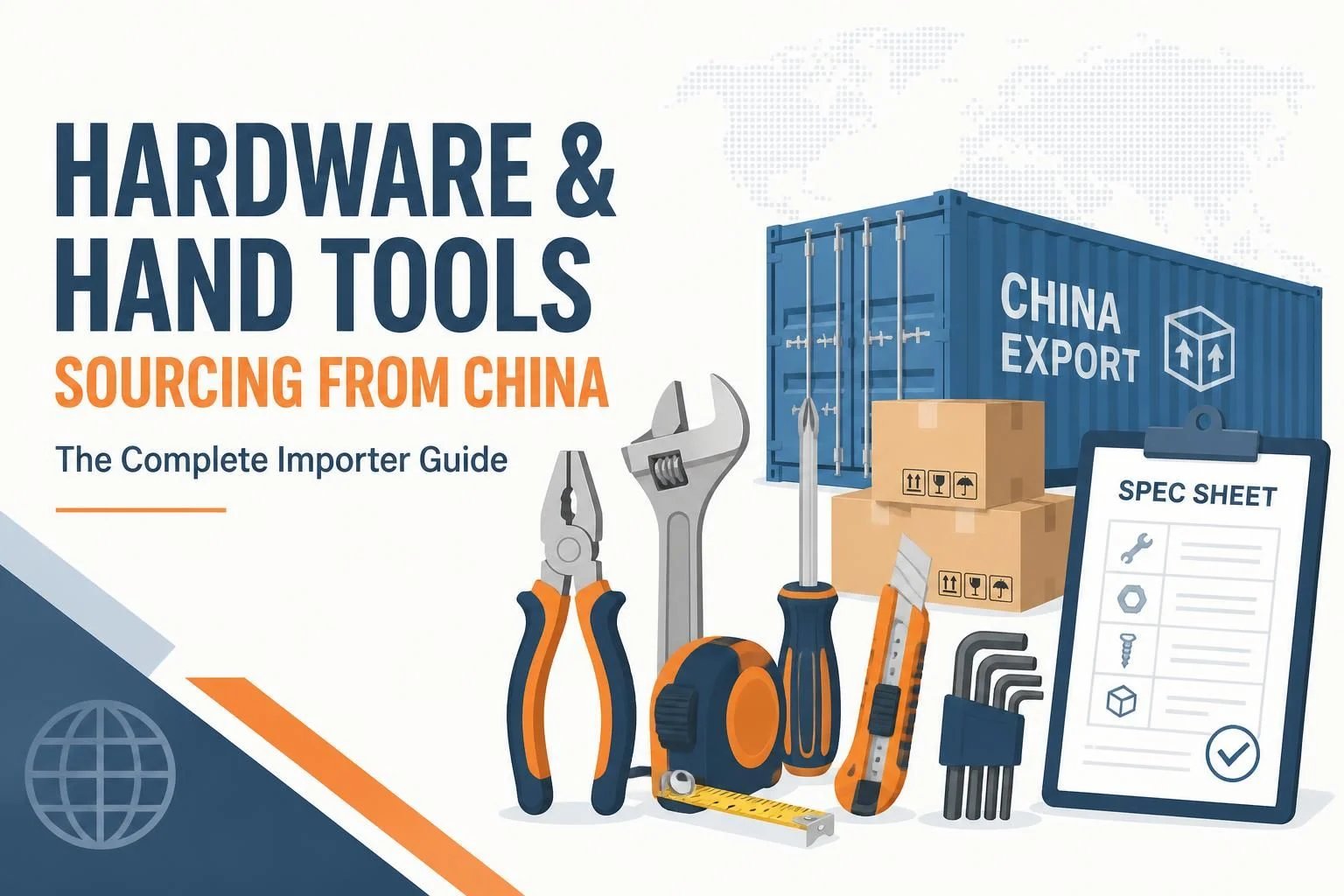
Hardware and hand tools sourcing from China can work well when you buy against evidence, not a catalog photo. A plier, wrench, tape measure, blade, or tool set may look right online and still fail on steel grade, heat treatment, coating, tolerance, grip, packaging, or carton strength. Those details decide whether the product earns repeat orders or becomes a returns problem.
This guide gives importers a practical order of work. It covers where to source, how to write a product brief, screen suppliers, approve samples, check compliance, control quality, calculate landed cost, and ship. It is for wholesalers, distributors, retailers, private-label teams, and e-commerce sellers buying hardware or hand tools from China.
Key Takeaways
- Use 7 pre-deposit checks: product brief, supplier, sample, specification, compliance, QC, and freight.
- Yiwu International Trade City is useful for mixed hardware buying; specialist or high-volume work may need factory validation.
- A golden sample and measurable acceptance limits matter more than a supplier’s promise of “same quality.”
Important: This is a sourcing overview, not engineering, legal, product-safety, customs, or tax advice. Check the exact product, claims, destination market, HS code, importer responsibilities, and current rules with qualified advisers before ordering.
Is China the right place to source hardware and hand tools?
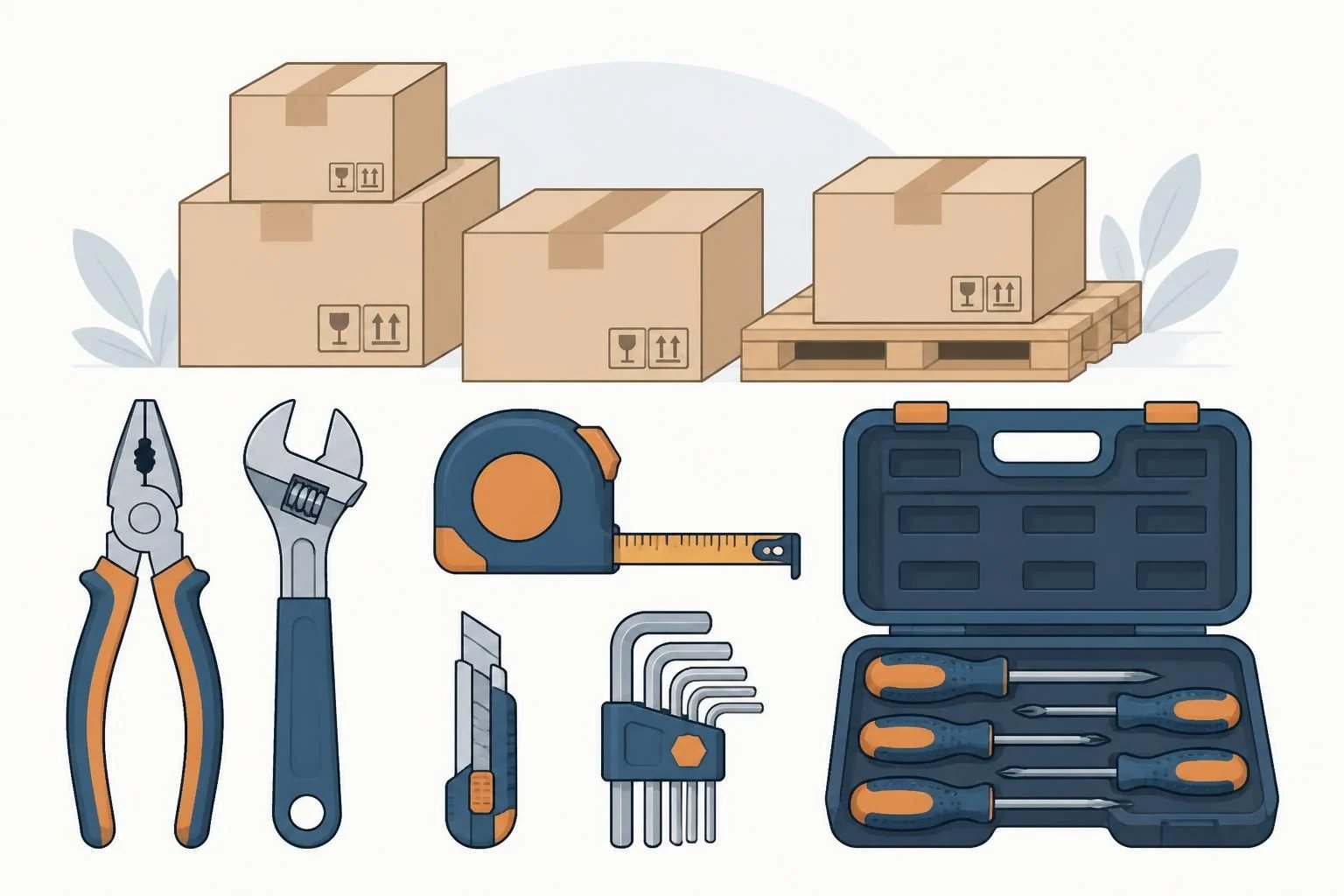
China is a practical buying base for broad hardware assortments, replacement parts, tool accessories, and private-label hand tools. Yiwu International Trade City puts many product categories and sellers in one market system, so buyers can compare mixed products quickly. That convenience does not replace product engineering or supplier checks.
China is usually a good fit when you need variety, existing designs, reasonable minimums, or a mix of SKUs in one shipment. It can also work for branded tool sets when you control specifications, samples, artwork, and inspection. The right route depends on the product. A simple adjustable wrench and a safety-rated insulated tool do not carry the same sourcing risk.
| Buying need | Usually the better starting point | What to verify first |
|---|---|---|
| Mixed general hardware order | Yiwu market and local supplier search | Assortment, MOQ, cartons, consolidation |
| Existing hand-tool design | Factory or trading supplier | Samples, material, finish, functional checks |
| Private-label tool set | Factory with packaging capability | Tooling, logo method, packaging, production control |
| Precision or safety-critical item | Specialist factory and technical review | Standards, test method, traceability, capability |
| Large repeat order | Factory-direct comparison | Capacity, process ownership, change control |
Ask a narrower question: “Can this supplier make the exact version I can sell?” It gives the later decisions a clearer standard. For category context, start with our hardware and hand tools page and the Yiwu market overview.
The hardest part of tool sourcing is usually the specification gap. Two tools can share a shape, colour, and product photo while using different steel, heat treatment, coating thickness, jaws, springs, tolerances, or packaging. Price comparisons only become useful after you close that gap.
Where should you source hardware and hand tools in China?
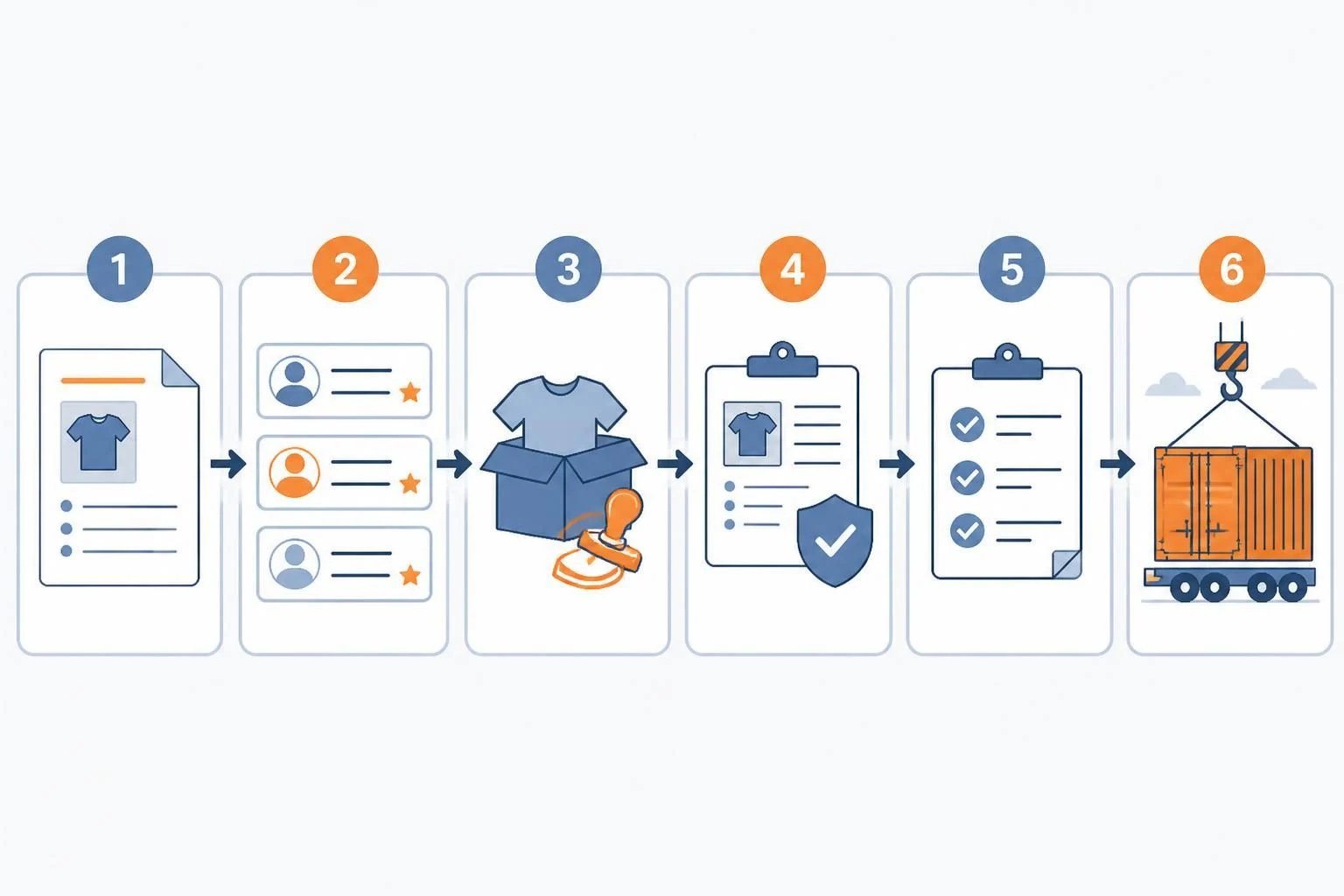
Start by matching the product to the sourcing environment. Yiwu is useful when you need assortment discovery, mixed-carton buying, low-to-medium order quantities, or several general hardware SKUs at once. Use the current official market directory to identify hardware locations, then confirm booths, floors, and opening arrangements before travel because market layouts change.
Factory sourcing deserves more attention when the product needs controlled forging, machining, heat treatment, plating, precision measurement, load performance, or a custom production run. A market seller can still be the right commercial contact. But you need to know whether that seller owns the factory relationship and which processes happen elsewhere.
Use three routes deliberately:
- Start with market discovery for existing items, assortment building, packaging ideas, and early samples.
- Compare trading companies when one commercial contact will manage goods from several factories.
- Validate the factory when a product is technical, customized, high-volume, or sensitive to process variation.
Do not assume a product’s city of origin from a single online article. China’s industrial clusters change by subcategory, and many tool suppliers subcontract some processes. Ask who makes the forging, machining, heat treatment, plating, assembly, printing, and packing. Then check the answer against samples and production evidence.
For a visit, use the Yiwu market map as a planning aid and confirm current locations with the official directory. If you need an on-the-ground team to compare suppliers and collect evidence, our Yiwu sourcing agent service can help coordinate the work.
What should a hardware and hand-tool product brief include?
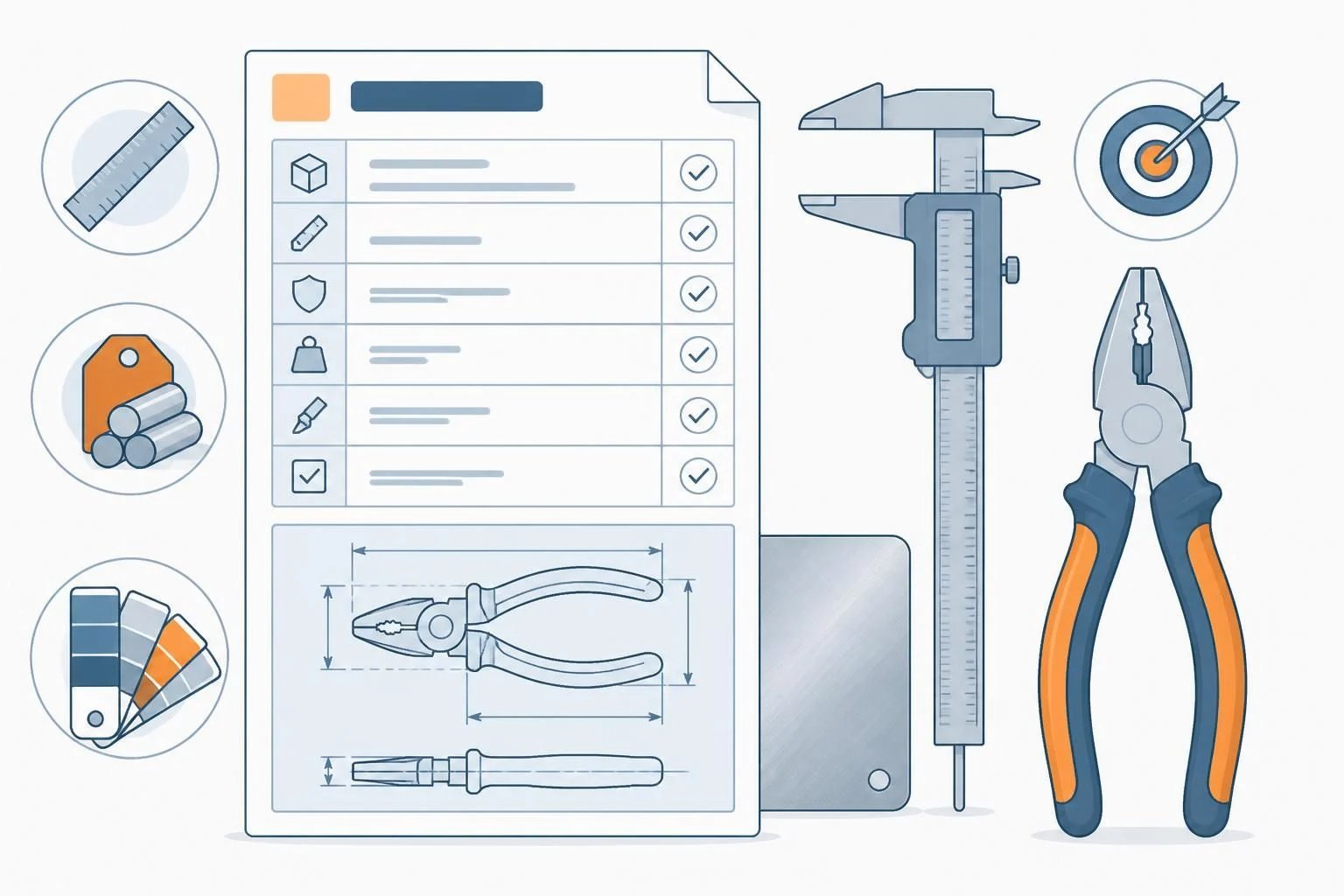
A precise brief is the quickest way to get comparable quotations. It should let a supplier identify the exact product, material, finish, packaging, performance target, quantity, and destination. A request that says “heavy-duty pliers, best quality” gives every seller room to quote a different item.
Write the brief before asking for price. Include drawings or marked-up photos where possible. If you have a reference sample, photograph it from all sides, record its dimensions and weight, and identify which details must match.
Use this product-brief checklist
- Product and user: SKU name, use case, target customer, and destination market.
- Dimensions: drawings, measurements, tolerances, units, and reference photos.
- Materials: steel grade or accepted equivalent, handle material, coating/plating, colour, and finish.
- Performance: applicable torque, cutting, alignment, accuracy, cycle, insulation, or load test.
- Appearance: logo location, marking method, colour standard, finish standard, and acceptable cosmetic defects.
- Packaging: unit pack, inner box, master carton, barcode, warnings, language, and carton marks.
- Commercial terms: quantity, target delivery date, Incoterm, quotation currency, target market, and required documents.
“CR-V steel” alone is not a full requirement. It may describe an alloy family, but it does not identify which part uses it, how it was treated, what hardness applies, or how a buyer will check performance. Make the claim measurable. A workable brief names the part, accepted material evidence, test method, and pass/fail limit.
Use the MOQ reference when you are setting quantity expectations, then test the complete budget with a sourcing-cost calculation. A detailed brief also gives an inspector something real to inspect.
How do you verify a Chinese hand-tool supplier?

Verify the legal entity, production role, process capability, samples, documents, and payment identity before approving a supplier. A valid business licence or a good marketplace rating is only one piece of the check. It cannot prove that the quoted product, factory, bank account, and sample all belong to the same controlled order.
Begin with eight to twelve candidates, not one. Send the same brief to each supplier. Ask for the legal company name, business licence, factory or trading status, production photos/video, current catalog, export markets, relevant test evidence, and a clear statement of outsourced processes. Then compare like with like.
| Check | What a useful answer looks like | Pause if you see |
|---|---|---|
| Legal identity | Licence, contract party, and bank account align | Different names with no written explanation |
| Product capability | Specific machines/processes and comparable products | A generic catalog only |
| Material and finish | Defined material and available evidence | “Same as photo” without details |
| Sample control | Sample code, revision record, and approval route | No way to distinguish versions |
| Process ownership | Clear in-house and outsourced steps | Refusal to identify critical processes |
| Payment | Company account matching contract party | Pressure to pay a personal account |
Red flags include unexplained material substitutions, a report that names another product or company, vague answers about heat treatment, and a quote that drops after you ask for exact packaging. None proves fraud by itself. Each is a reason to pause until the seller supplies evidence.
A lower quote can still describe a different tool. The difference may sit in the handle, coating, jaw finish, packaging, or test requirement rather than the product photo. A written comparison sheet makes those differences visible before a buyer treats two quotations as equivalent.
For a fuller commercial due-diligence process, see how to find reliable suppliers in Yiwu and how to verify a supplier’s legal identity.
How do you compare samples and control tool quality?
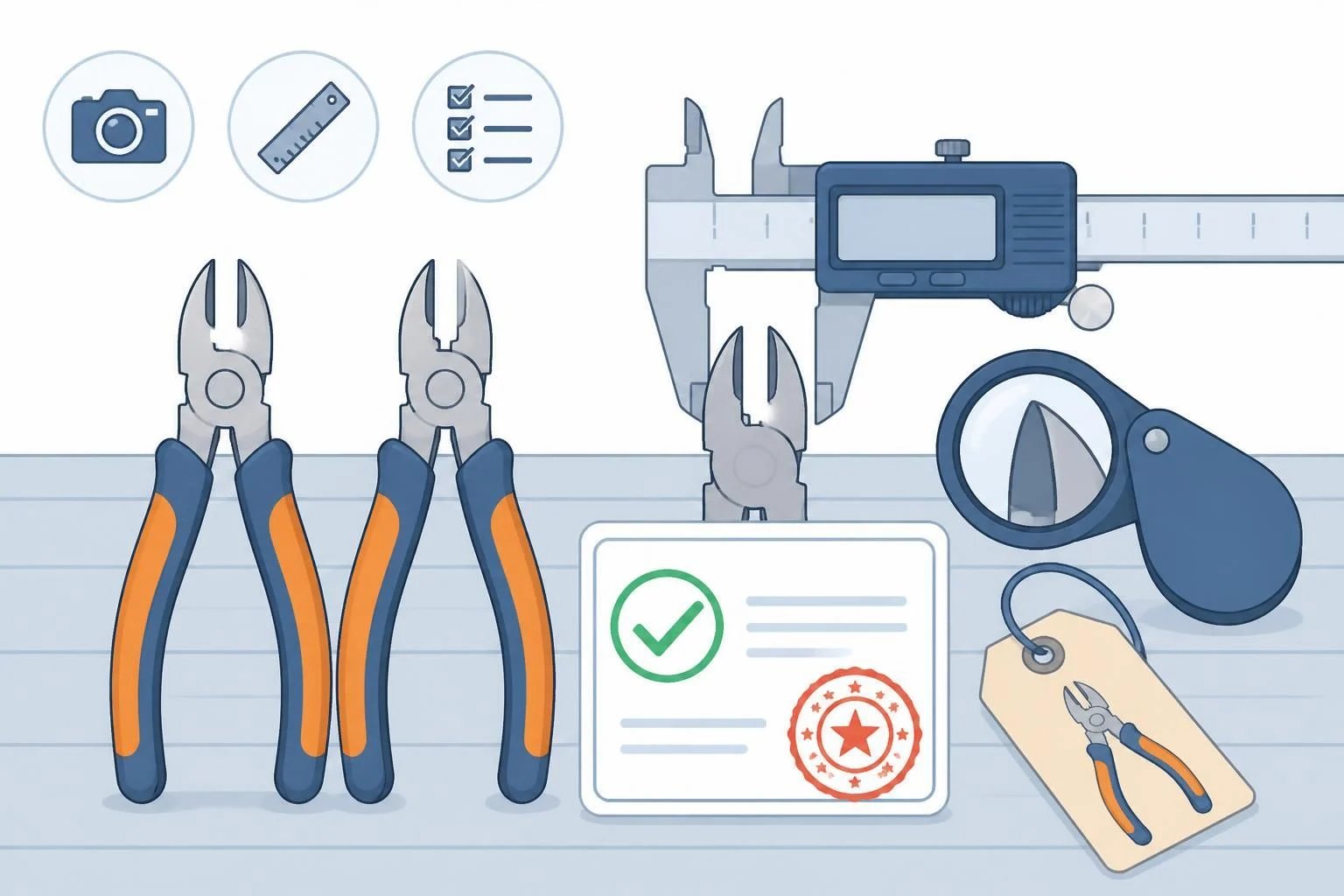
Approve a golden sample and signed specification before production. That sample becomes the reference for inspection. Without it, “good quality” is a debate rather than an acceptance standard. The production team, supplier, and inspector must be looking at the same agreed version.
Score samples against what matters for the tool. Visual appearance is only one line. Check dimensions, material evidence, surface finish, coating adhesion, fit, moving parts, markings, packaging, carton condition, and function. The functional test must reflect the product. Pliers may need jaw alignment and cutting checks; tape measures may need accuracy checks; blades need defined cutting and edge requirements; insulated tools need a product-specific safety review.
Set measurable acceptance criteria
Use a specification table with a target, tolerance, test method, sample size, and result field. For example, do not write “good rust protection.” Write the agreed finish, test exposure where applicable, cosmetic standard, and evidence required. Do not write “strong handle.” Define pull, torque, cycle, or other relevant test conditions with professional support.
An AQL sampling plan can help you inspect a production lot, but it cannot turn a vague product requirement into a good one. Choose the plan according to order size and product risk. A product with a safety function, sharp edge, electrical component, lifting use, or tight tolerance may need more than a standard visual random check.
Ask for quality inspection and warehousing support once you have approved the sample and inspection scope. Keep the approved sample, product specification, artwork, and defect photos with the order file. That record makes corrections faster if a shipment fails.
Which regulations and certifications apply to imported hand tools?

The answer depends on the exact product and the market where you sell it. Ordinary manual tools do not automatically need CE marking just because they enter Europe. However, a tool with electrical parts, batteries, laser functions, personal-protective claims, lifting use, pressure, child-directed design, or chemical exposure may fall under additional rules. These examples are not exhaustive and do not determine the legal regime for a particular SKU.
For the European Union, identify the applicable legislation and current chemical restrictions with the European Commission and ECHA. For U.S. consumer-product questions, use the U.S. Consumer Product Safety Commission’s product-category guidance. For Great Britain, use current GOV.UK product-safety guidance. Before publication, replace this paragraph with verified, SKU-specific primary-source links for the products and destinations the page targets. Check the final product and destination; a general guide cannot determine legal compliance.
The document names matter:
| Document | What it can show | What it does not show by itself |
|---|---|---|
| Test report | Result for a defined sample and method | Approval for every version or market |
| Declaration of conformity | A responsible party’s stated compliance basis | Independent proof without supporting records |
| Certificate | A stated scope, issuer, and validity period | Universal permission to sell |
| SDS/material declaration | Chemical or material information | Finished-product compliance in every market |
| Technical file | Evidence behind a regulated product | A substitute for the product itself matching the file |
Compliance review belongs before production, not at the container door. Confirm labeling, traceability, importer details, documentation, chemical restrictions, and any category-specific standards early. For duty and customs planning, use an import duty lookup as a starting point, then confirm the code and treatment with the destination customs authority or broker.
What MOQ and landed cost should you plan for?
MOQ depends on whether the item is stock, customized, branded, tooled, specially packaged, or made from a controlled material. A seller may accept a small mixed order of existing tools but require a much larger run for a custom colour, logo, forged component, or retail-ready box. That is normal. It is not a reason to guess your commercial model.
Calculate landed cost per sellable unit, rather than relying on the supplier’s ex-works price alone:
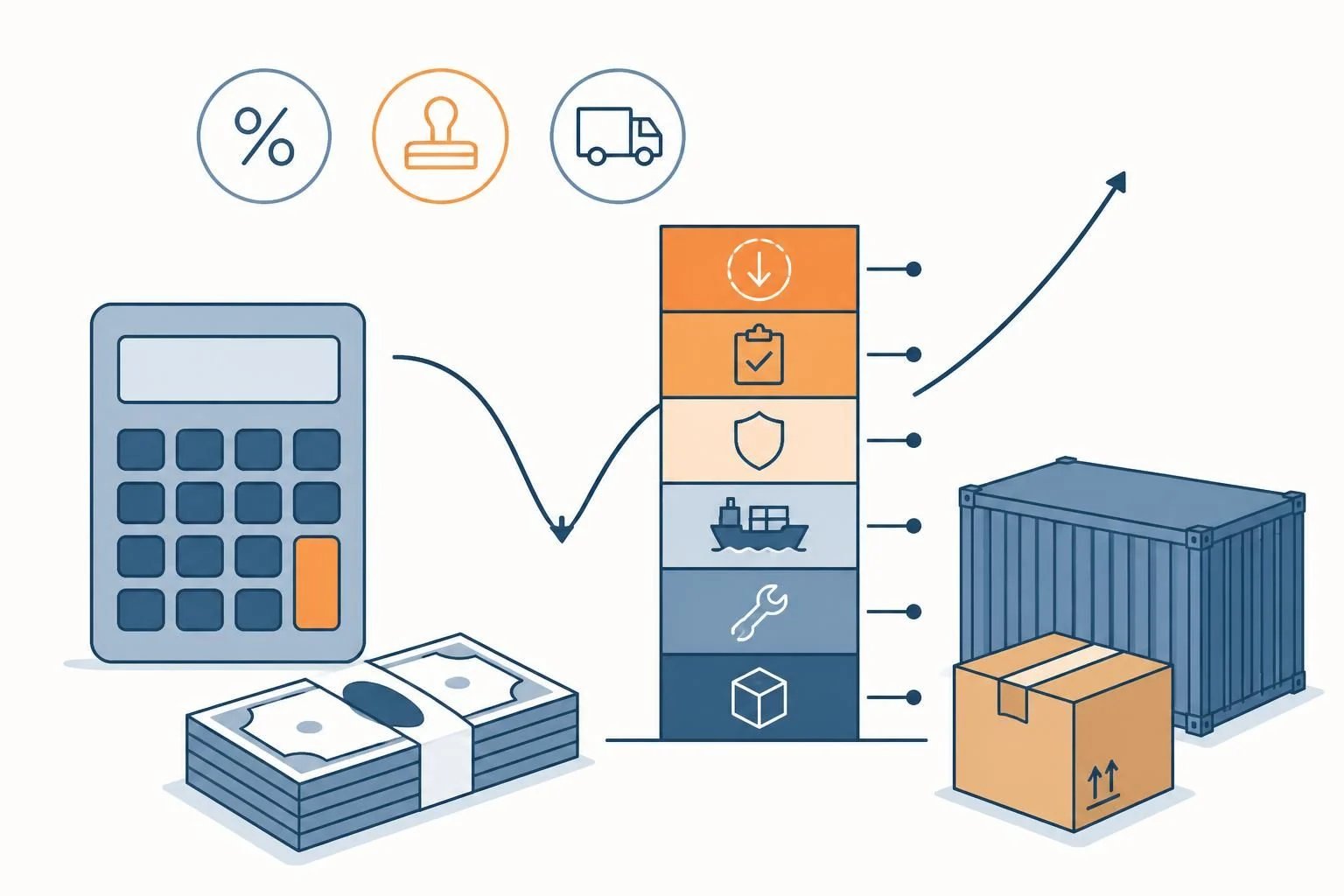
(product + samples + tooling + packaging + tests + inspection + China logistics + freight + insurance + duty/tax + clearance + delivery + expected loss) ÷ sellable units received
This illustrative cost structure is not a market average. It shows the cost lines to consider for a private-label hand-tool set:
Fixed costs such as artwork, print plates, tooling, tests, and sample freight can make a small order expensive per unit. A large order can spread those costs, but it can also create excess stock. Test scenarios with the sourcing cost calculator, freight estimator, and CBM calculator before you approve a quantity.
Set terms before you pay a supplier
Put the approved product and process into the purchase order. The document should identify the product revision, golden sample, materials, finish, performance requirements, packaging, labels, quantity tolerance, documents, delivery date, inspection condition, Incoterm, payment schedule, and remedy for material deviations.
Before any deposit, match four names: the company on the quotation, the contract party, the invoicing entity, and the receiving bank account. If they do not match, get a clear written explanation and supporting documentation. Do not treat an informal messaging-app confirmation as a change to a controlled order.
Keep payment and delivery terms understandable. Incoterms allocate defined duties, but they do not decide whether your product is legal to import or whether a supplier met your quality requirement. DDP also needs careful review: buyers should still know who acts as importer of record, what duty/tax is included, and how destination compliance is handled.
Use change control. If the supplier proposes another material, plating line, carton, factory, or label after approval, require written acceptance before production continues. That may feel slow. It is much quicker than resolving a surprise after final payment.
Inspect, consolidate, and ship hardware orders
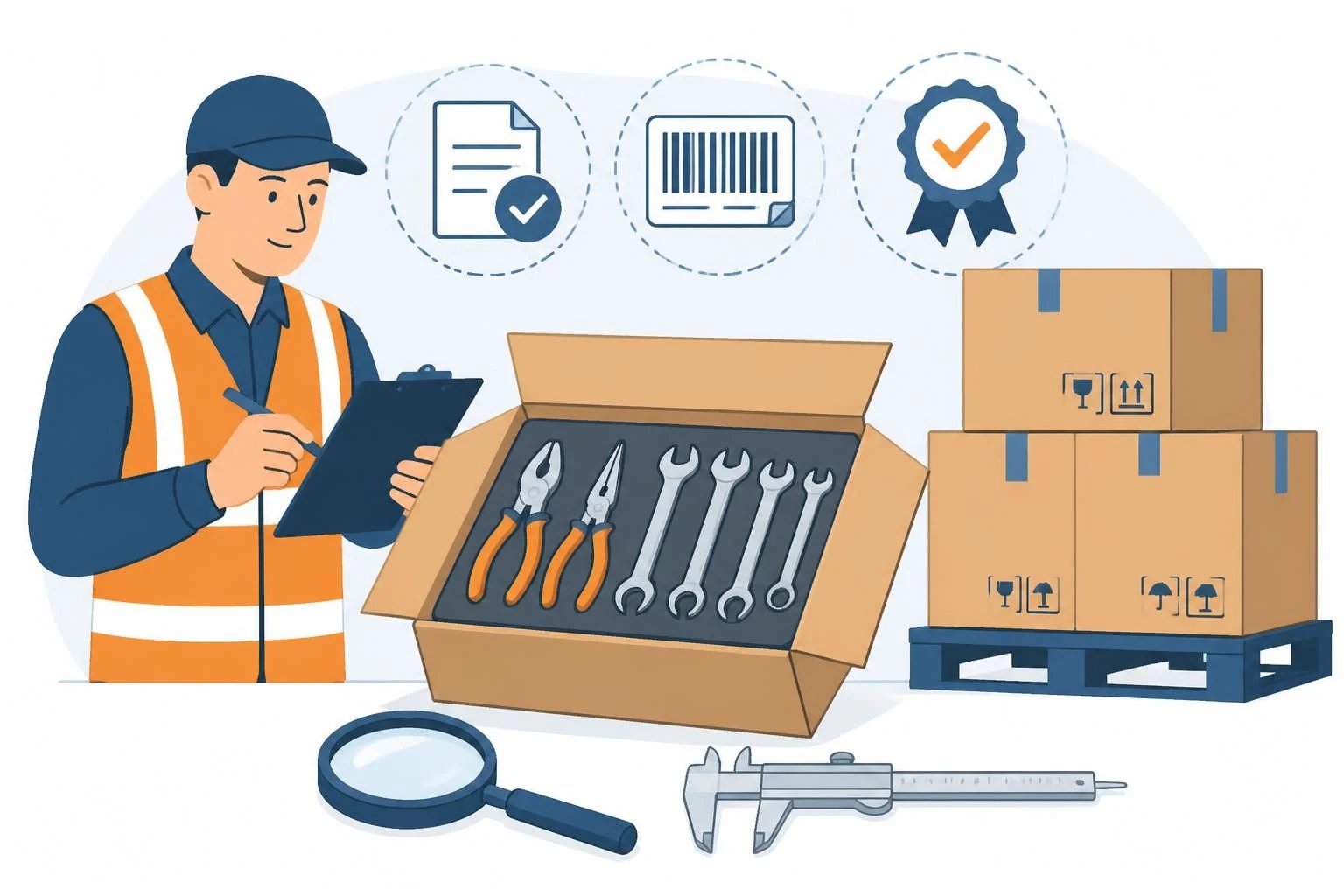
Inspect before the final balance and before you consolidate mixed orders. Hardware shipments need the normal quantity, appearance, SKU, barcode, and carton checks. They may also need corrosion protection, blade guards, moisture barriers, protective oil, pallet checks, or loading evidence. The product has to arrive in saleable condition, not simply pass a factory table check.
Choose the inspection stage based on risk. A custom or high-value order may need a pre-production review, during-production check, pre-shipment inspection, and container-loading record. A stock mixed order may need a stronger pre-shipment check at the consolidation warehouse. Agree the scope before the inspector arrives.

Check these freight details
- Gross weight, carton dimensions, and total CBM.
- Inner-box and master-carton count by SKU.
- Rust, moisture, blade, and scratch protection where relevant.
- Carton marks, barcodes, importer labels, and pallet requirements.
- Commercial invoice, packing list, HS-code review, and insurance.
- Freight restrictions for batteries, aerosols, magnets, or electrical components.
- Who books freight, clears customs, pays duty/tax, and delivers the cargo.
Heavy tools make freight planning important. Sea freight often suits larger volumes; courier and air can suit urgency or samples; rail fits selected lanes and product profiles. None is automatically cheapest or fastest for every shipment. Confirm the route with a forwarder. Buyers shipping toward Europe can also review the Yiwu–London railway route as one route context, not a blanket shipping recommendation.
Can you source hardware and hand tools without visiting China?
Yes. Remote sourcing works when decisions create an evidence trail. You need the same controls as an in-person buyer: a product brief, controlled quotations, supplier screening, retained samples, a signed specification, inspection evidence, and shipping documents. Video calls alone are not enough.
Use this remote workflow:
- Send one controlled product brief to shortlisted suppliers.
- Compare legal identity, capability, quotations, and available evidence.
- Order and score physical samples before agreeing production.
- Approve a golden sample, specification, packaging, and compliance plan.
- Inspect production against those approved references.
- Consolidate only after the order meets the agreed acceptance criteria.
Union Service can coordinate supplier search, quotation comparison, sample collection, inspection, warehousing, consolidation, and shipping. See our import agent services when you want a team in Yiwu to manage the operating steps.
Before this guide is published: A named sourcing/QC author and a qualified compliance reviewer should confirm the final wording, the target product types, the target markets, and the current primary regulatory sources. The reviewer should also record the review date on the live page.
Common hardware-sourcing mistakes to avoid
The most expensive failures usually begin before production. A buyer accepts a product photo as a specification, compares non-equivalent quotations, or assumes a generic certificate covers every variation. The correction cost appears later in rework, reinspection, delayed launches, claims, freight, and unsellable stock.
Avoid these mistakes:
- Choosing a supplier on unit price alone.
- Leaving material, heat treatment, coating, or tolerance undefined.
- Approving a sample without retaining it as the golden sample.
- Mixing quality grades under one SKU.
- Assuming a test report covers your exact branded product.
- Skipping pre-shipment inspection because the sample looked good.
- Ignoring corrosion protection, carton strength, and shipment handling.
- Using an unconfirmed HS code or unclear Incoterm.
- Paying an account that does not match the contract entity.
- Letting production change after approval without written control.
The answer is not more paperwork for its own sake. It is a short chain of evidence that lets each person make the next decision confidently. If the supplier cannot meet that standard during sampling, they are unlikely to meet it when a container is due.
Frequently asked questions
Is China a good place to source hand tools?
China can be a good source for existing hand tools, accessories, mixed hardware orders, and private-label programs. Yiwu’s market system helps buyers compare broad assortments in one place. Technical, safety-critical, or highly customized items need a supplier with proven process control and a product-specific review before you order.
Is Yiwu good for hardware and hand tools?
Yiwu is useful for general hardware discovery, mixed-order buying, and supplier comparison. Confirm current hardware locations, suppliers, and opening information using the official market directory before visiting. Use factory validation when product performance or customization requires it.
What is the MOQ for hardware products in China?
There is no single MOQ. Stock tools may allow small mixed orders, while custom branding, special packaging, forged parts, or tooling can require a larger run. Build your quote around seven checks: brief, supplier, sample, specification, compliance, QC, and freight. That way, you compare MOQ against the correct product and its landed cost.
How can I verify a Chinese hand-tool supplier?
Check six areas: legal entity, product capability, material and finish evidence, sample control, process ownership, and payment identity. The business licence, contract party, and bank account should align. A supplier’s catalog or marketplace rating cannot prove that the production sample matches the factory and terms proposed for your order.
Do hand tools need CE marking in Europe?
Not every ordinary manual hand tool needs CE marking. The answer changes if the item has electrical, battery, laser, PPE, lifting, pressure, child-directed, or other regulated features. Review the specific product under current EU rules and keep a technical basis for the decision. Before publication, add a verified official source that applies to the SKU and market.
How do you inspect hand tools before shipping?
Inspect against the approved golden sample and written specification. Check quantity, SKU, dimensions, material evidence, finish, moving parts, function, markings, packaging, cartons, and shipment protection. For higher-risk products, add defined performance testing and a suitable sampling plan. A visual check alone cannot prove every material or compliance claim.
How do I calculate landed cost for tools from China?
Add product price, samples, tooling, packaging, tests, inspection, China logistics, freight, insurance, duty/tax, clearance, delivery, and expected loss. Divide by sellable units received. This site has three planning tools: the sourcing-cost calculator, freight estimator, and CBM calculator. Confirm duty using the correct HS code and destination.
Build the evidence before you buy
Hardware and hand tools sourcing from China becomes manageable when the buyer controls the product definition before the commercial commitment. Match the product to the right supplier type. Approve a real sample. Write the specification. Check the destination requirements. Inspect against agreed limits. Then book freight with the product, cartons, documents, and customs route understood.
That sequence takes discipline. It also gives you a much clearer view of price, risk, and margin than the first low quote ever can. If you need help coordinating quotes, samples, inspection, warehousing, and shipment evidence in Yiwu, get a free quote.