



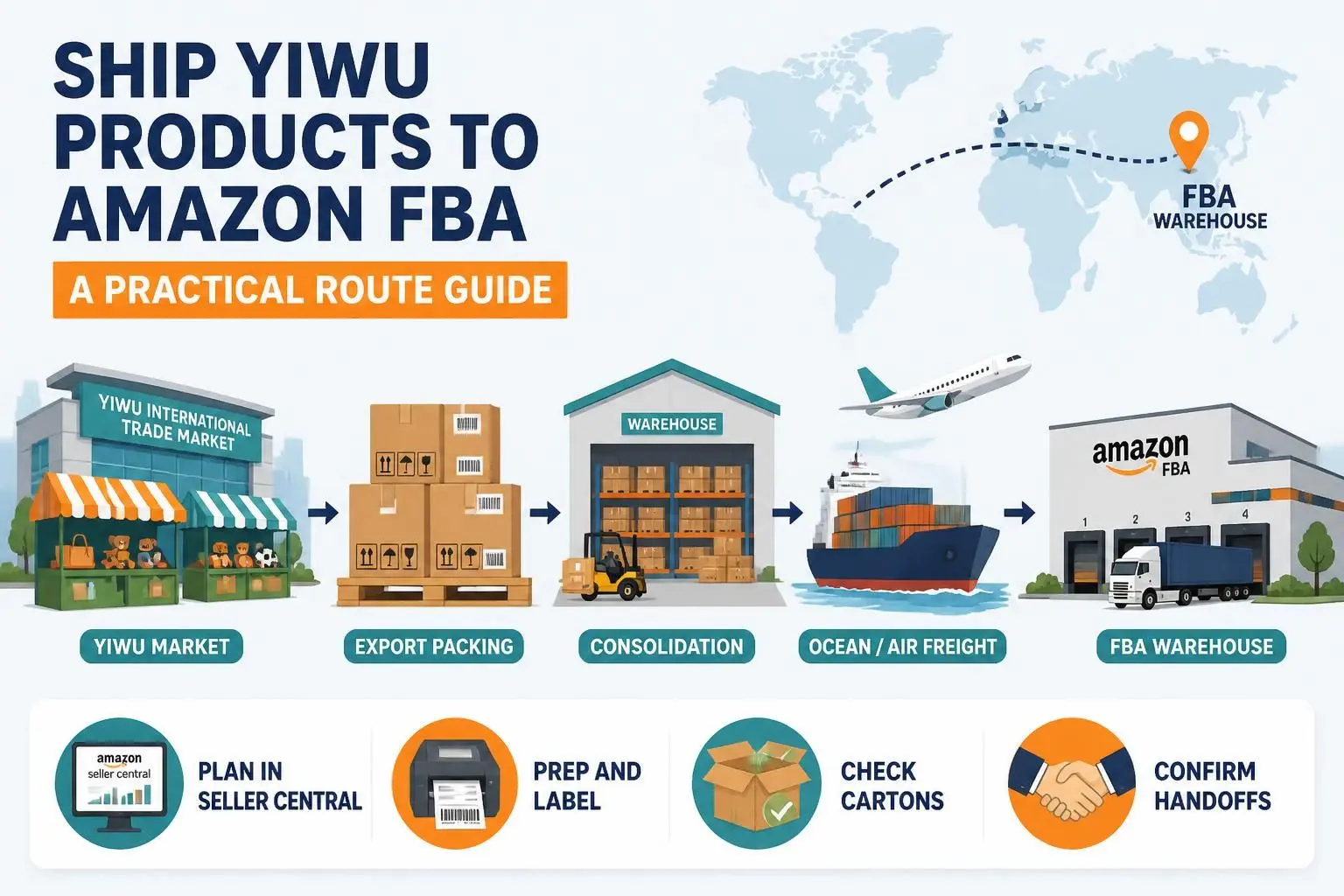
If you want to ship Yiwu products to Amazon FBA warehouses, build the shipment in Seller Central first, then make the cartons match that plan. Confirm each product’s prep and labeling instructions, check the destination Amazon assigns, prepare export and import documents, and share the final carton data with your freight forwarder. A Yiwu warehouse can help combine suppliers’ orders, inspect goods and prepare cartons, but you remain responsible for confirming that the shipment follows your Seller Central plan and the rules for your destination country.
Key takeaways
- Create or update the FBA shipment in Seller Central before printing labels or dispatching cartons.
- Keep product labels, carton labels, carton contents and shipment records consistent.
- Confirm who handles export clearance, import entry, duties, delivery appointments and proof of delivery.
- Use a Yiwu warehouse when you need to receive, inspect or consolidate goods from several suppliers.
What is the route from Yiwu to Amazon FBA?
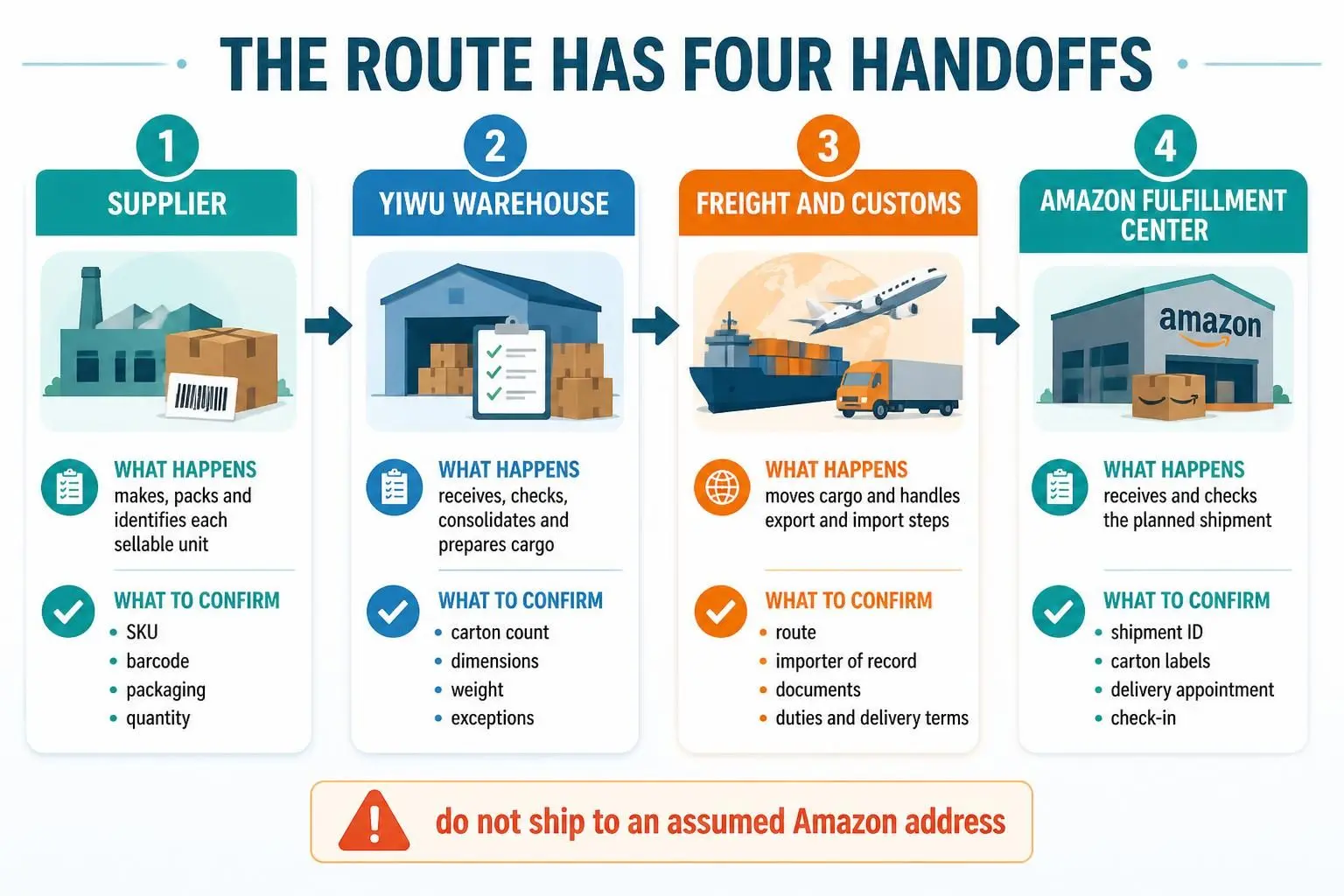
The route usually has four handoffs: the supplier prepares the goods, a Yiwu warehouse receives and checks them, a freight provider moves the shipment through export and import, and the Amazon fulfillment center receives the cartons. The exact route and destination depend on your shipment plan, product type, marketplace and transport arrangement.
| Stage | What happens | What to confirm |
|---|---|---|
| Supplier | Makes, packs and identifies each sellable unit | SKU, barcode, packaging and quantity |
| Yiwu warehouse | Receives, checks, consolidates and prepares cargo | Carton count, dimensions, weight and exceptions |
| Freight and customs | Moves cargo and handles export/import steps | Route, importer of record, documents, duties and delivery terms |
| Amazon fulfillment center | Receives and checks the planned shipment | Shipment ID, carton labels, delivery appointment and check-in |
Do not ask a supplier to ship directly to an assumed Amazon address. Amazon may assign a destination or split a shipment based on the options available in your account. Use the destination and carton instructions shown in the current Seller Central workflow. Amazon’s FBA overview explains the service; account-specific shipment instructions appear in Seller Central.
When should you use a Yiwu warehouse?
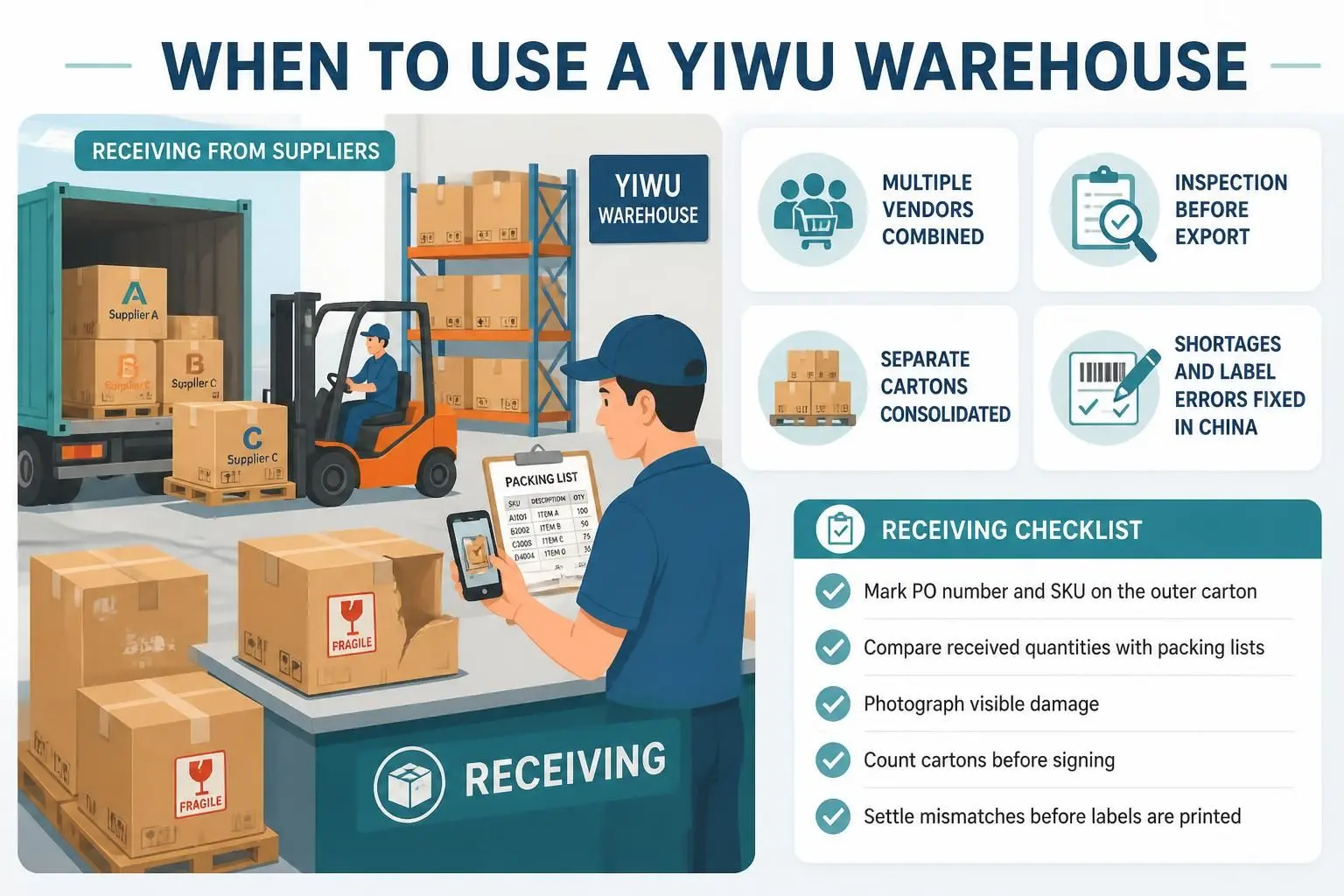
A Yiwu warehouse is useful when products come from multiple market vendors or factories, when you need an inspection before export, or when separate supplier cartons need to be combined into a shipment plan. It also gives you a place to resolve shortages, damaged packaging or incorrect labels before freight leaves China.
Ask each supplier to mark the purchase order number and your product SKU on the outer carton. When goods arrive, compare the received quantities with the supplier packing lists and your order records. Photograph visible damage and count cartons before signing the warehouse receiving record. If there is a mismatch, settle it with the supplier before final carton labels are produced.
If you are still building your supplier shortlist, start with our practical guide to finding reliable Yiwu suppliers. Buyers who have not visited the market can also review how to buy from Yiwu Market before planning supplier visits or sample orders.
You can review quality inspection and warehousing services before choosing how much preparation to do in Yiwu. Inspection should follow a written checklist based on the product’s risks, not a generic visual check alone. Keep the approved sample, product specification and inspection result together so the team can compare the shipment with what you ordered.
What should you prepare in Seller Central?
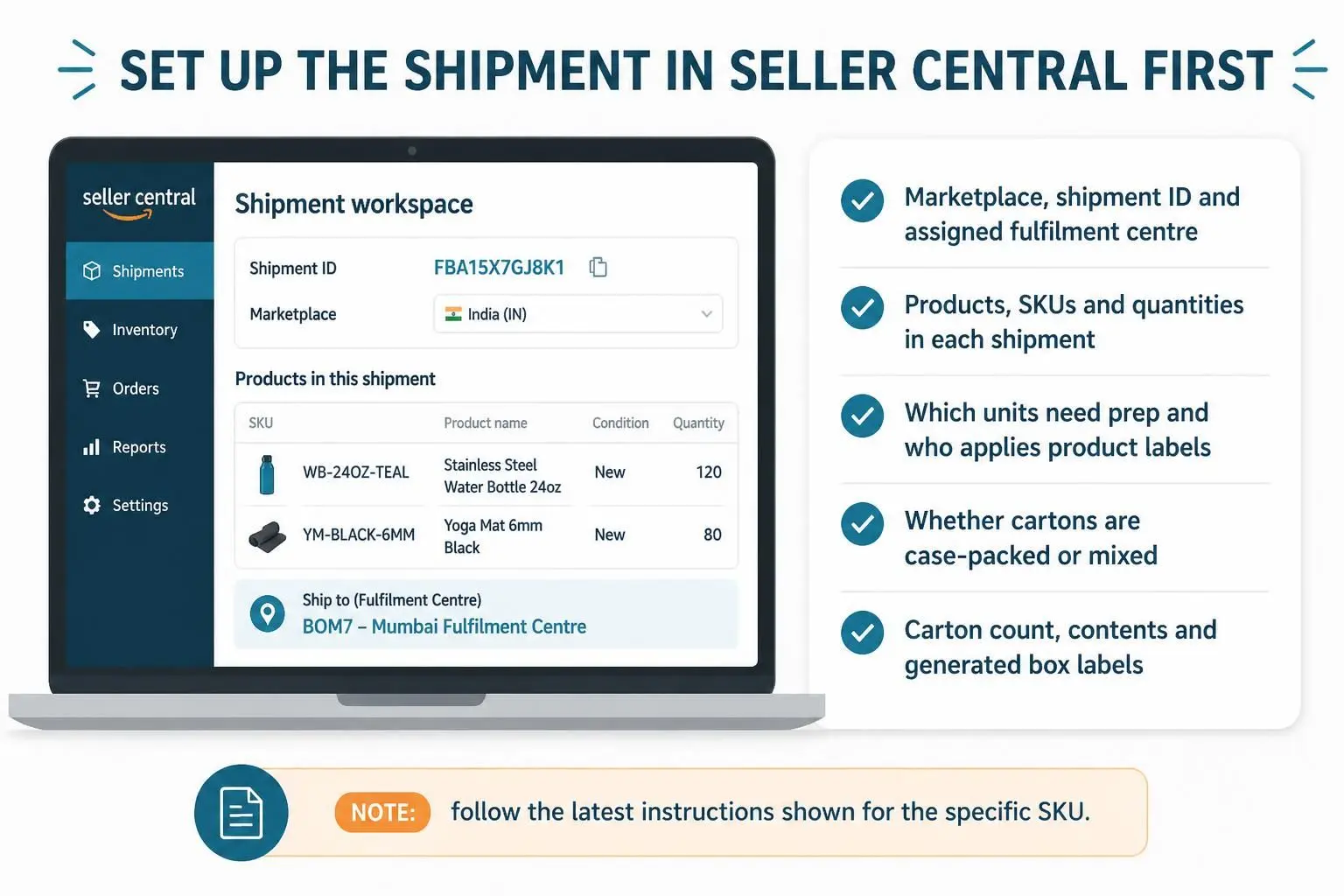
Start in the Seller Central account that owns the inventory and the destination marketplace. Confirm that each product is eligible for FBA, has the correct SKU and barcode preference, and has the required listing information. Then create the shipment using the current Send to Amazon workflow or the equivalent workflow available in your account.
Before anyone labels cartons, save or share the shipment details that identify:
- The marketplace, shipment ID and assigned fulfillment center or centers.
- The products, SKUs and quantities included in each shipment.
- Which units require prep and who will apply product labels, if applicable.
- Whether cartons are case-packed or contain different products.
- The carton count, carton contents and the box labels generated for the shipment.
Amazon’s requirements can change, and prep or label rules can differ by category, product and marketplace. Follow the latest instructions shown for the specific SKU and shipment in Seller Central. If a product needs special prep, do not infer the requirement from a similar product or an older shipment.
How do you handle product prep and labels?
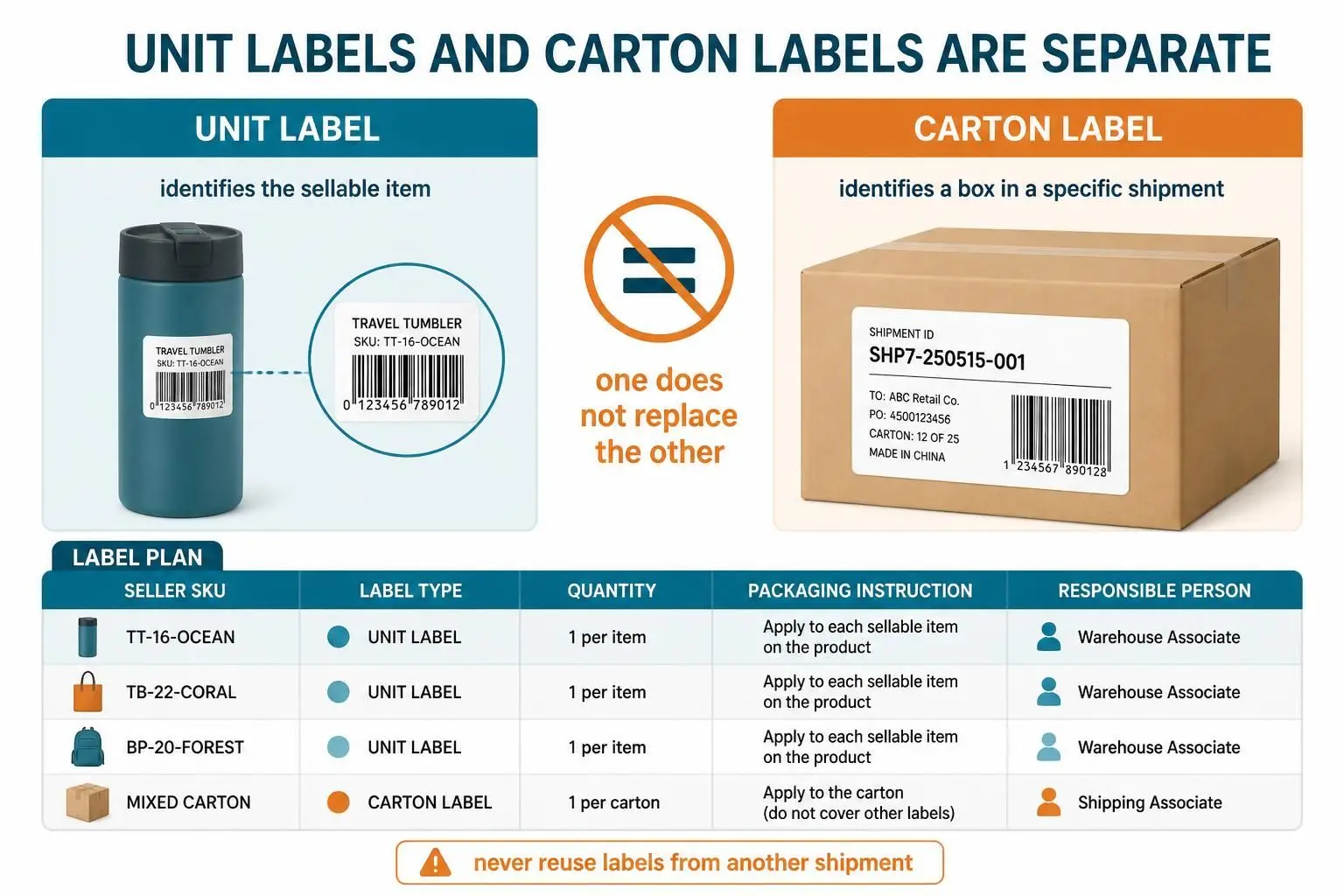
Treat unit labels and shipment carton labels as separate controls. A unit label identifies the sellable item in Amazon’s system when that product’s barcode setup requires it. A carton label identifies a box as part of a specific shipment. One does not replace the other.
Create a label plan for every SKU before the prep team starts. It should show the seller SKU, barcode or label type, quantity, packaging instruction, and the person responsible for applying and checking it. For products sold as a set, make sure the packaging keeps the set together and that any required set marking is clear. For fragile, sharp, liquid or battery-powered items, check the current category-specific rules and carrier restrictions before packing.
Print carton labels from the shipment in Seller Central after the shipment and box information are final. Attach the correct label to the correct carton, keep it visible, and avoid placing it over a seam or where tape, straps or stretch wrap will obscure it. Scan or visually compare each label against the carton list before pickup. Do not reuse labels from another shipment.
How should cartons be checked before freight pickup?
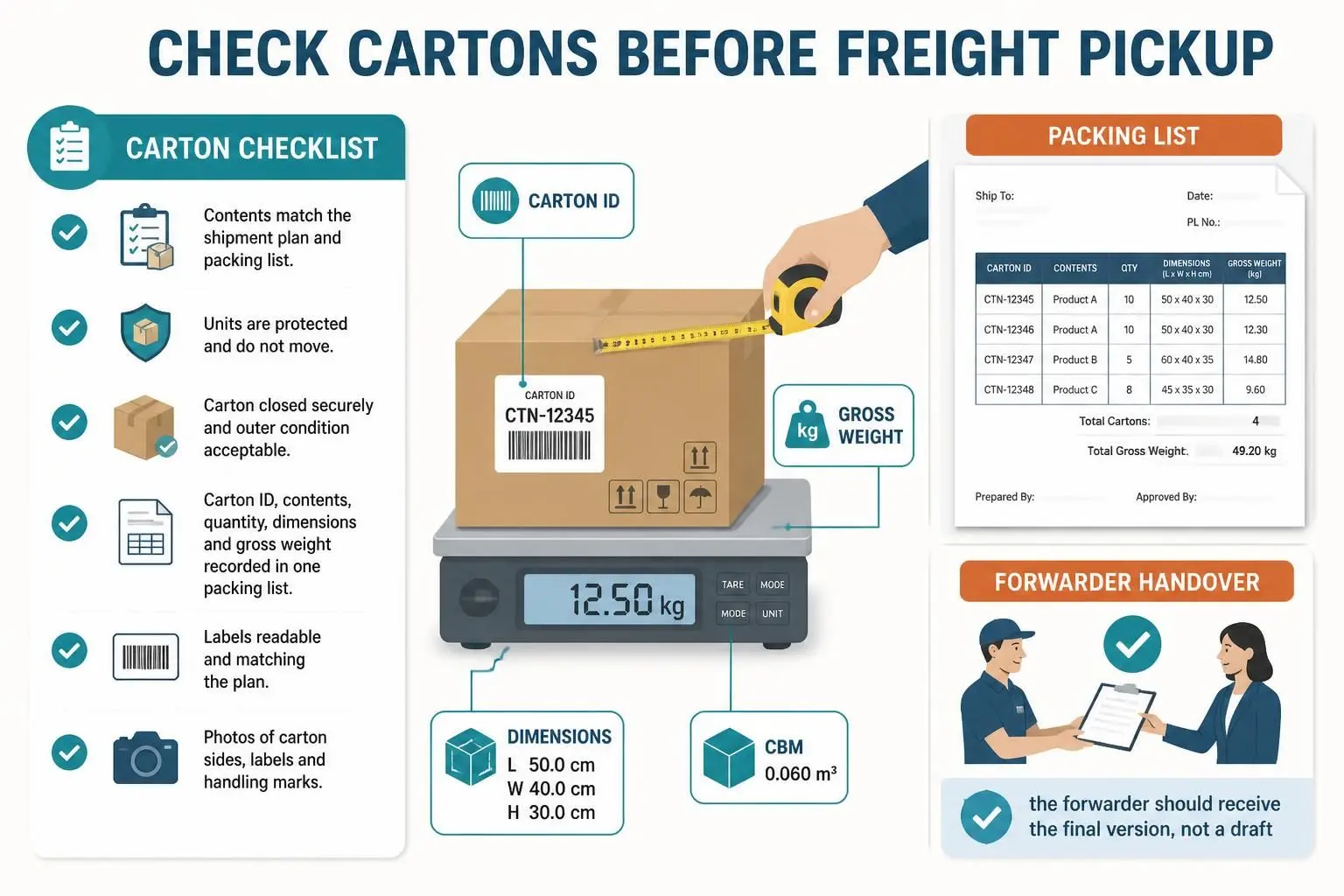
Close the cartons only after the contents, packaging and quantities have passed the agreed checks. Weigh and measure each finished carton, then record the dimensions and gross weight against its carton ID. The freight forwarder needs accurate cargo data to quote space, prepare transport records and plan handling. Use the CBM calculator to estimate volume, then confirm the forwarder’s chargeable-weight method for your chosen mode.
Use a carton checklist like this:
- Match the carton contents to the shipment plan and supplier packing list.
- Confirm that units are protected and do not move excessively inside the carton.
- Check the carton is closed securely and its outer condition is acceptable for export handling.
- Record carton ID, contents, quantity, dimensions and gross weight in one packing list.
- Confirm carton labels are readable and match the shipment plan.
- Keep photos of the carton sides, labels and any special handling marks.
For a multi-supplier order, reconcile the final packing list with the warehouse receiving record and the shipment plan. If carton contents changed during consolidation, update Seller Central before using labels or dispatching the cargo. A freight provider should receive the final version, not a draft carton list.
Which freight option should you choose?
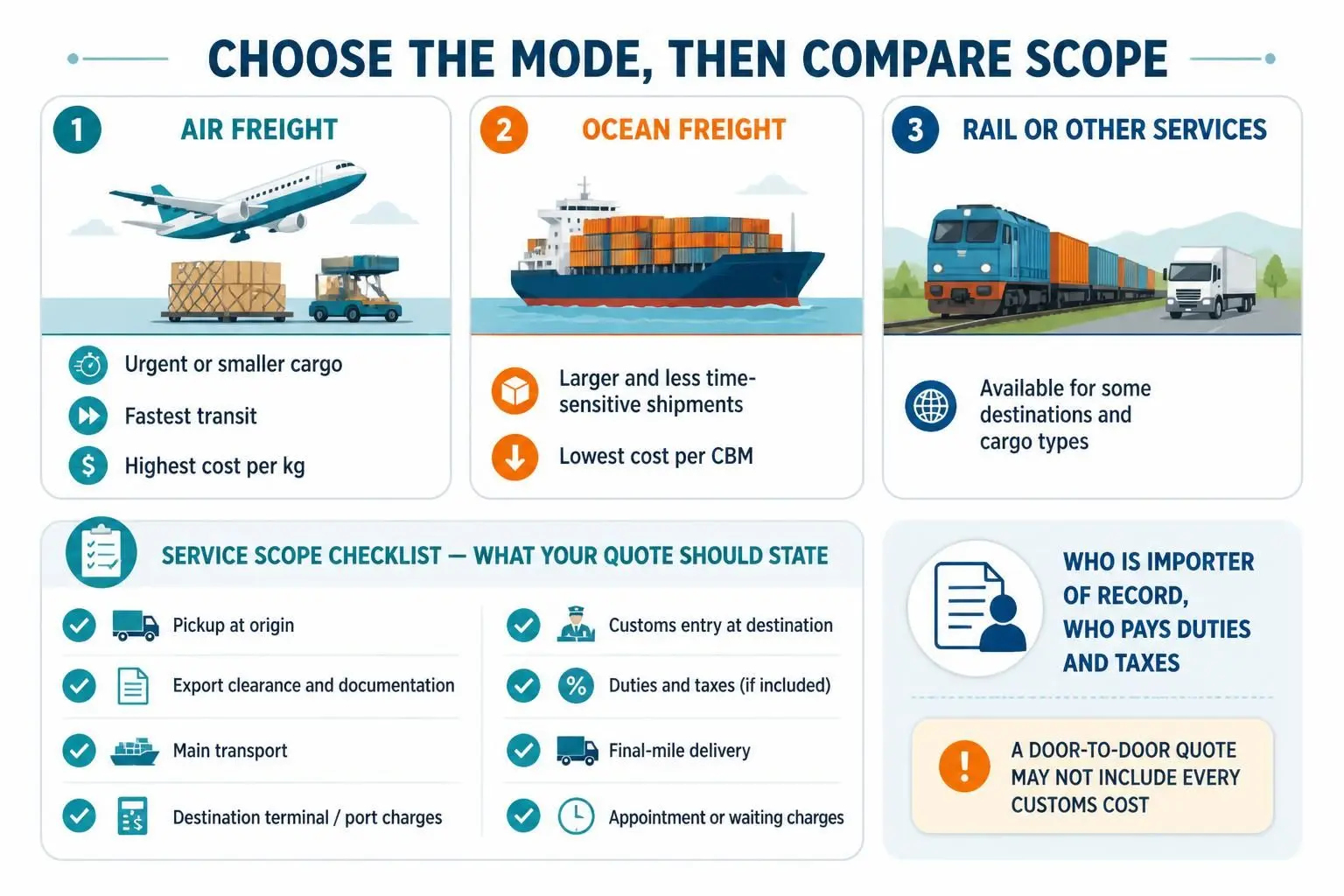
Choose the transport mode by comparing the shipment’s size, required delivery window, product restrictions and total landed cost. Air freight can suit urgent or smaller cargo, while ocean freight often suits larger, less time-sensitive shipments. Rail or other services may be available for some destinations and cargo types. Transit time is only one part of the decision; customs, origin handling, destination handling and Amazon receiving capacity also affect the delivery date.
Ask forwarders to quote the same shipment data and comparable service scope. Clarify whether the quote includes pickup, export clearance, main transport, destination charges, customs entry, duties, final-mile delivery and any appointment or waiting charges. Ask which party acts as importer of record and who pays duties and taxes. Do not assume that a door-to-door quote includes every customs cost or Amazon delivery requirement.
Compare the quotes with the freight estimator and check how your chosen import duty rate affects the landed cost. The final customs classification, origin declaration and import requirements depend on the product and destination. Your customs broker should confirm the details before cargo leaves China.
What documents and handoffs should you confirm?
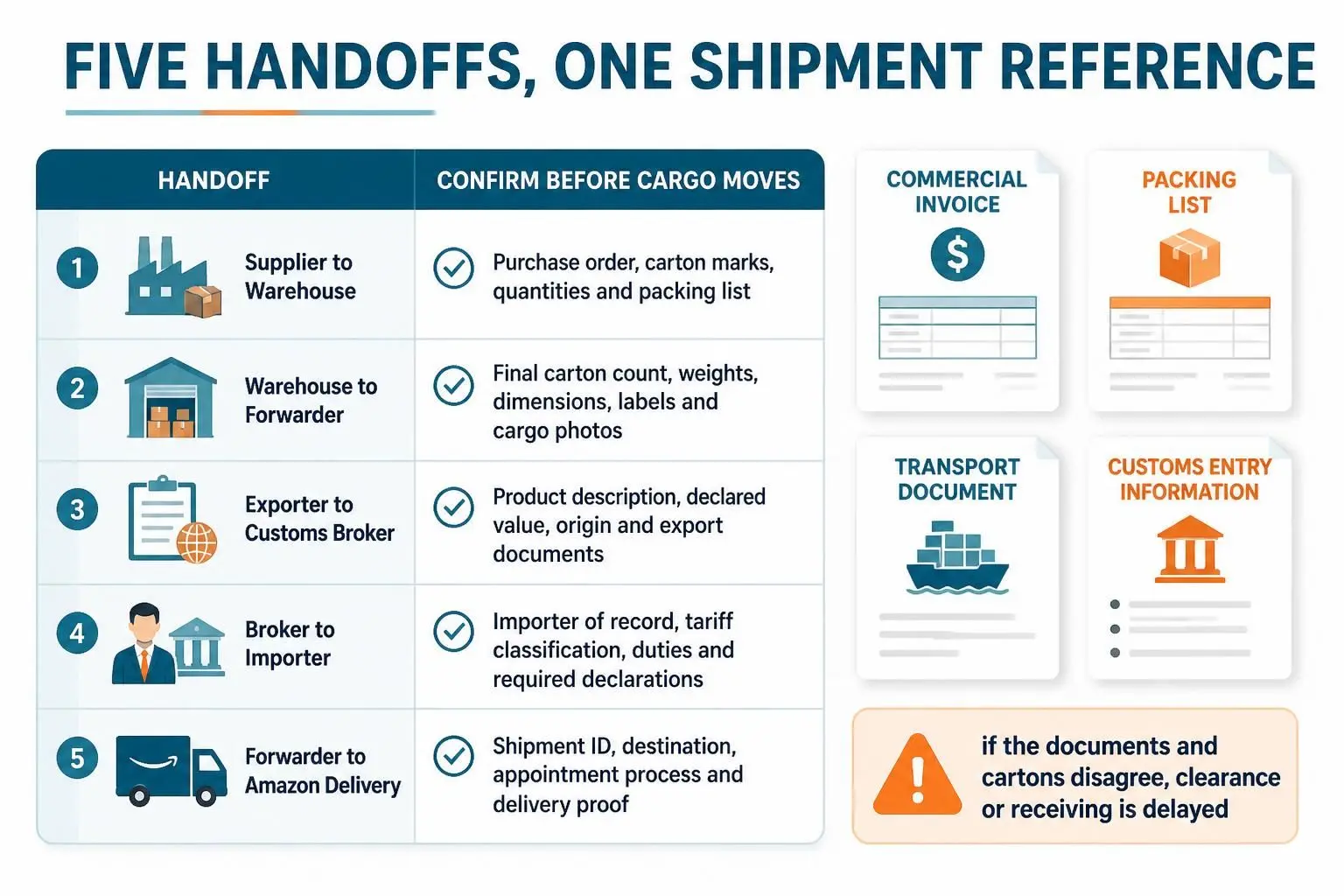
The document set depends on the product, transport mode and importing country. Common records include a commercial invoice, packing list, transport document and customs entry information. Some goods need additional permits, declarations, safety documents or product-specific records. Ask your customs broker and carrier for the exact list for your shipment rather than treating a generic checklist as complete.
Assign a named owner for each handoff:
| Handoff | Confirm before cargo moves |
|---|---|
| Supplier to warehouse | Purchase order, carton marks, quantities and packing list |
| Warehouse to forwarder | Final carton count, weights, dimensions, labels and cargo photos |
| Exporter to customs broker | Product description, declared value, origin and export documents |
| Broker to importer | Importer of record, tariff classification, duties and required declarations |
| Forwarder to Amazon delivery | Shipment ID, destination, appointment process and delivery proof |
Share one shipment reference across these records where possible. If the invoice, packing list, shipment contents and physical cartons disagree, customs clearance or receiving may be delayed while the mismatch is resolved.
How do you track delivery and resolve receiving issues?
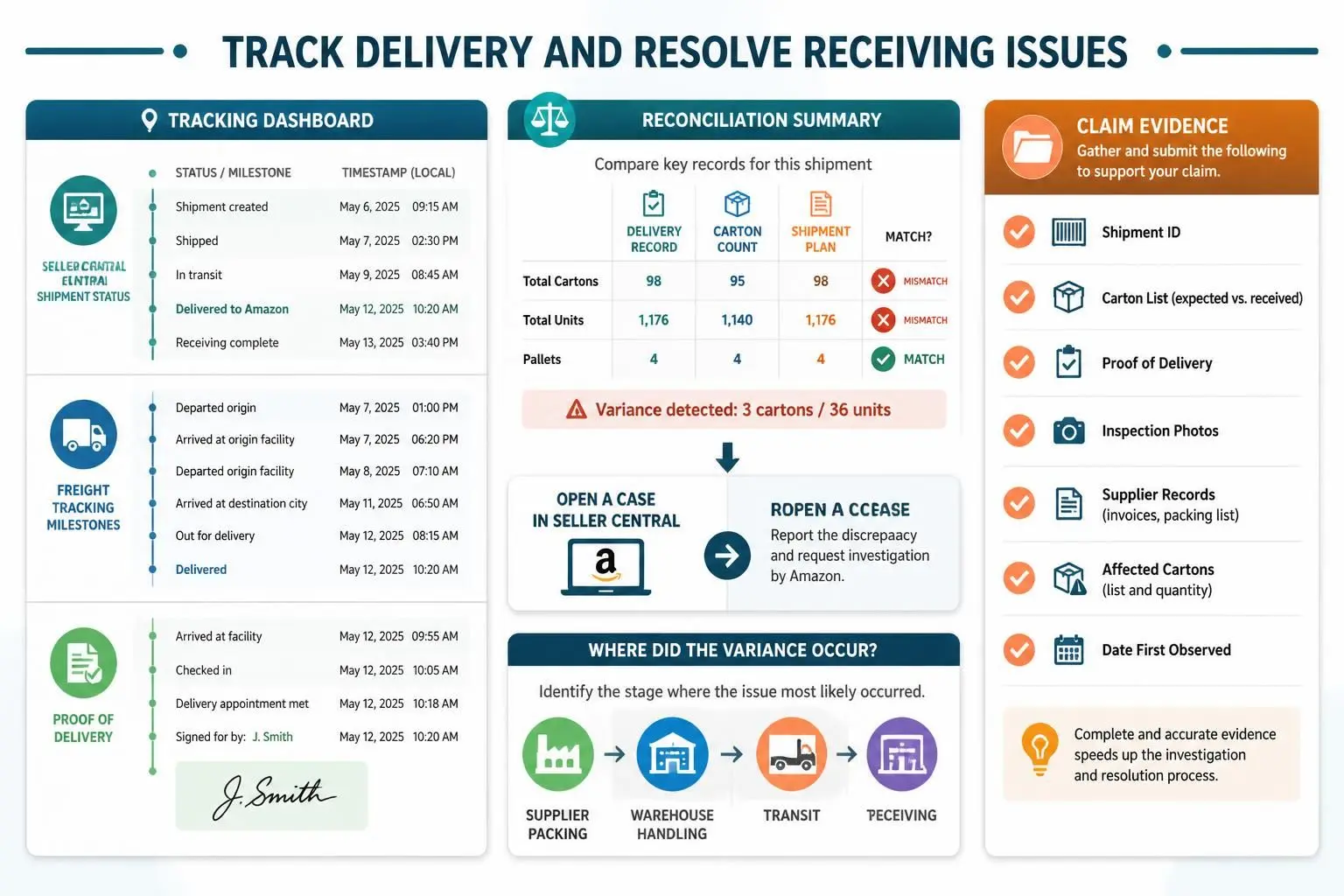
Keep the Seller Central shipment status, freight tracking information and proof of delivery together. Ask the carrier to provide pickup confirmation, transport milestones and a delivery record. When Amazon’s status does not update as expected, compare the delivery record and carton counts with the shipment plan before opening a case in Seller Central.
For shortage or damage claims, save the shipment ID, carton list, proof of delivery, inspection photos and supplier records. Note which cartons were affected and when the issue was first observed. This evidence helps you identify whether the variance occurred at supplier packing, warehouse handling, transit or fulfillment-center receiving.
For broader support with sourcing services and order coordination, share the product list, target marketplace, expected quantity and required arrival window before you request a quote. Union Service can confirm which sourcing, inspection, warehouse and transport steps it can handle for the specific order; service scope and shipping terms should be agreed in writing.
Frequently asked questions
Can a Yiwu supplier ship directly to an Amazon fulfillment center?
It may be possible for some shipments, but the supplier must be able to follow your current Seller Central plan, prepare products correctly, produce accurate carton data and coordinate the required transport and delivery steps. For multiple suppliers or when you need an inspection, routing goods through a Yiwu warehouse can make it easier to reconcile the shipment before export.
Does Amazon provide the shipping labels?
Seller Central provides shipment-related carton labels for the shipment workflow. Product-level labeling depends on your barcode setup and the instructions for each SKU. Confirm both before printing. The freight label, customs documents and Amazon carton label serve different purposes.
Should I choose DDP shipping?
DDP can simplify the buyer’s payment process only when the parties clearly define the importer of record, customs entry, duties, taxes and delivery scope. Confirm that the provider can lawfully perform each role in the destination country and that the quote names exclusions. Ask a customs professional to review the arrangement for your shipment.
How early should I book freight?
Book after you have a realistic production-ready date, confirmed shipment plan and final carton data. Leave time for supplier corrections, warehouse inspection, export and import clearance, and delivery scheduling. Ask the forwarder for a current route estimate and build a buffer; do not use a past shipment’s transit time as a guarantee.
What is the most common preventable mistake?
Dispatching cartons before the carton contents, labels and Seller Central shipment plan agree. Freeze the final carton list, reconcile the labels and keep a copy with the freight documents before pickup.
Plan the shipment before production ends
The simplest way to reduce avoidable FBA delays is to connect the order, prep and freight decisions early. Confirm the Seller Central plan, give suppliers a clear packing brief, inspect and reconcile the goods in Yiwu, and only then finalize carton labels and freight documents. Get a free quote from our Yiwu sourcing agent team with your product list, destination marketplace and carton estimate.
Sources and current requirements: Amazon FBA overview · Seller Central Help · Confirm all SKU, prep, barcode, carton and delivery instructions in your own Seller Central account before dispatch.