



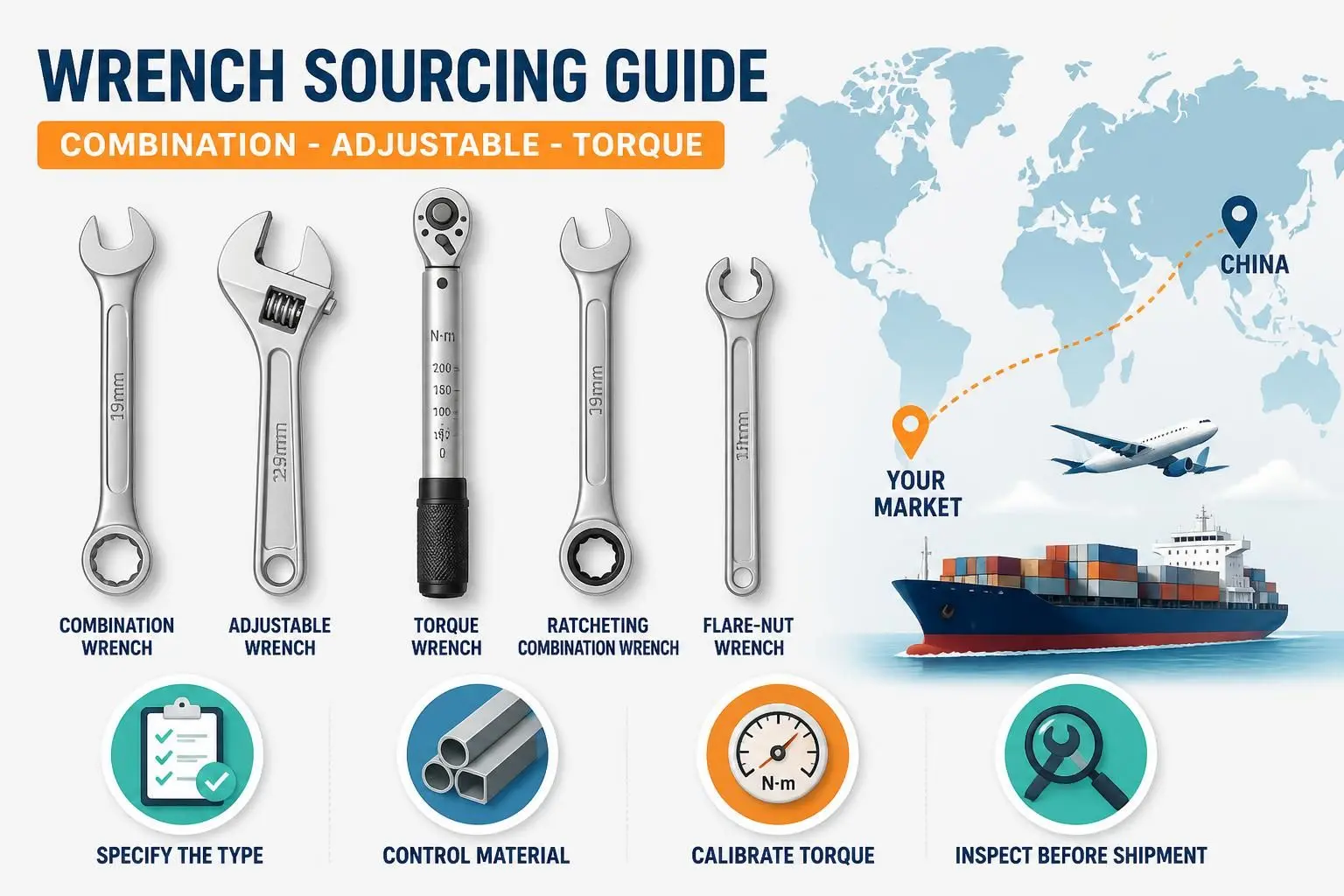
Buying wrenches in volume seems simple until the first shipment arrives. Two tools can share the same size marking, yet differ in steel, heat treatment, jaw fit, plating, packaging, and inspection records.
For most wholesale programs, combination wrenches make the strongest core range. Adjustable wrenches add size flexibility. Torque wrenches belong in applications where tightening force affects safety, warranty, leakage, or assembly quality.
This guide explains where each type fits, how to compare specifications, and what to put in your RFQ before you source from China. It also shows the checks that matter before a supplier ships.
Key Takeaways
- Combination wrenches suit repeatable everyday fastening; adjustable wrenches cover changing sizes.
- Torque tools need a clear range, test method, and calibration evidence. ISO 6789 separates conformance from calibration.
- The lowest unit quote can lose after plating defects, packaging labor, freight, and replacements.
- Ask for drawings, samples, process records, and inspection evidence before placing a volume order.
Which wrench type fits the job?
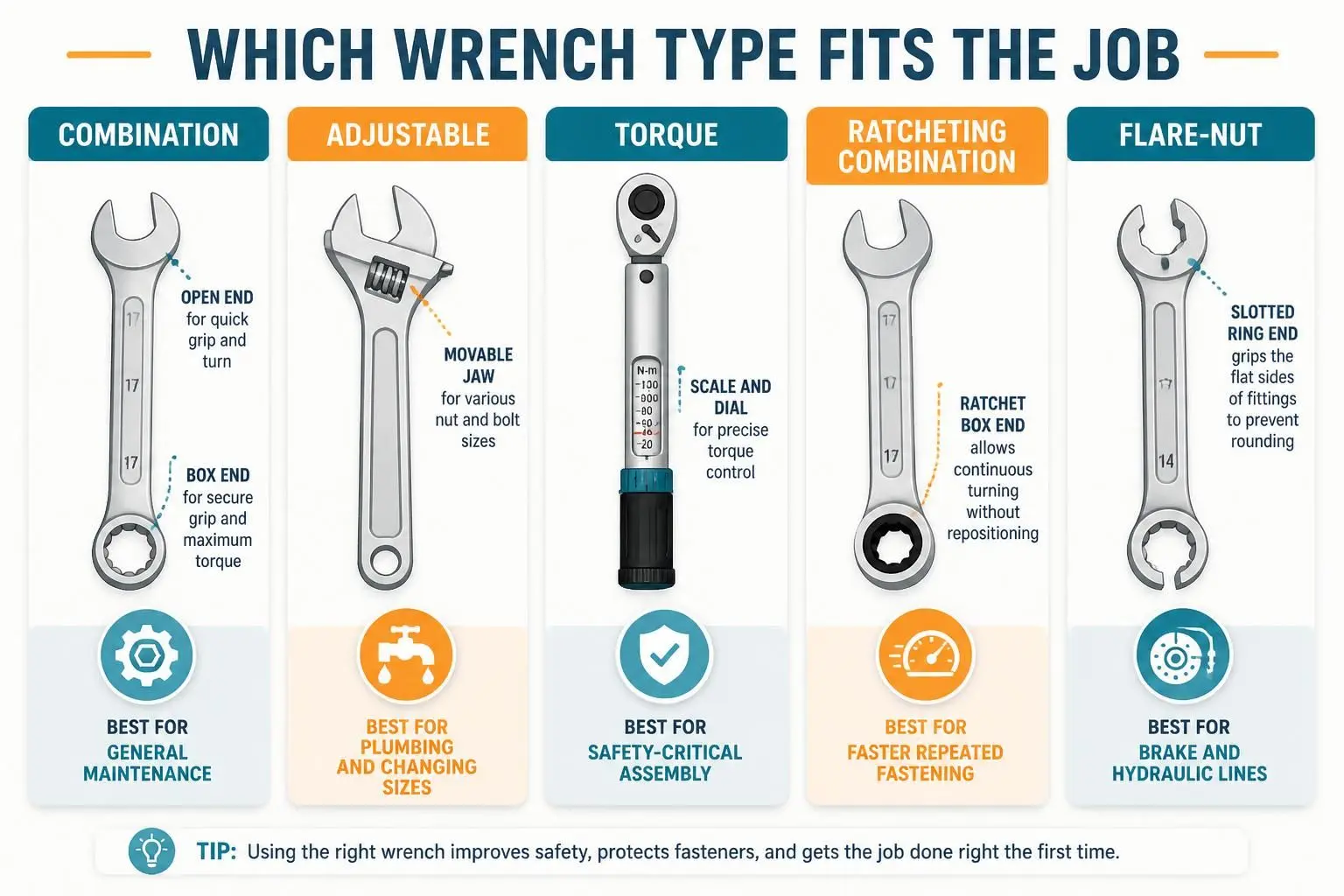
A 2025 hand-tools market estimate placed professional users at 62.3% of global revenue (Dataintelo, 2025). That matters because professional buyers usually pay for repeatability, fit, service life, and documentation. Match each wrench type to a defined job. Treating every wrench as the same commodity creates avoidable specification problems.
| Wrench type | Best use | Main strength | Main risk | Typical buyer |
|---|---|---|---|---|
| Combination | General maintenance and assembly | Fixed-size fit with open and box ends | More SKUs to stock | Hardware retailer, workshop supplier |
| Adjustable | Plumbing, maintenance, changing sizes | One tool covers many fasteners | Jaw slip or rounding if poorly adjusted | General hardware, field service |
| Torque | Safety-critical and specification-controlled assembly | Controlled tightening force | Calibration and after-sales requirements | Automotive, machinery, industrial assembly |
| Ratcheting combination | Faster repeated fastening | Less hand repositioning | More moving parts | Professional tool users |
| Flare-nut | Brake, fuel, and hydraulic lines | Better grip on line fittings | Narrower use case | Automotive and maintenance suppliers |
A combination wrench has a fixed open end and a fixed box end, normally in the same size. The fit is predictable, which makes it a sensible first SKU for a broad wholesale line.
An adjustable wrench uses a movable jaw. It covers more sizes, but it needs correct adjustment. The jaw should sit fully against the fastener before force is applied. Poor fit increases slip and corner rounding.
A torque wrench measures or applies a target torque. It should not replace a normal combination wrench for general loosening or rough work. Use it as a controlled assembly tool.
A wrench program works best when the product matches the application. Combination wrenches provide repeatable fixed-size engagement, adjustable wrenches provide size coverage, and torque wrenches control tightening force.
For sourcing context, see our hardware and hand tools category and the Yiwu hardware market.
Combination vs adjustable wrenches: what should buyers source first?
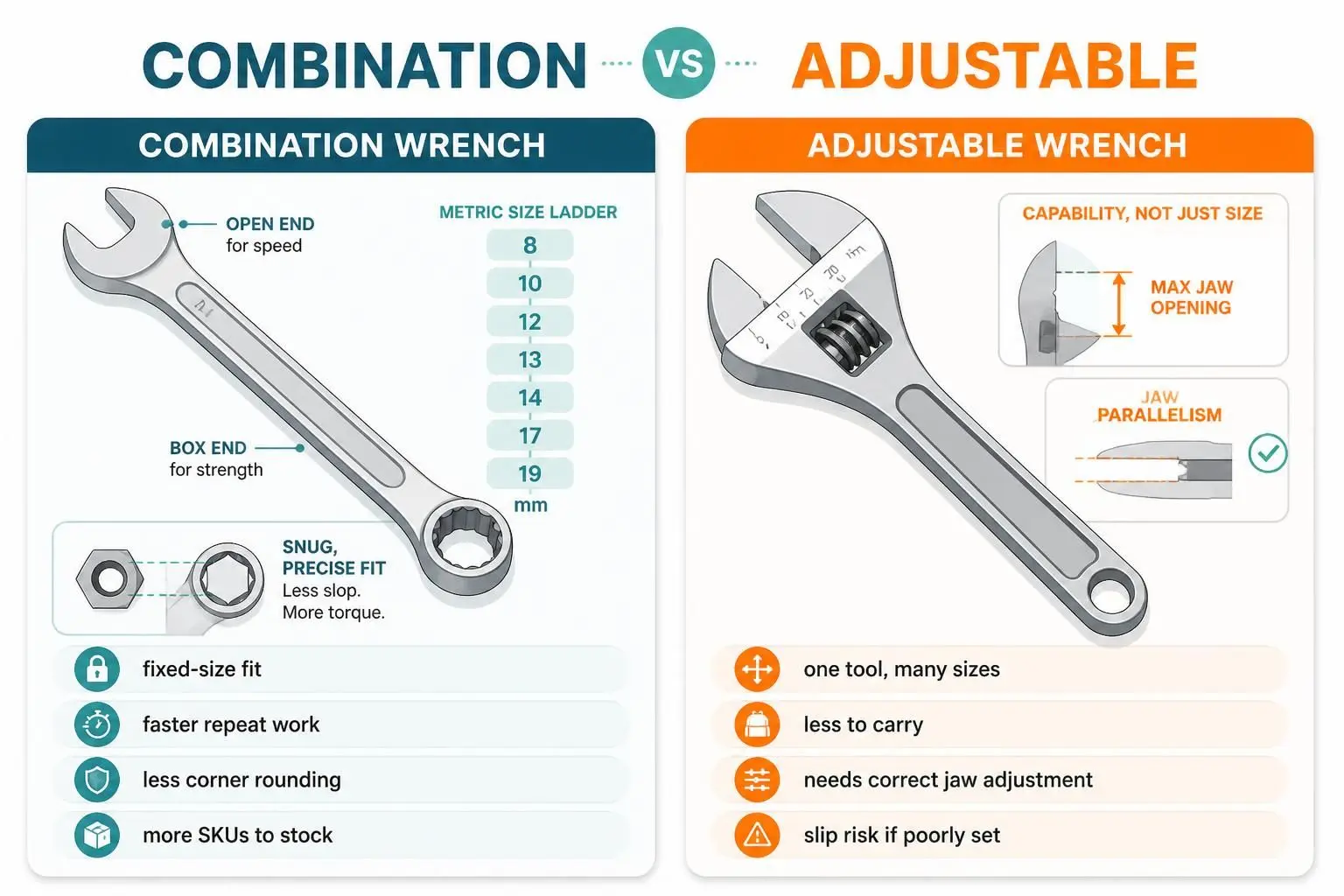
Start with a metric combination-wrench range. Add adjustable models when customers need broader coverage. A fixed-size combination wrench usually gives better contact and faster repeat work, while an adjustable wrench reduces the number of tools a field worker carries.
Let customer demand guide the decision. A workshop supplier may need a full metric range. A plumbing retailer may sell more adjustable wrenches in several lengths. A private-label brand may want both, but with different packaging and use claims.
Why combination wrenches work well as a core line
The box end usually gives better contact than an open end. Buyers use the open end when access is limited, then switch to the box end for higher grip.
For a general metric range, many programs start around 8–19 mm. That is only a planning example. Your final range should come from customer demand, regional standards, and the products your buyers service.
Combination wrenches also make assortment planning clearer. Each size has a defined place in the set. Retailers can then offer 8-piece, 10-piece, 12-piece, or 14-piece sets with a clear size logic.
Where adjustable wrenches earn their place
Adjustable tools work when fastener sizes change, access is limited, or the user needs one compact tool. Common lengths include 6, 8, 10, and 12 inches, with larger models for heavier work.
The weak point is jaw movement. The worm screw, guide surfaces, and jaw tolerance all affect how well the wrench holds its setting. Ask suppliers to show the maximum jaw opening, jaw parallelism, and slip test method.
Do not market one adjustable wrench as a replacement for a complete fixed-size set. Its strength is coverage, not universal performance.
Buyers often compare one adjustable wrench with one combination set on unit price alone. Compare the cost per supported use case instead. A $4 adjustable wrench may cover several sizes, but a retailer may still need combination sets because customers value fit, speed, and lower rounding risk.
When does a torque wrench justify the premium?
A torque wrench earns its price when tightening force affects safety, sealing, fatigue life, warranty, or assembly consistency. ISO 6789-1:2017 covers design conformance, marking, and declaration of conformance for hand torque tools (ISO, 2017).
That distinction matters when you write the RFQ. A supplier may say a tool is “tested,” but you still need to know what was tested, with which device, across what range, and under which conditions.
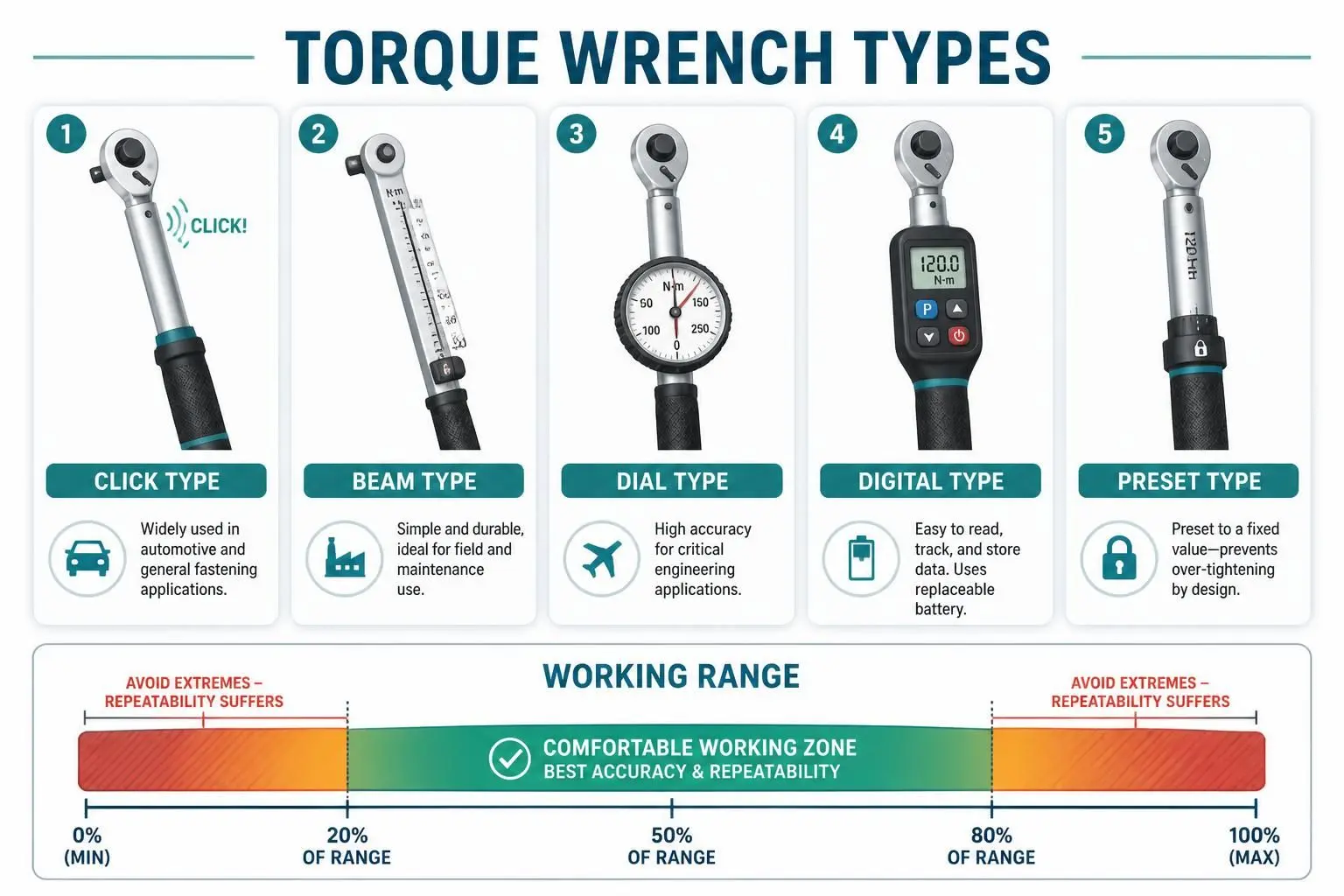
Torque wrench types
- Click type: common for automotive and general mechanical work.
- Beam type: simple and durable, but requires the user to read the scale.
- Dial type: useful when the user needs a visible reading.
- Digital type: supports alerts, data capture, and more detailed records.
- Preset type: useful for repeat production tasks when the target value does not change.
Choose the range before choosing the tool. A torque wrench should perform comfortably inside its working range. If a target sits near the bottom or top of the scale, repeatability and readability may suffer.
Also specify drive size, units, direction, tolerance, operating temperature, storage method, and certificate requirements. If the tool will be sold into a regulated or safety-sensitive channel, ask whether the certificate is traceable and whether the supplier can provide the uncertainty statement.
Which materials and finishes signal a reliable wrench?
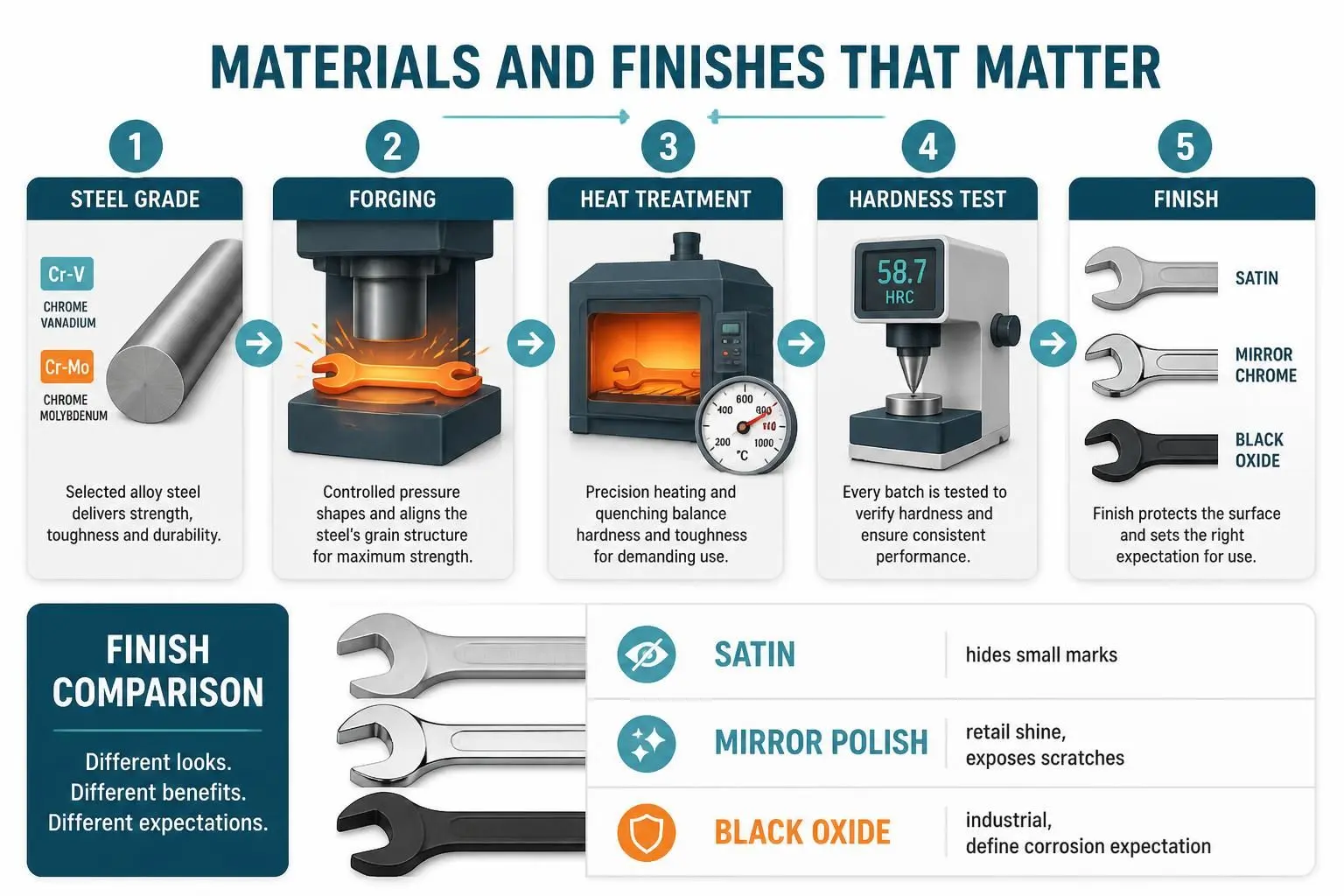
Steel grade matters, but it does not prove quality on its own. A useful supplier review connects the material, forging process, heat treatment, hardness, dimensions, surface finish, and final inspection.
Chrome vanadium is common in combination and adjustable wrenches. Chrome molybdenum appears more often where higher impact or strength claims are part of the product position. The label still needs supporting evidence. Ask for the material standard or mill certificate when the order value justifies it.
Specifications to confirm
| Specification | Ask the supplier for | Verify during QC | Common failure |
|---|---|---|---|
| Material | Grade and heat-treatment process | Certificate or test record | Soft jaws or early deformation |
| Forging | Process description and drawing | Surface and profile inspection | Cracks, thin sections, poor symmetry |
| Hardness | Target range and test method | Sample-based hardness test | Inconsistent service life |
| Finish | Plating type and corrosion target | Adhesion, pits, stains, rust check | Peeling or poor appearance |
| Marking | Logo, size, units, location | Legibility and permanence | Mixed or missing markings |
| Geometry | Drawing with tolerances | Jaw gap, angle, thickness | Poor fit or access problems |
Satin finishes hide small marks better than mirror polish. Mirror polish often looks stronger on a retail shelf, but it can expose scratches and plating defects. Black oxide and phosphate finishes may suit industrial positioning, but buyers should define corrosion expectations.
Do not accept “chrome vanadium” as the full specification. Ask how the factory controls hardness and dimensions after heat treatment. That is where many quality differences appear.
What should a wrench sourcing RFQ include?
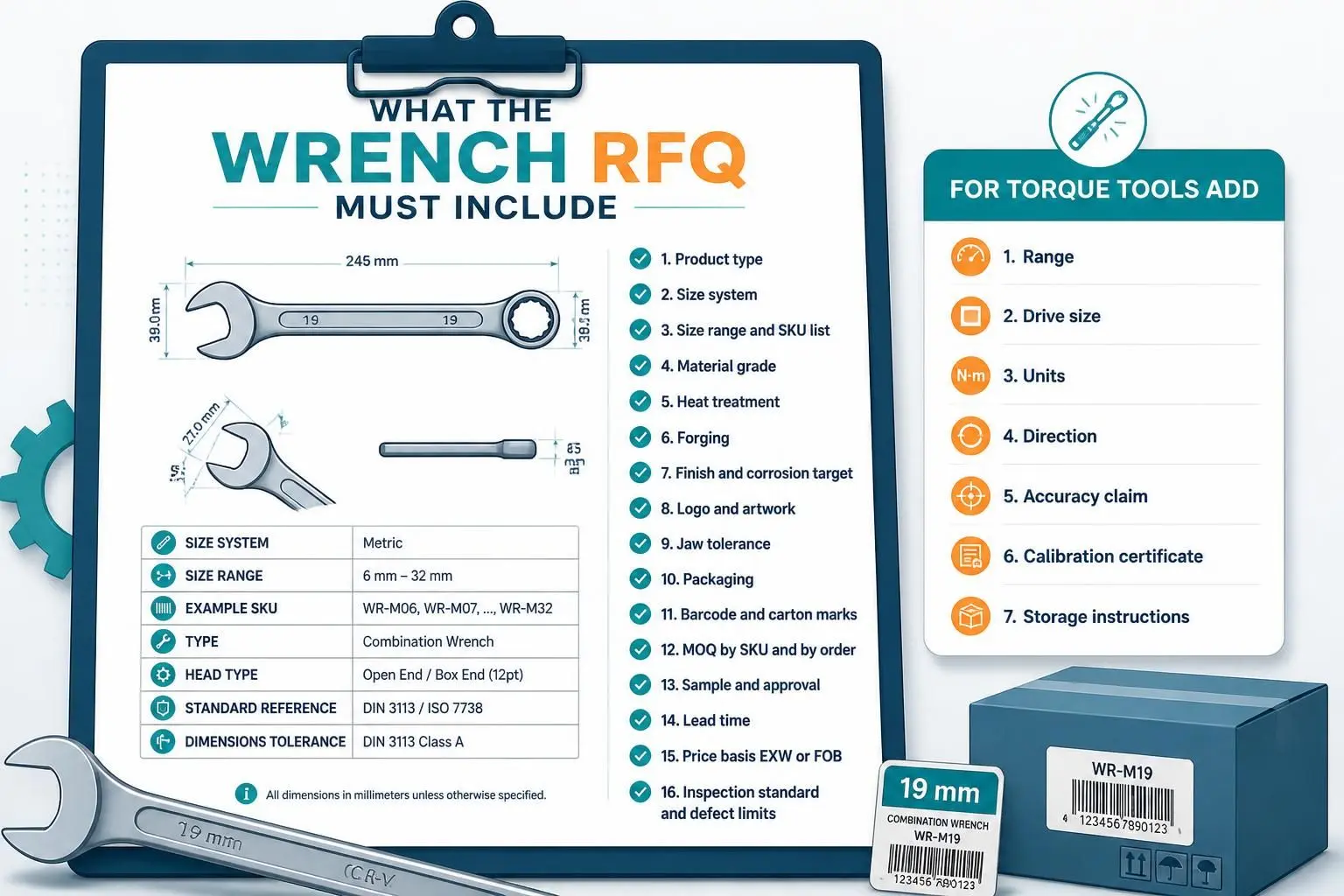
A precise RFQ stops suppliers from quoting different products under the same SKU name. Put the drawing, size list, material, finish, markings, packaging, MOQ, test method, and defect limits in one document.
Use these fields:
- Product type: combination, adjustable, torque, ratcheting, flare-nut, or other.
- Size system: metric, SAE, or dual marking.
- Size range and individual SKU list.
- Material grade and heat-treatment requirement.
- Forging and machining requirements.
- Finish and corrosion expectation.
- Logo method, position, size, and artwork file.
- Tolerance for jaw gap, thickness, angle, and opening.
- Packaging: bulk, carded, pouch, box, case, or set.
- Barcode, carton marks, and language requirements.
- MOQ by SKU and MOQ by total order.
- Sample quantity and approval process.
- Lead time, tooling, and reorder timing.
- Price basis: EXW, FOB, or another agreed term.
- Inspection standard, defect limits, and replacement policy.
For torque tools, add range, drive size, units, direction, accuracy claim, calibration certificate, and storage instructions.
Use the RFQ in your internal sourcing services workflow. If several factories quote the same file, the differences become easier to compare.
What quality-control checks matter before shipment?
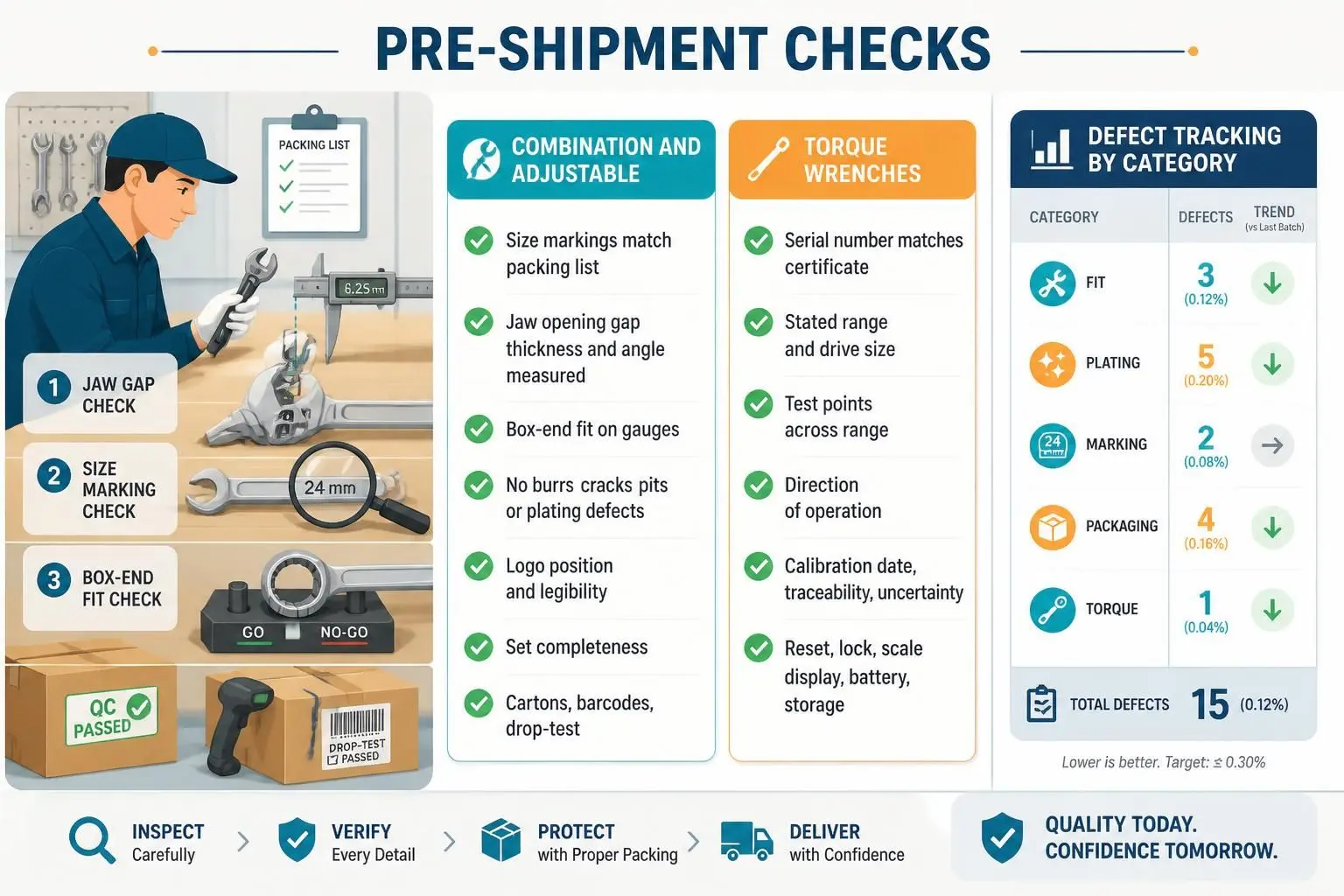
Pre-shipment inspection should verify fit, finish, markings, packaging, quantity, and torque performance when the product requires it. Compare the shipment with the approved sample. The inspection should use the same product drawing and acceptance limits that shaped the RFQ.
Combination and adjustable wrench checks
- Confirm size markings against the packing list.
- Measure jaw opening, gap, thickness, and angle.
- Check box-end fit on approved fastener gauges.
- Look for burrs, cracks, pits, sharp edges, stains, and plating defects.
- Confirm logo position and marking legibility.
- Inspect set completeness and mixed-size errors.
- Check cartons, inner boxes, barcodes, and drop-test packaging.
Torque wrench checks
- Confirm the serial number or identification matches the certificate.
- Check the stated range and drive size.
- Test representative points across the working range.
- Confirm the direction of operation.
- Review calibration date, traceability, and uncertainty information.
- Check reset, lock, scale, display, battery, and storage functions.
For a buyer-facing case study, publish your own inspection summary. Track defects by category;fit, plating, marking, packaging, and torque;and show the cost of each failure. That evidence tells a buyer more than a generic “AQL passed” statement.
Our quality inspection service can be used to check samples, production lots, packaging, and shipment quantities before cargo leaves China.
How do sourcing costs change across product types?
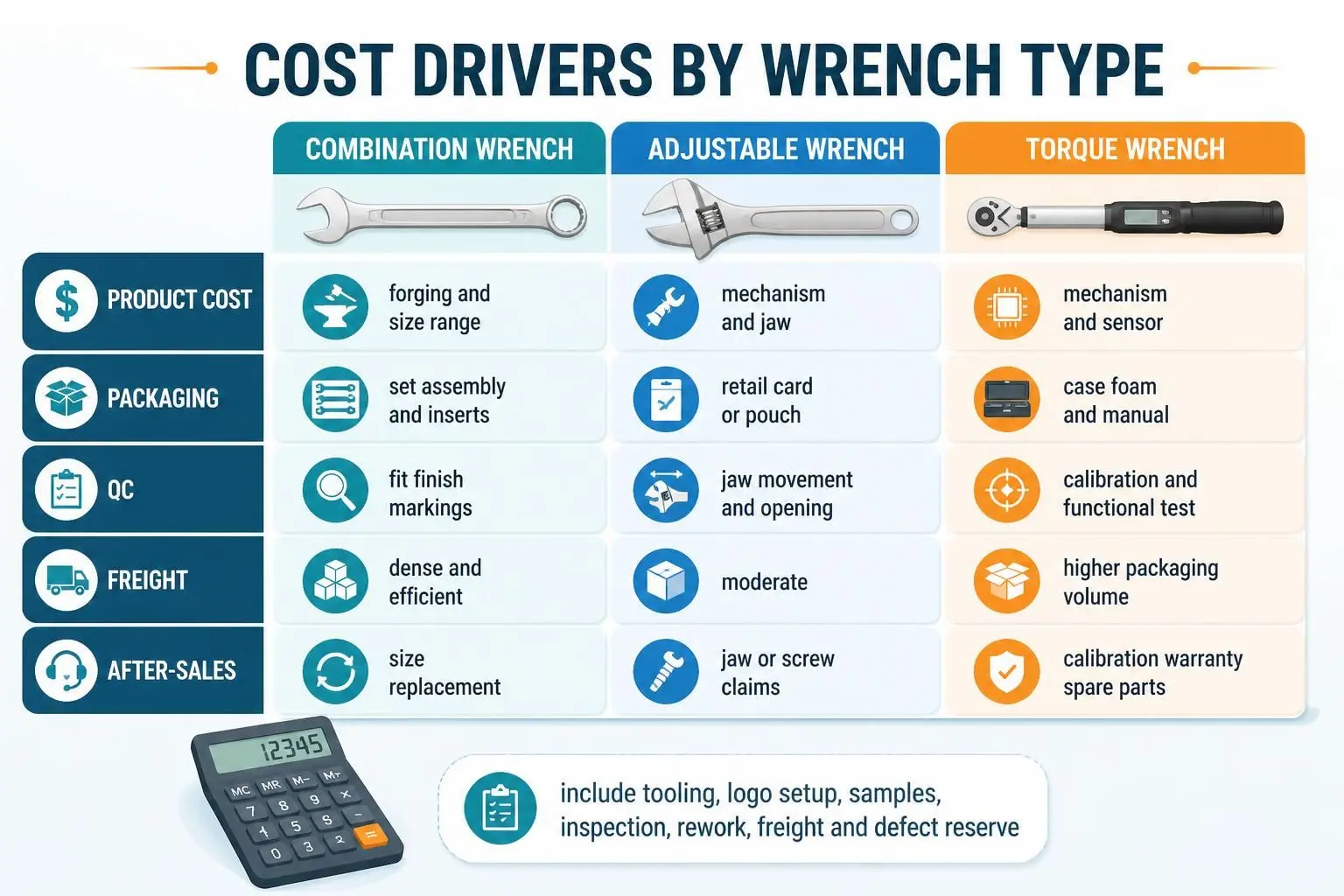
The lowest unit quote is not always the lowest landed cost. A 2025 hand-tools market report estimated the global category at $25.5 billion to $26.5 billion, depending on the definition and forecast base (Research and Markets, 2025). Those reports provide context, but your sourcing model should use real supplier quotes.
| Cost driver | Combination wrench | Adjustable wrench | Torque wrench |
|---|---|---|---|
| Product cost | Forging, size range, finish | Mechanism, jaw, handle length | Mechanism, sensor or scale |
| Packaging | Set assembly and inserts | Retail card or pouch | Case, foam, manual |
| QC | Fit, finish, markings | Jaw movement and opening | Calibration and functional test |
| Freight | Dense and efficient | Moderate | Higher packaging volume |
| After-sales | Size replacement | Jaw or screw claims | Calibration, warranty, spare parts |
When you compare quotes, include tooling, logo setup, samples, inspection, rework, freight, and defect reserve. A set with many sizes may have a low per-piece price but higher carton and assembly costs.
The sourcing cost calculator can help structure the comparison. Use the same assumptions for every supplier.
How can importers choose and manage a China wrench supplier?
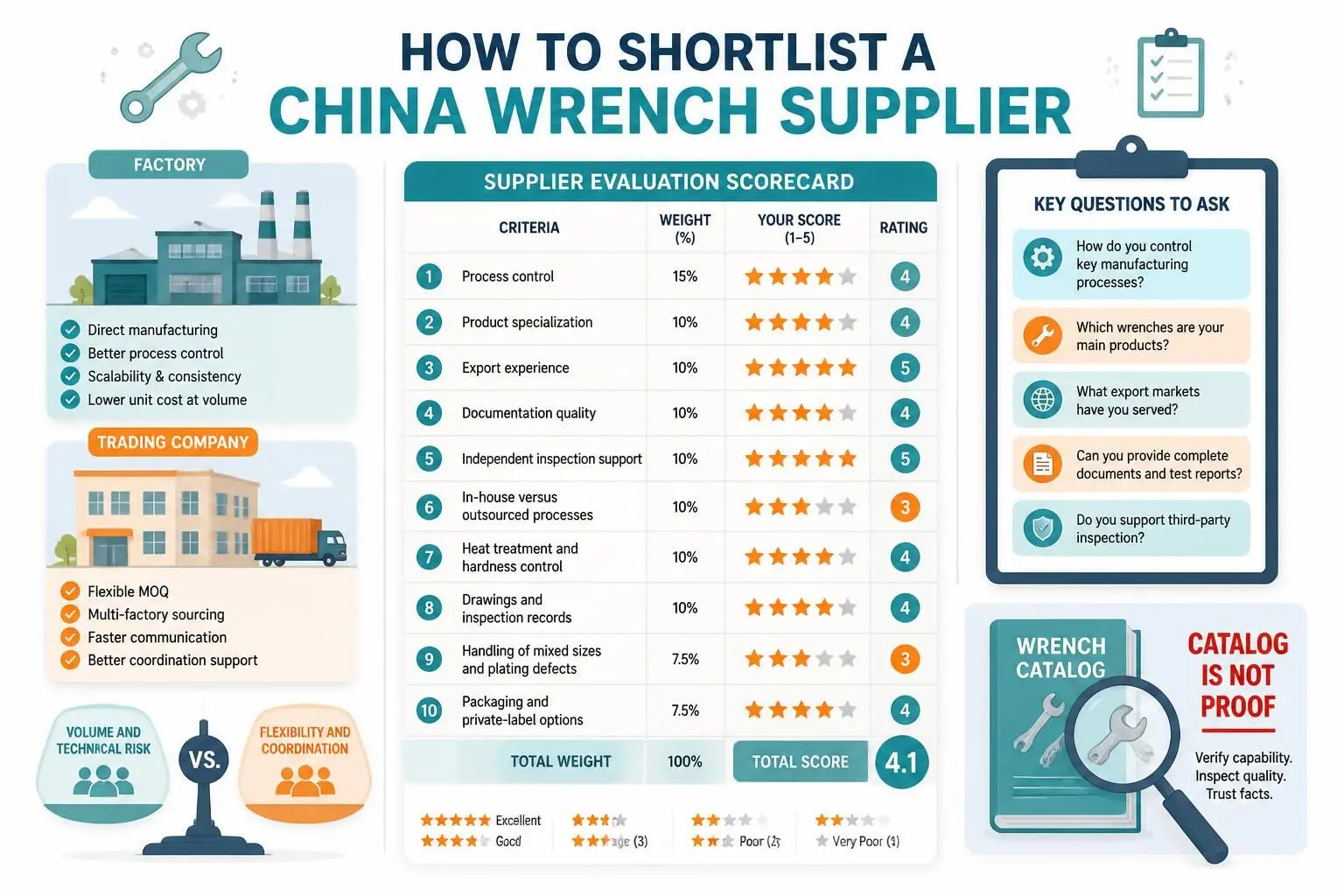
Shortlist suppliers by process control, product specialization, export experience, documentation quality, and willingness to support independent inspection. A polished catalog helps with initial screening. It does not prove that the factory can repeat the approved sample.
Ask each supplier:
- Which wrench types do you produce in-house?
- Which processes are outsourced?
- How do you control heat treatment and hardness?
- Can you provide drawings and inspection records?
- What happens when a sample changes during production?
- Can an independent inspector visit before shipment?
- How do you handle mixed sizes, shortages, or plating defects?
- Which packaging formats and private-label options are standard?
A factory may be the right fit for a large repeat order. A trading company may be more flexible across several product categories. Choose between them based on volume, technical risk, and the amount of supplier coordination you need.
For buyers visiting Zhejiang, China, the Yiwu market overview and Yiwu hardware market guide are useful starting points. For remote sourcing, ask for factory videos, current samples, test records, and a clear inspection plan.
Get a wrench sourcing shortlist: Tell us your target sizes, finish, packaging, quantity, and destination market. We can compare suppliers, arrange samples, and organize QC before shipment.
Frequently Asked Questions
Are combination wrenches better than adjustable wrenches?
They solve different problems. Combination wrenches give a fixed fit and faster repeat work. Adjustable wrenches cover more sizes in one tool, but they need careful jaw adjustment. For a wholesale range, start with fixed-size combination models and add adjustable tools for field service and plumbing applications.
What is the best steel for a wrench?
There is no single best grade for every use. Chrome vanadium is common for general-purpose combination and adjustable wrenches. The more useful question is whether the factory controls forging, heat treatment, hardness, dimensions, and finish. Ask for records that support the product claim.
Do torque wrenches need calibration certificates?
They need a defined test and documentation approach. ISO 6789-1 covers conformance and marking, while ISO 6789-2 covers calibration and measurement uncertainty. Ask the supplier which document they provide, what range was tested, and whether the result is traceable.
What wrench sizes should a wholesaler stock first?
Use customer demand and local standards. A general metric program often starts around 8–19 mm, then adds larger sizes based on application. If you sell into markets that use SAE sizes, quote a separate range rather than mixing systems without clear labels.
What should I ask a China wrench supplier before ordering?
Ask for a drawing, material and heat-treatment details, finish, size list, MOQ, sample process, lead time, packaging, branding method, inspection standard, defect limits, and replacement policy. For torque tools, also request range, accuracy claim, calibration documentation, and storage instructions.
Conclusion
Combination, adjustable, and torque wrenches should have different roles in your product line. Combination wrenches are the practical core. Adjustable wrenches add coverage. Torque wrenches serve controlled assembly work where the tightening result matters.
The decision gets easier when every claim becomes a measurable field: material, hardness, jaw fit, finish, markings, packaging, calibration, and inspection evidence.
Before placing a volume order, approve a sample, freeze the specification, and inspect the shipment against that version. If you need help comparing suppliers or preparing a QC plan, get a free quote from Union Service.