



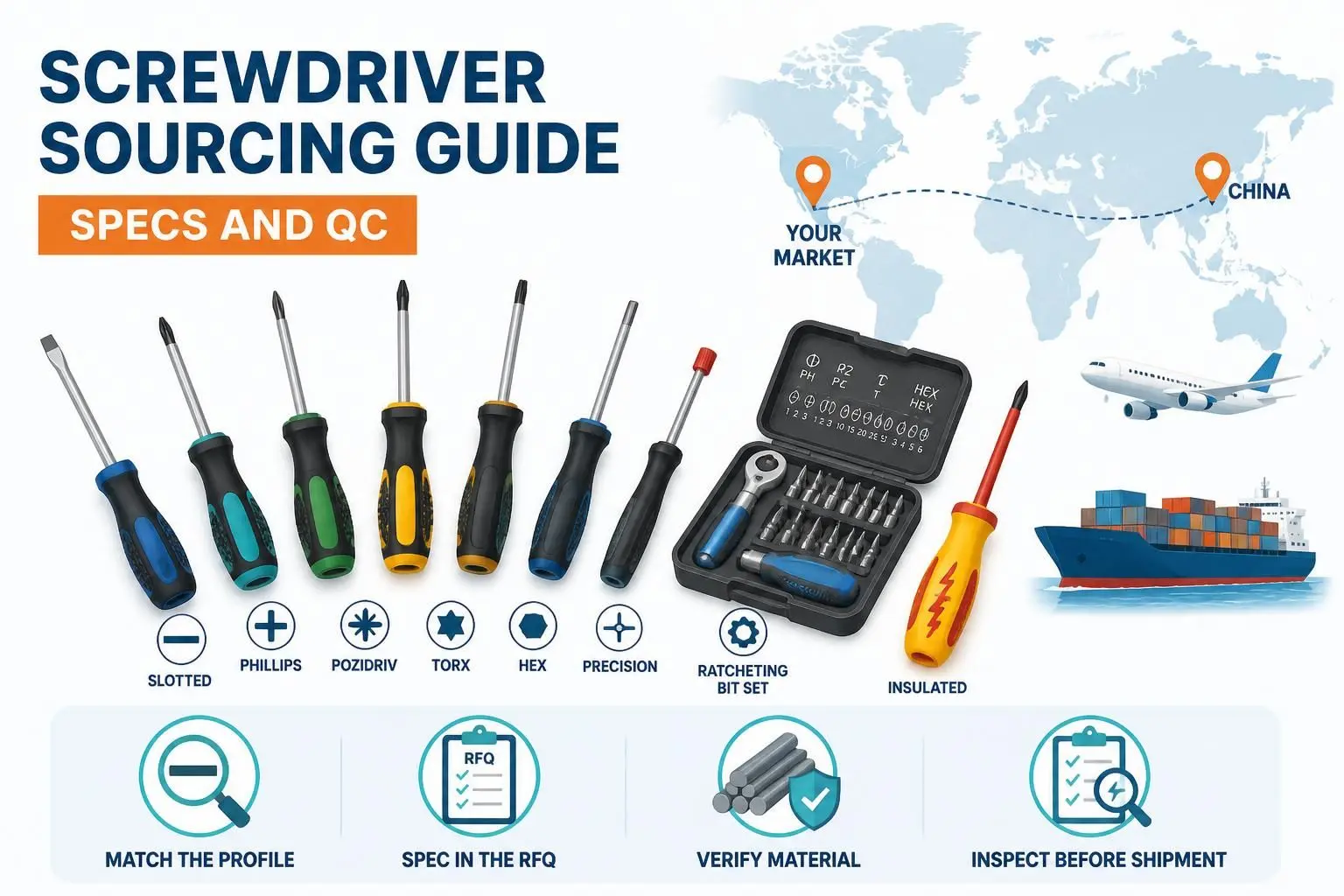
A screwdriver sourcing guide should help you buy tools that fit the intended screws, survive normal use, and arrive as specified. That takes more than a catalog photo and a claim about steel grade. You need a defined drive profile, dimensions, construction, packaging, and inspection method for each SKU.
This guide takes you from assortment planning through the first purchase order. It is for importers, distributors, hardware retailers, and private-label buyers sourcing from China. If you are building a wider tool range, start with our hardware and hand tools category and hand-tools sourcing guide.
Key Takeaways
- Match every screwdriver tip to an exact drive profile and size; similar-looking profiles can damage screws.
- Put material, tip geometry, handle, markings, packaging, and acceptance tests into one RFQ.
- Compare suppliers against the same approved sample and written specification.
- Buy insulated or torque-limiting models only with product-specific evidence for their stated claims.
Which screwdriver types should you source first?
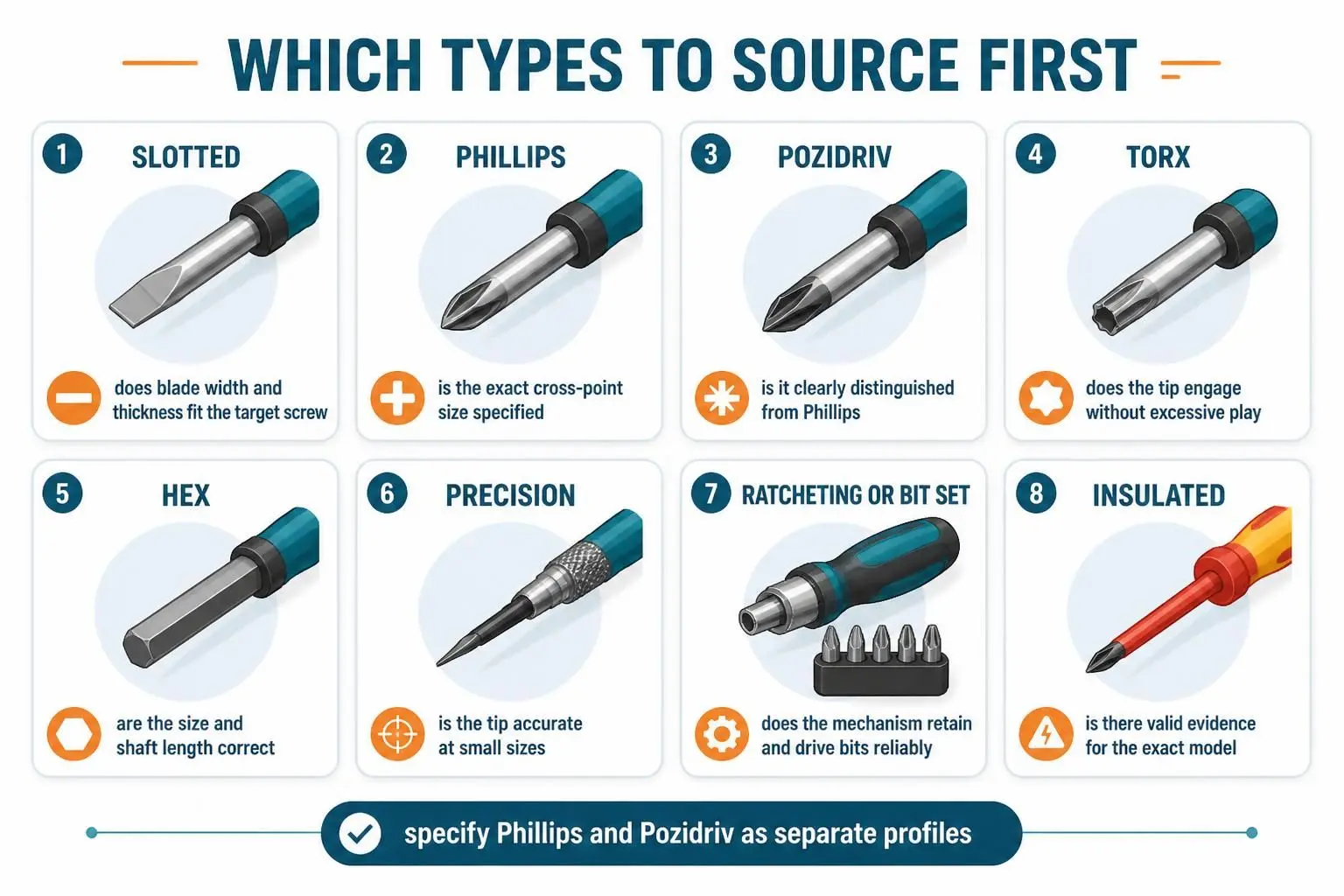
Start with the fasteners your customers actually encounter. A general hardware range may need slotted and Phillips drivers. A furniture or automotive range may need hex and Torx. Electrical and precision buyers have different requirements again. Assortment decisions should come from customer applications, not a supplier’s most popular set.
| Drive or model | Typical demand | Main buying question |
|---|---|---|
| Slotted | General maintenance and legacy fasteners | Does blade width and thickness fit the target screw? |
| Phillips | General assembly and repair | Is the exact cross-point size specified? |
| Pozidriv | Fasteners designed for that profile | Is it clearly distinguished from Phillips? |
| Torx | Automotive, machinery, electronics | Does the tip engage without excessive play? |
| Hex | Furniture, bicycles, machinery | Are the size and shaft length correct? |
| Precision | Small fasteners and electronics | Is the tip accurate at small sizes? |
| Ratcheting or bit set | Repeated work and broad coverage | Does the mechanism retain and drive bits reliably? |
| Insulated | Electrical work within stated limits | Is there valid evidence for the exact model? |
Specify Phillips and Pozidriv as separate profiles in your RFQ. ISO 8764-1:2004, confirmed current by ISO in 2024, names PH tips for H recesses and PZ tips for Z recesses. Do not assume a driver labeled only “cross screwdriver” will fit both. Approve each profile against the matching screw or a defined gauge.
Decide whether you need fixed-blade drivers, replaceable bits, or both. Fixed blades are easy to identify by SKU. Bit sets offer coverage in a smaller package, but add bit retention, holder fit, and missing-piece risks. For retail, check that the package shows the actual profile and size of every piece.
If your assortment includes socket tools, the socket-set sourcing guide covers a related but separate set of fit and packaging questions. Build the screwdriver range around its own use cases.
What belongs in a screwdriver RFQ?
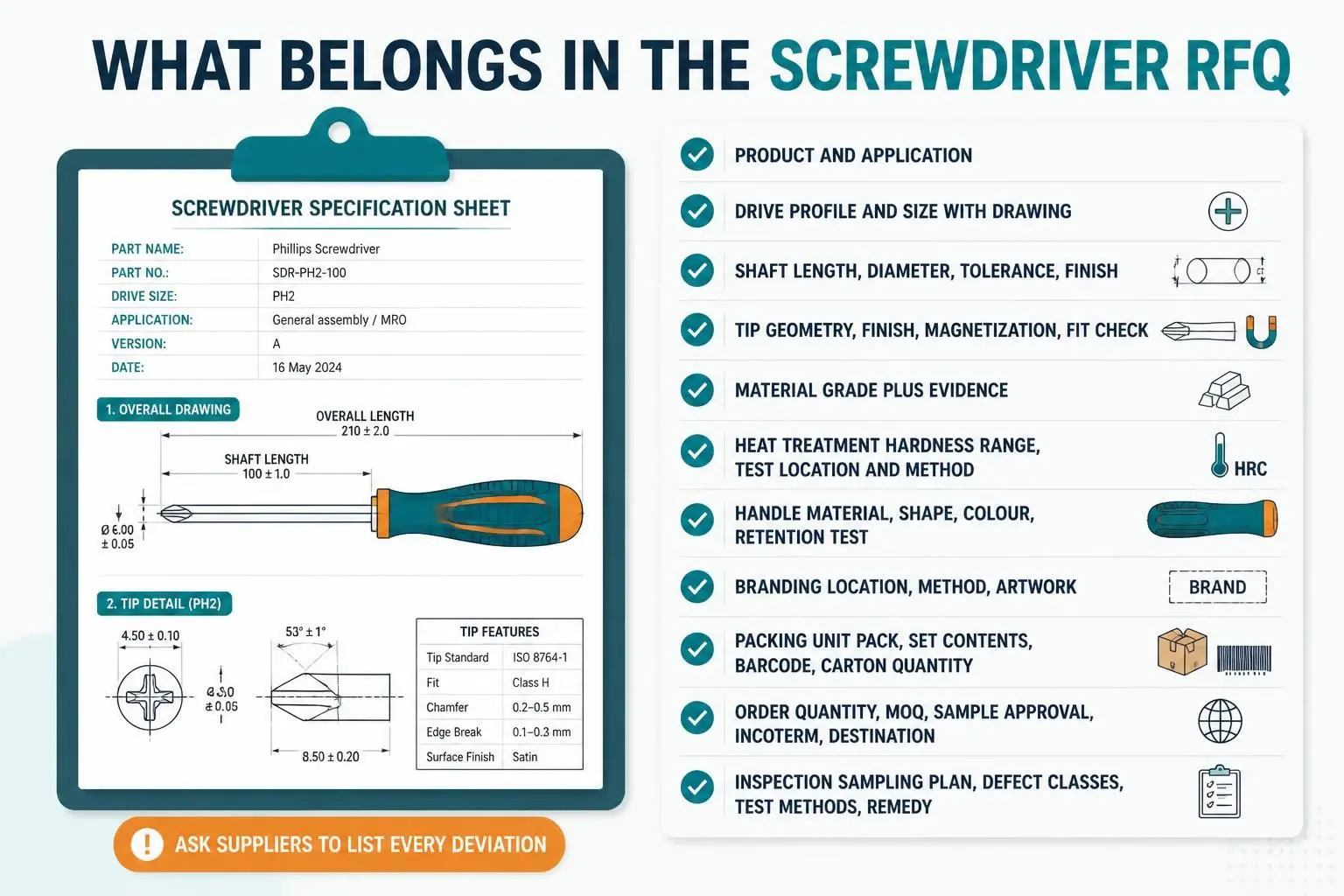
An RFQ should let two suppliers price the same product. Name the drive profile and size first. Then state the tip dimensions or drawing, shaft dimensions, material requirement, heat treatment, finish, handle construction, logo, packaging, quantity, test method, and destination. Ask suppliers to list every deviation instead of silently substituting a catalog model.
For one fixed-blade SKU, the row might look like this:
| Field | Example format to complete |
|---|---|
| Product | Fixed-blade screwdriver; intended application |
| Drive | Exact profile and size, with drawing or reference standard |
| Shaft | Length, diameter, tolerance, and finish |
| Tip | Geometry, finish, magnetization requirement, and fit check |
| Material | Stated grade plus evidence required |
| Heat treatment | Agreed hardness range, test location, and method |
| Handle | Material, shape, color, and retention test |
| Branding | Logo location, method, and artwork approval |
| Packing | Unit pack, set contents, barcode, carton quantity |
| Order | Quantity, MOQ, sample approval, Incoterm, destination |
| Inspection | Sampling plan, defect classes, test methods, remedy |
For example, consider a private-label PH2 fixed-blade driver for general assembly. The RFQ should identify the PH2 profile, shaft dimensions, handle drawing, finish, unit pack, and carton quantity. The buyer then compares two supplier samples with the same matching screw and agreed test method. This is a worked specification example, not a tested product or quoted factory offer.
This is a format, not a universal specification. The right dimensions and test limits depend on the model, screw profile, and buyer market. Attach a drawing or approved sample where a description would be ambiguous. For a mixed set, list each piece on a separate line and state the total piece count, case, insert, and spare-bit policy.
Ask for a sample made with the proposed production process. A showroom sample from another factory or an unapproved steel grade tells you little about the order you will receive. Keep one signed reference sample with the buyer and one with the supplier. Record its label, date, and any agreed exceptions.
Packaging deserves its own approval. A good tool can become an expensive return when a set contains the wrong profile, a barcode covers a size marking, or the case opens in transit. If you sell through retail channels, provide the exact artwork, warnings, language, and barcode file.
For MOQ planning, use the MOQ reference as a starting point, then get an item-specific quote. Handle molds, custom colors, printing, and set cases can each have different minimums.
How do material and heat treatment affect tip life?
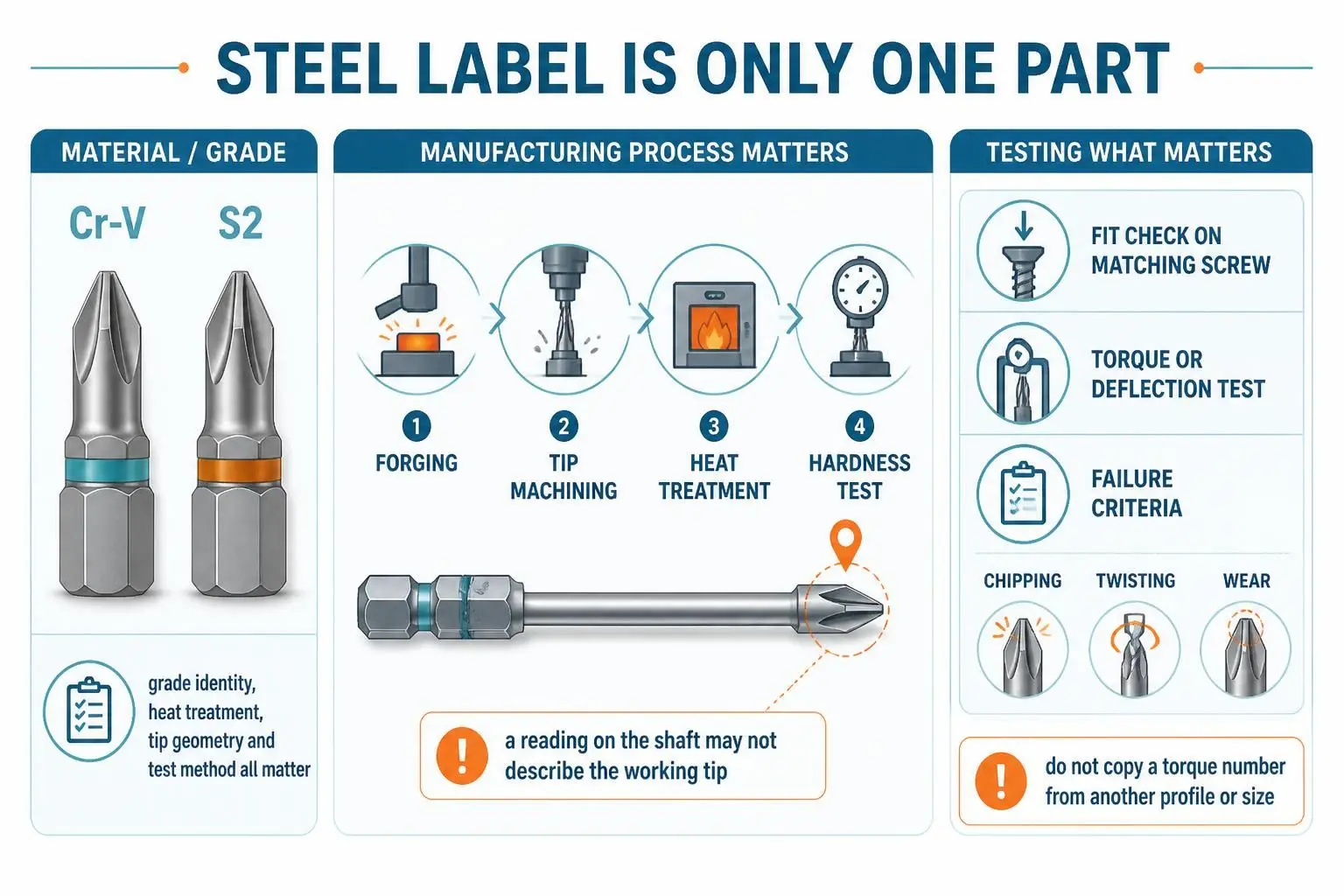
A steel label is only one part of tip performance. Shape, heat treatment, surface condition, and contact with the screw all matter. Suppliers often advertise Cr-V or S2, but the label does not tell you whether the tip fits, chips, twists, or wears under your intended use. Ask for both material evidence and finished-tool testing.
Cr-V and S2 labels need a specific grade and test basis before buyers can compare them. Do not assume one automatically wins across every screwdriver design. Tip geometry and heat treatment also need testing on finished tools. Chipping and deformation are possible failure modes to check for, not outcomes guaranteed by a particular steel label.
Request the hardness range, measurement method, and location on the tool. A reading on the shaft may not describe the working tip. Ask whether the test is performed on finished production units or only on a material coupon. For critical applications, agree on a torque or deflection test with a defined fixture and failure criterion. Do not copy a torque number from another profile or size.
Look closely at finish and corrosion protection. A coating can hide burrs or change fit at the tip. Compare approved and production samples under the same lighting. Check for sharp edges, cracks, pits, poor plating, and incomplete markings. If the tool will be stored in humid conditions, specify a corrosion test method and acceptance limit that suit the destination market.
One useful supplier comparison holds the nominal steel grade constant, then measures tip fit and performance on several samples. That isolates differences in geometry and process control. Publish the sample count and method if you later use the result in marketing; without them, it is just an anecdote.
That comparison also creates a useful decision record. Suppose two samples share a grade label but one shows more play in the test screw. Record the measured fit, test screw, sample ID, and photos before deciding whether to reject it. This hypothetical example shows the method; it makes no claim about a factory’s actual performance.
Which handles and specialty models need extra checks?
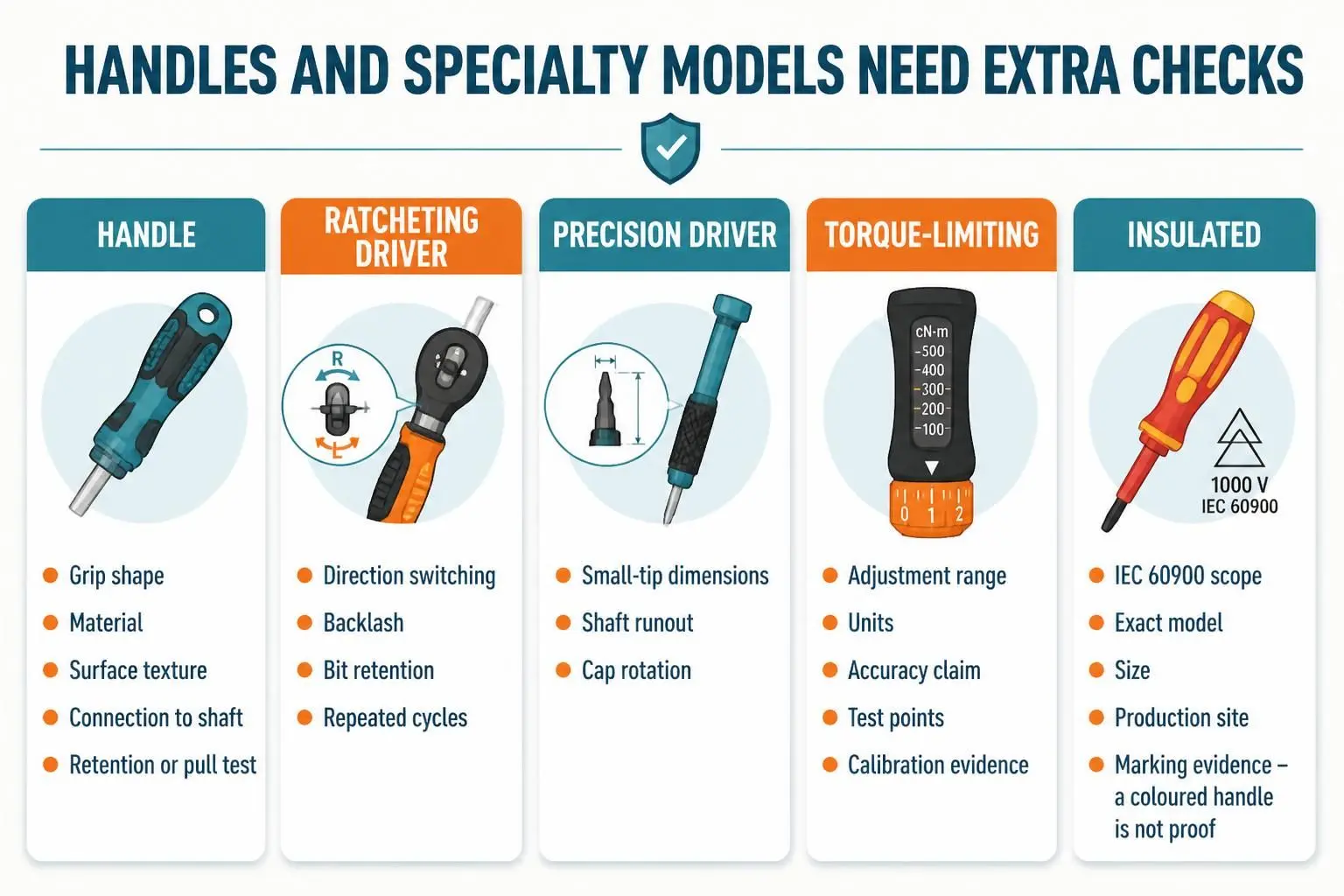
The handle must remain secure and usable throughout the tool’s intended work. Compare grip shape, material, surface texture, and connection to the shaft. A comfortable handle is valuable only if it resists slipping, cracking, and rotation. Specify retention or pull tests when the product claim depends on handle strength.
For ratcheting drivers, check direction switching, backlash, bit retention, and operation after repeated cycles. For precision drivers, inspect small-tip dimensions, shaft runout, and cap rotation. A torque-limiting screwdriver needs its adjustment range, units, accuracy claim, test points, and calibration evidence defined in the purchase order. Do not apply ordinary fixed-driver acceptance rules to these products.
Insulated screwdrivers need separate scrutiny. IEC 60900:2018 covers insulated, insulating, and hybrid hand tools for work live or close to live parts within the voltage scope stated by IEC. That scope does not certify a supplier’s product. Before using an electrical safety claim, ask a qualified reviewer which edition and market requirements apply. Confirm that certificates and test reports cover the exact model, size, production site, and marking. A colored handle alone is not evidence of insulation performance.
Ask suppliers to show how they control changes. A new handle material, insert, or assembly process can affect a product that previously passed testing. Recheck the claim when the design or production site changes.
Compare suppliers on the same specification
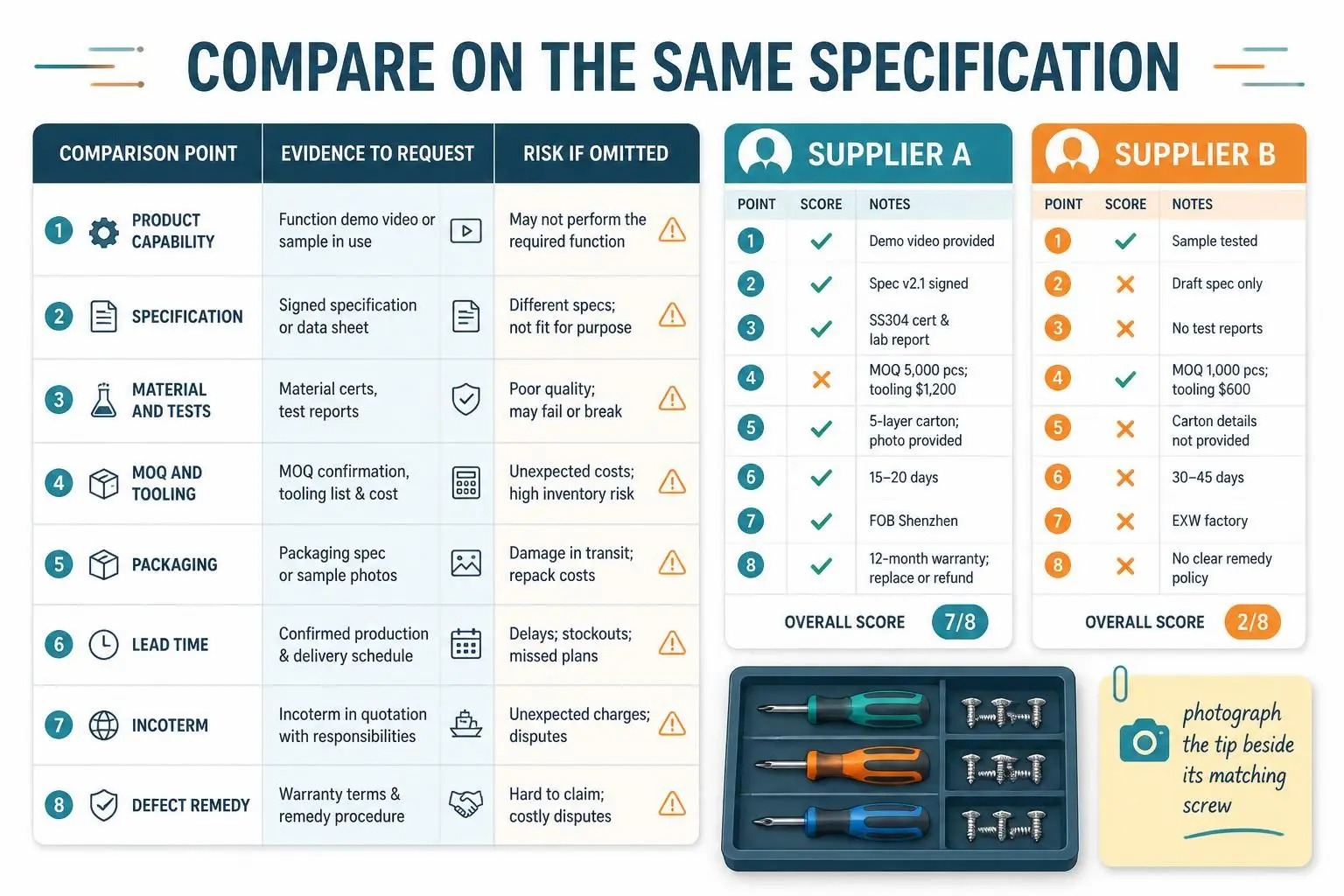
Give every shortlisted supplier the same RFQ and ask for the same sample quantity. Then compare what each quote includes. A lower unit price may omit a retail case, testing, logo application, or the Incoterm you assumed. A quote comparison is meaningful only when the product and commercial terms match.
| Comparison point | Evidence to request | Risk if omitted |
|---|---|---|
| Product capability | Similar finished samples and production process | Catalog claim exceeds factory capability |
| Specification | Marked-up drawing or signed spec sheet | Different tools priced as equivalent |
| Material and tests | Reports linked to model and lot | Unverifiable performance claim |
| MOQ and tooling | Written minimums and ownership terms | Unexpected setup cost |
| Packaging | Artwork proof and physical pack sample | Retail or transit failures |
| Lead time | Schedule for samples and production | Missed selling window |
| Incoterm | Named place and included charges | Misread landed cost |
| Defect remedy | Replacement, credit, and claim window | Dispute after arrival |
Ask who performs forging or machining, heat treatment, molding, assembly, and final inspection. A trader can still be a useful supplier, but you need to know who controls the process and who will answer a defect claim. Request a factory visit or independent audit when order value and risk justify it.
Run a small comparison with samples from the exact profiles and sizes you plan to sell. Photograph the tip beside its matching screw. Record fit, dimensions, markings, handle security, packaging, and any functional result against the same method. Do not rank suppliers by one subjective feel test.
For Yiwu-based purchasing, a Yiwu sourcing agent can coordinate sample collection, supplier questions, inspection, consolidation, and shipment. State your acceptance rules before asking an agent to compare factories.
Union Service’s company background explains the team behind that service. Ask the person reviewing your samples to identify their inspection method and record the result against your signed specification.
What should pre-shipment inspection cover?
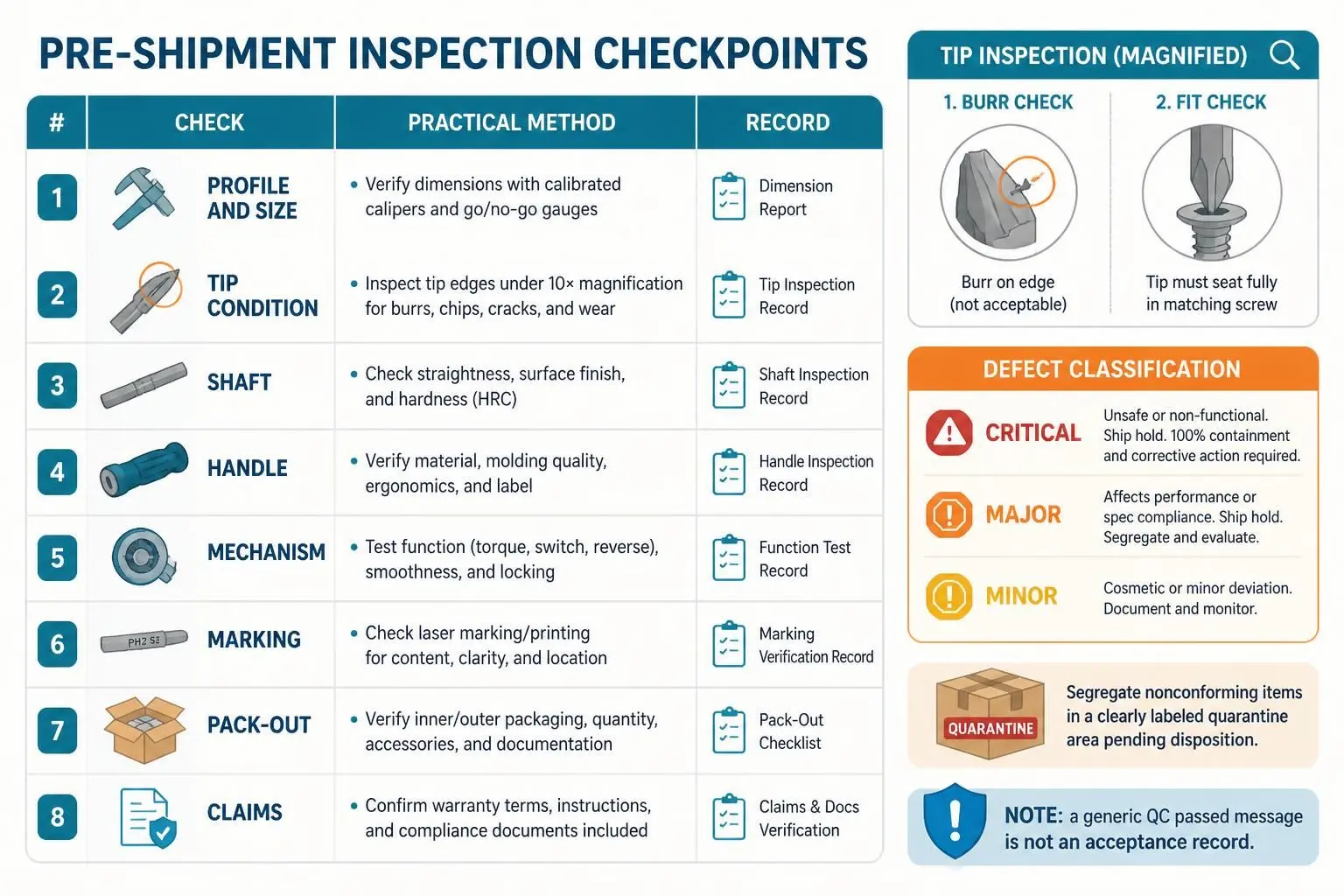
Inspect production against the approved sample, purchase order, and specification. Start with identity and quantity: exact SKU, profile, size, set contents, labels, and carton count. Then check the product itself. A shipment can pass a visual glance yet fail because the tip does not seat correctly or the handle rotates on the shaft.
Use a written sampling plan and define critical, major, and minor defects before production. Set acceptance numbers in the purchase order. For safety-related claims, decide whether routine sampling is enough or whether separate lot testing and document review are required. A generic “QC passed” message is not an acceptance record.
| Check | Practical method | Record |
|---|---|---|
| Profile and size | Compare with drawing, gauge, and matching screw | SKU, measured result, photo |
| Tip condition | Magnified visual review and fit check | Burr, chip, coating, wear |
| Shaft | Measure length and straightness | Dimension and tolerance |
| Handle | Inspect molding and perform agreed retention test | Movement, crack, slip |
| Mechanism | Operate ratchet or bit holder as specified | Direction, retention, failure |
| Marking | Read profile, size, brand, and safety marks | Legibility and location |
| Pack-out | Count pieces and verify artwork/barcodes | Missing items, carton count |
| Claims | Match reports to model and lot | Report ID and scope |
Keep failures separated by SKU and lot. If a tip fails the fit check, photograph it beside a passing sample and the test screw. That makes the supplier response faster and reduces arguments over wording. For rework, require a new inspection of the affected lot before release.
Consider a set in which one driver has the correct printed size but fails the agreed fit check. Record the set SKU, component profile, carton and lot, test screw, photo, and result. Quarantine the affected lot while the supplier investigates. Release only after the agreed correction and reinspection. This is a model response to a possible defect, not a report of an actual shipment.
Inspection does not replace supplier process control. It catches a sample of finished problems. Ask how the factory controls tip machining, heat treatment, handle assembly, and final sorting. See our quality inspection and warehousing service for the practical steps between production and shipment.
Control landed cost and repeat orders
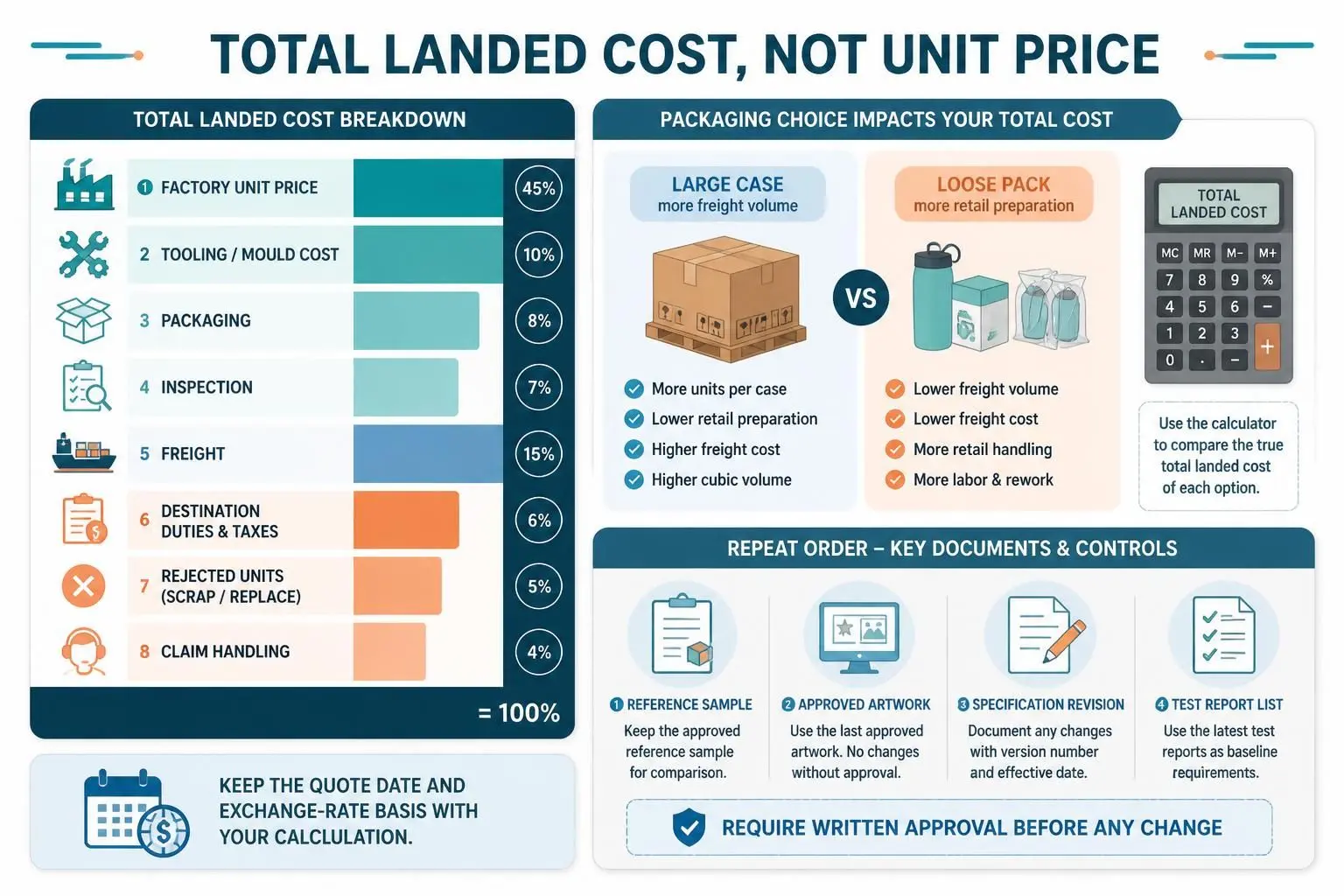
Compare total landed cost, not only the factory unit price. Add tooling, packaging, inspection, freight, destination duties and taxes, rejected units, and claim handling. A large case can raise freight cost even when the tools are light. A cheap loose pack may lower the unit quote but increase retail preparation work.
Use the sourcing cost calculator for a first comparison and the freight estimator when pack dimensions are known. Duty depends on destination, classification, and origin rules; confirm the applicable treatment for your shipment. Keep the quote date and exchange-rate basis with your calculation.
For repeat orders, retain a reference sample, approved artwork, spec revision, and test report list. Require written approval before the supplier changes steel grade, heat treatment, tip geometry, handle mold, finish, or case. Recheck the first lot after a change. This is especially important when a buyer expands from single drivers to mixed sets.
What belongs in the first purchase order?
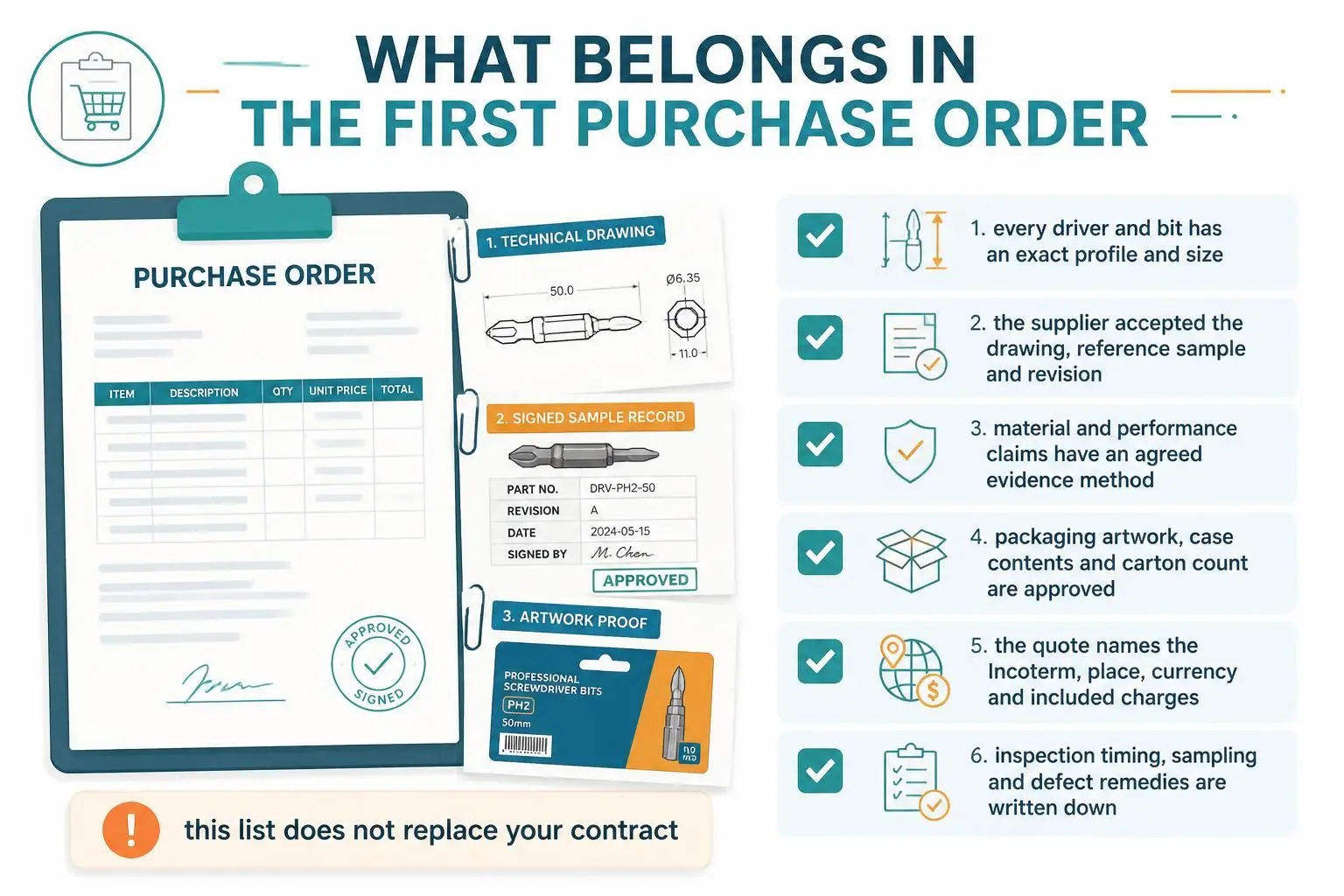
The first PO should turn the approved sample into a repeatable order. Include the exact SKU and profile, drawing revision, material and process requirements, handle and finish, marking and artwork, packaging, quantity, price basis, delivery date, tests, sampling plan, and defect remedy. Attach the signed sample record and list any accepted deviations.
Before paying a production deposit, confirm these points:
- Every driver and bit has an exact profile and size.
- The supplier accepted the drawing, reference sample, and revision.
- Material and performance claims have an agreed evidence method.
- Packaging artwork, case contents, and carton count are approved.
- The quote names the Incoterm, place, currency, and included charges.
- Inspection timing, sampling, and defect remedies are written down.
This list does not replace your contract, but it closes the most common gaps in a catalog-only order. Send Union Service your target SKUs, destination, and expected volume to request a quotation with a sample and inspection plan.
Frequently asked questions
Are Phillips and Pozidriv screwdrivers interchangeable?
Do not specify them as interchangeable. Order each named profile and size separately, then confirm fit using the matching screw or a defined gauge. A supplier’s “cross screwdriver” label does not identify the intended fastener accurately enough for sample approval or production inspection.
Is S2 always better than Cr-V for screwdriver tips?
No universal material ranking tells you how a finished screwdriver will perform. Grade identity, heat treatment, tip geometry, and the test method all matter. Ask for specific material evidence and compare finished samples against the same fit and performance requirements. Do not accept a steel name as proof of durability.
What is a reasonable MOQ for private-label screwdriver sets?
It depends on the factory’s production run, handle color, logo method, case, and packaging. There is no reliable universal minimum. Ask suppliers to quote the same set at several quantities, with tooling and print costs separated. That shows where a larger order actually changes the price.
What documents should I request for insulated screwdrivers?
Request model-specific certificates and test reports, the applicable standard and edition, the issuing body’s details, and evidence that the marked voltage and tool sizes match the supplied goods. Confirm destination-market rules with a qualified compliance adviser. Handle color and a generic catalog statement do not establish electrical safety.
How do I inspect a mixed screwdriver set?
Treat each piece as a defined SKU inside the set. Check its profile, size, tip condition, markings, and handle or bit-holder function. Then count all pieces and verify the insert, case, barcode, and carton. Record defects by component and lot so the supplier can fix the affected part without obscuring the failure.
Final buying decision
The strongest screwdriver order starts with a precise use case and a measurable sample. Define the tip profile and size, agree on materials and tests, approve the handle and pack, then inspect production against that baseline. Keep specialty safety claims separate and supported by model-specific evidence.
If you need help comparing suppliers or preparing the first order, send your SKU list and target market to Union Service for a screwdriver sourcing quote.