


Yiwu International Trade City in Zhejiang, China works well for toy buyers who need broad product choice, low-to-medium MOQs, and the chance to compare suppliers in one trip. It is also a market where a low quote can hide testing, packaging, rework, freight, or customs costs.
Use a controlled process when you buy toys from Yiwu. Define the product, shortlist suppliers, approve samples, check destination-market requirements, inspect the order, and calculate landed cost before paying a deposit.
This guide covers that process for wholesalers, retailers, e-commerce sellers, distributors, and private-label importers. It also explains how to source remotely when you cannot visit China.
TL;DR: Yiwu can work well for educational toys, plush toys, party products, outdoor toys, craft items, and other small commodities. Start with a precise product brief, supplier verification, samples, toy-safety planning, written specifications, pre-shipment QC, and a landed-cost calculation. Buyers who cannot visit China can appoint a local sourcing agent to coordinate these steps.
Is Yiwu a good place to source toys in 2026?
Yes, if you need variety and flexible purchasing options. Yiwu is less suitable when you need a very large production run, complex engineering, or a heavily customized product that requires direct factory development from the first meeting.
Yiwu International Trade City groups small-commodity categories in one market complex. That makes in-person product comparison faster than visiting separate wholesale areas. Check the current Yiwu market overview and market directory before planning a visit because category locations and operating details can change.
Toy buyers usually benefit from Yiwu when they need to:
- Compare many designs before choosing a product direction.
- Combine toys with party supplies, stationery, gifts, bags, or seasonal products.
- Start with a smaller order than a factory may require.
- Test several products before committing to a larger production run.
- Source existing designs with new packaging, colors, or a private label.
Yiwu may not be the best first stop when your product requires a new mold, complex electronics, advanced software, or a long engineering process. In those cases, a factory-direct project may offer better technical control. Many importers use both routes: Yiwu for product discovery and supplier comparison, then a factory for a mature product with predictable demand.
Read the toys category page at /toys/ when you are still comparing product directions.
Which Yiwu market district sells toys?
For this site’s current market directory, start toy enquiries with the District 4 guide. Confirm the floor, building, and booth information with the market or a local contact before you travel. A map from several years ago can help with orientation, but it should not replace current market information.
| District | Common product focus | Why a toy buyer may visit |
|---|---|---|
| District 1 | Crafts, decorations, jewelry, seasonal items | Party products, gifts, decorations, and adjacent categories |
| District 2 | Hardware, electronics, bags | Electronic accessories, storage, packaging, and related products |
| District 3 | Textiles, clothing, accessories | Costume accessories, soft goods, and textile add-ons |
| District 4 | Outdoor, sports, and toy-related categories | Start with the current District 4 directory, then confirm the supplier and booth location |
| District 5 | Imported products and newer categories | Product comparison and category expansion |
Prepare before entering the market. Bring a category list, target price, product references, age range, order estimate, packaging requirements, and a way to label every sample. Ask each supplier for a written quotation rather than relying on a handwritten price or a quick message.
Use the Yiwu market map to plan your route. Ask the market or your local contact to confirm current locations before you go.
How do you choose a toy product before contacting suppliers?
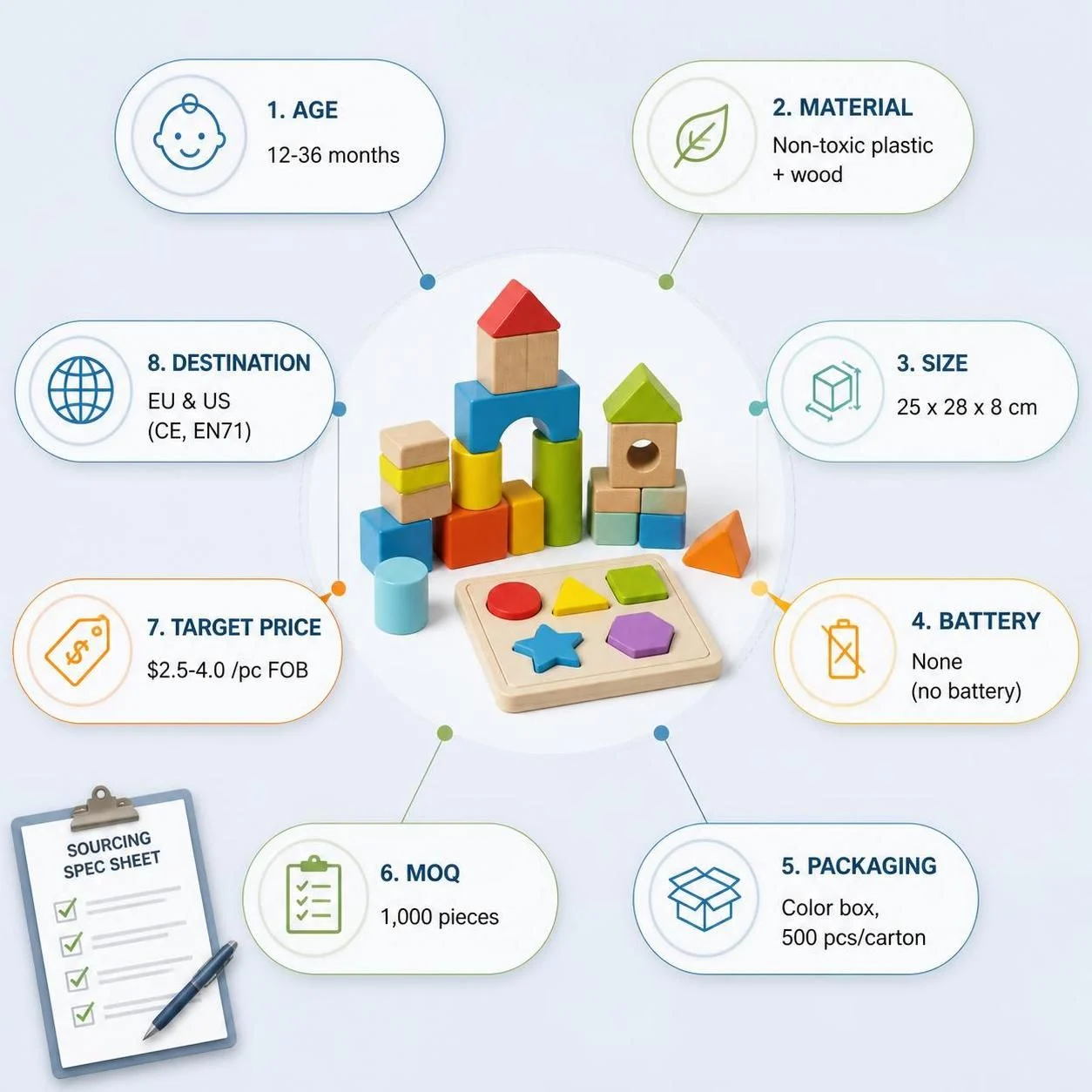
Start with a product brief. A supplier cannot quote accurately when the buyer only sends a product photo and the words “best price.” Your brief should define what the toy does, who will use it, how it will be packed, and where it will be sold.
Include these details:
- Product type, use case, and target age range.
- Dimensions, materials, colors, functions, and tolerances.
- Batteries, magnets, small parts, sound, water, or chemical components.
- Packaging dimensions, language, warnings, barcode, and logo requirements.
- Target quantity, target unit cost, and expected launch date.
- Destination country and sales channel.
- Required documents, test reports, or customer specifications.
Existing product or custom product?
An existing product is faster to sample and usually carries less development risk. You may still need new packaging, a logo, a color change, or a bundle configuration.
A custom product gives you more control, but it adds tooling, artwork, testing, approval, and production time. Ask for a development schedule before you commit. A supplier who can make an existing toy may not have the design, mold, or compliance process needed for a new one.
Pay special attention to products for children under three, battery toys, magnetic toys, water beads, projectile toys, ride-on products, slime, and toys with cosmetics or chemicals. These categories can create additional testing, labeling, and documentation requirements.
Use the MOQ reference when turning your idea into a purchase plan.
How do you find and verify toy suppliers in Yiwu?
Do not approve a supplier from a booth photo or a low quote alone. A proper supplier check covers the legal entity, product capability, sample quality, relevant test evidence, payment details, and ability to meet your written specification.
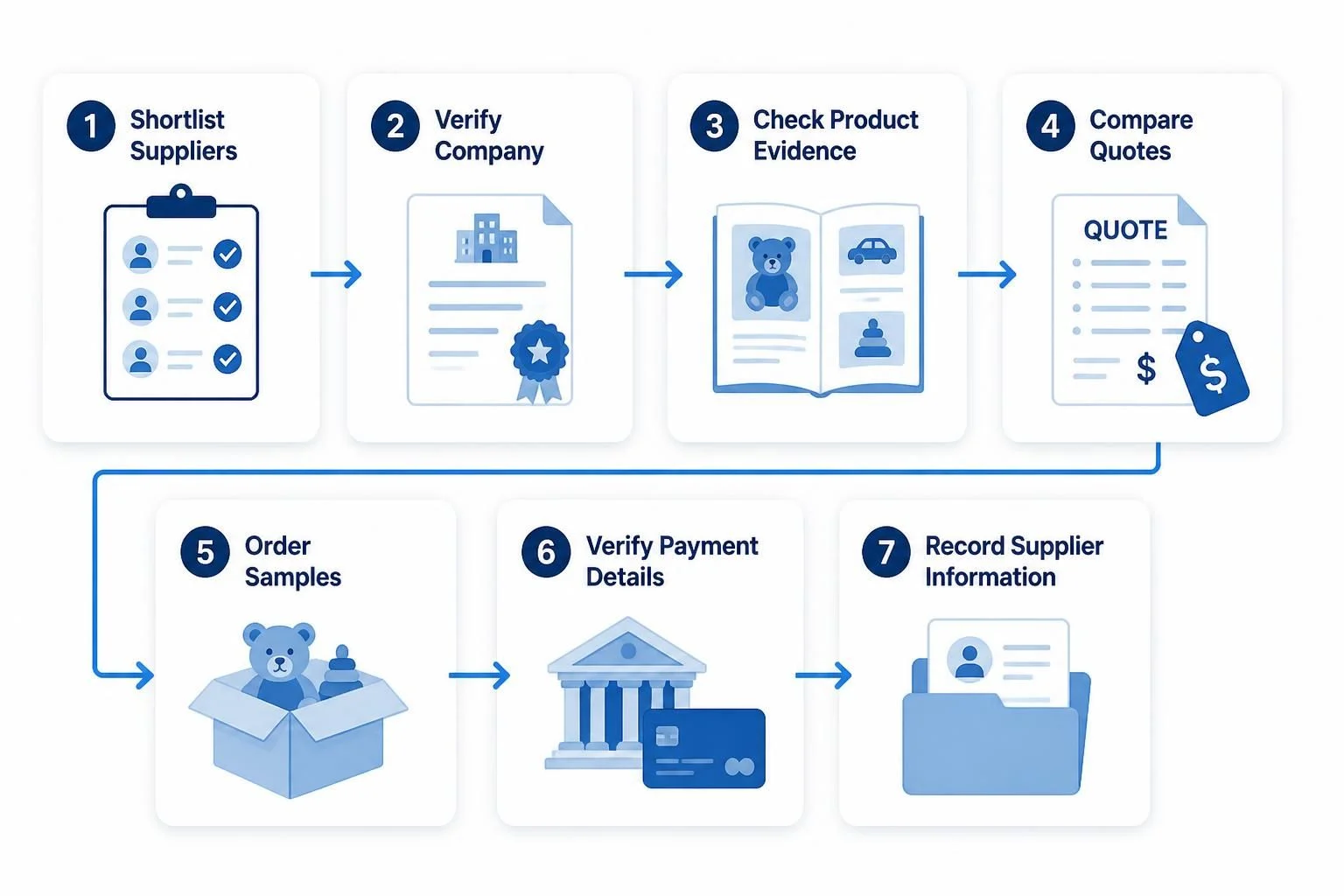
Use this process:
- Shortlist 8–12 suppliers. Include several suppliers for the same product so you can compare quality, MOQ, lead time, and packaging.
- Request basic company information. Ask for the legal company name, business license, address, main product categories, export markets, and the name of the contracting party.
- Request product evidence. Ask for a current catalog, product specification, material information, packaging options, and test reports that match the exact product.
- Compare like for like. Check whether quotes include packaging, logo printing, batteries, accessories, testing, and domestic transport.
- Order samples. A sample shows far more than a catalog photo. Check function, finish, smell, seams, paint, small parts, and packaging.
- Confirm the payment name. The bank-account holder, contract party, and supplier you verified should make sense together. Do not pay a personal account without a documented reason and proper review.
- Record the decision. Keep the quotation, sample photos, approved specification, messages, and test documents in one supplier file.
Factory, trading company, or market supplier?
There is no automatic winner. A market supplier may offer a broad catalog and smaller quantities. A trading company may coordinate several factories and handle export communication. A factory may offer better control for a repeat product or custom production run.
Ask a direct question: “Who will manufacture this exact item?” If the answer changes between the quotation, sample, and purchase order, stop and clarify the supply chain.
Common warning signs include copied or mismatched certificates, a company name that changes between documents, refusal to provide a sample, pressure to pay quickly, unexplained price changes, no written material information, and a promise that one certificate covers every product.
What we check before an order moves forward
Union Service’s sourcing and QC teams keep the supplier quotation, approved sample, product specification, packaging artwork, test evidence, and inspection records together for each order. That record makes it easier to spot a mismatch before payment or shipment: a different legal entity, an unapproved packaging change, or a report that does not identify the final product. Buyers should ask to receive the records that matter to their own order and keep them with the purchase order.
Our guide to finding reliable suppliers in Yiwu covers the wider supplier-selection process. You can also read how to verify legitimate suppliers at Futian Market.
What toy safety and import compliance do you need?
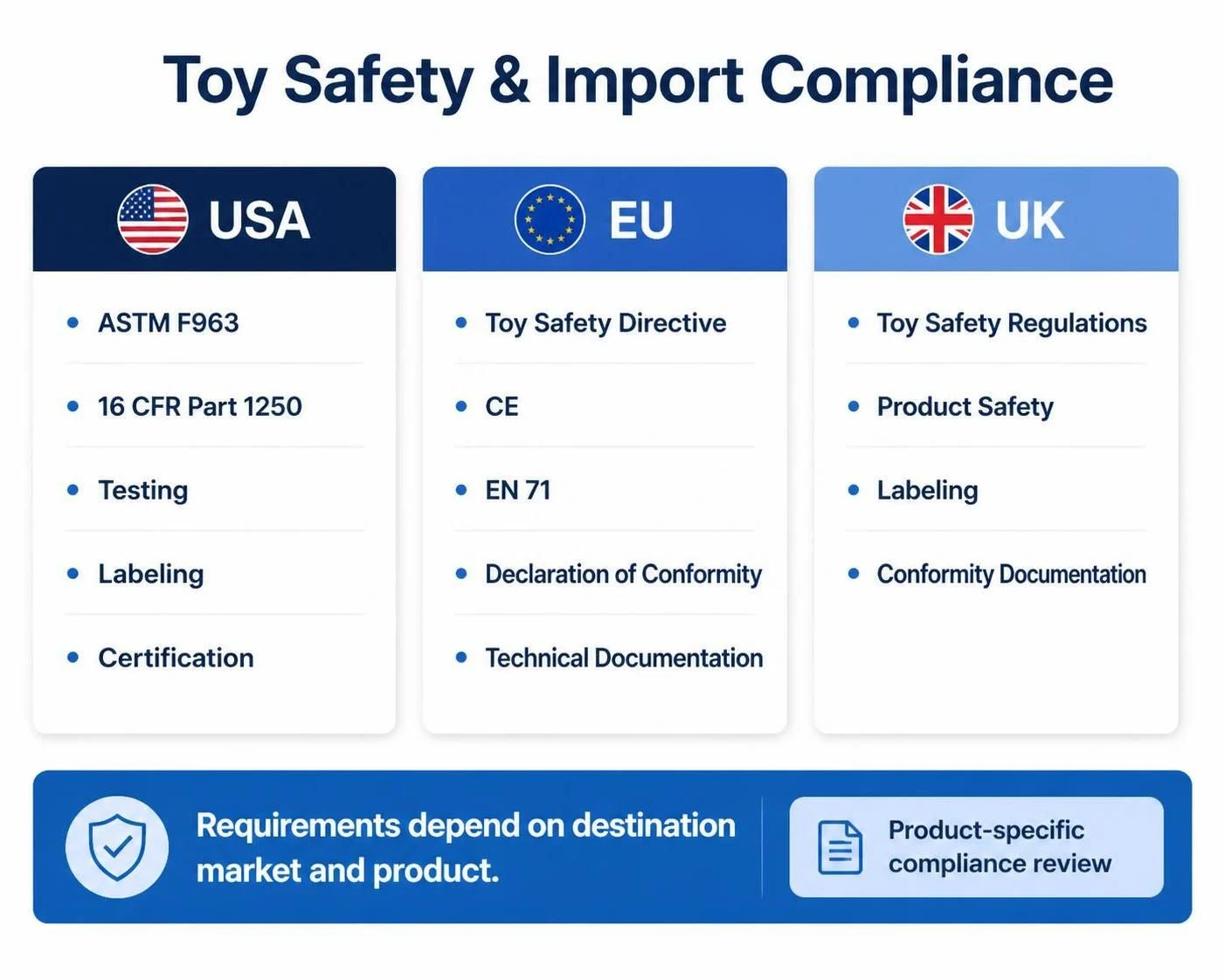
Toy requirements depend on the destination market, product type, age grade, materials, electronics, magnets, batteries, and claims printed on the packaging. A supplier’s generic certificate does not automatically prove that your exact product, brand, batch, or destination complies.
Treat compliance as a product requirement from the first quotation. Do not wait until the goods are packed.
United States
For the United States, start with the current federal toy-safety requirements in 16 CFR Part 1250. The regulation incorporates ASTM F963 for toys subject to the rule. Check the requirements that apply to the exact product, including testing, labeling, tracking-label, and certification responsibilities where applicable.
The importer remains responsible for understanding the obligations that apply to the product. Ask the supplier and testing laboratory what product was tested, which standard was used, the report date, the sample description, and whether the report covers your final materials and design.
European Union
Review the EU Toy Safety Directive 2009/48/EC together with the European Commission’s current toy-safety guidance. Depending on the toy, you may need technical documentation, a declaration of conformity, CE marking, warnings, instructions, and testing against applicable harmonized standards such as EN 71.
Chemical restrictions may also matter. Review the current requirements that apply to your product rather than copying a checklist from another toy or another year. EU rules and transition arrangements can change, so have the final documentation reviewed before production.
United Kingdom
Review the current Toy Safety Regulations 2011 and relevant UK product-safety guidance for businesses. Confirm the rules for your route to market, including labeling, importer details, conformity documentation, testing, and the current treatment of CE and UKCA markings before you print packaging.
Other destinations
Canada, Australia, the Gulf states, and other markets have their own rules. Ask a qualified compliance specialist or the relevant regulator for current requirements. CE marking is not a universal approval for every country, and a supplier’s CE document does not automatically prove that the exact product meets every destination-market requirement.
Know the documents
These terms are different:
| Document | What it generally shows |
|---|---|
| Test report | A laboratory tested a described sample against listed requirements |
| Certificate | A document issued under a specific certification or testing process |
| Declaration of conformity | The responsible party declares that the product meets named requirements |
| Technical file | The supporting design, risk, test, and manufacturing records required by the market |
| Supplier statement | A claim from the supplier that may need independent evidence |
For higher-risk products, use a laboratory and compliance adviser that understands your destination market. Keep the final product, packaging, instructions, warnings, and test sample aligned. Changing the plastic, paint, battery, magnet, or packaging after testing can change the compliance position.
What are typical MOQ, sample, and toy sourcing costs?
Yiwu toy MOQs vary by item, available stock, packaging, materials, customization, tooling, and the supplier’s production arrangement. The same item can have one MOQ in standard packaging and another with a new mold, printed box, or private label.
Build your budget from the full cost:
- Sample and courier charges.
- Product price.
- Mold, tooling, artwork, or development fees.
- Packaging, labeling, and inserts.
- Testing and certification.
- Local transport and consolidation.
- Sourcing or agent fees, if applicable.
- Freight, insurance, customs clearance, duty, VAT/GST, and delivery.
- An allowance for rework, damage, returns, or unsellable units.
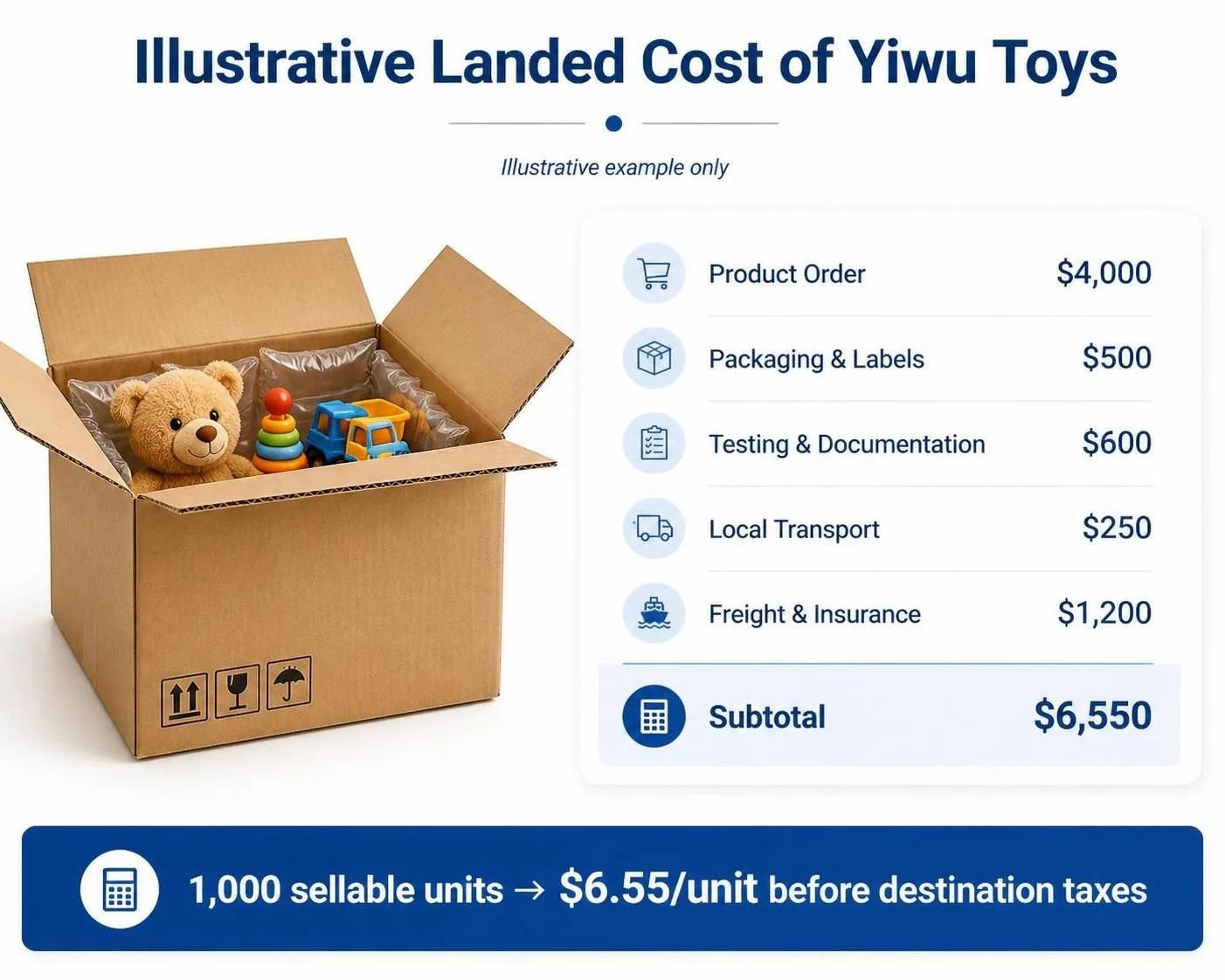
An illustrative landed-cost example
This fictional example shows the calculation. It is not a quote:
| Cost item | Example amount |
|---|---|
| Product order | $4,000 |
| Packaging and labels | $500 |
| Testing and documentation | $600 |
| Local transport and consolidation | $250 |
| Freight and insurance | $1,200 |
| Subtotal before destination taxes | $6,550 |
The total per unit then depends on the number of sellable units, destination taxes, customs charges, and any damaged or rejected pieces. If the order contains 1,000 sellable units, the subtotal would be $6.55 per unit before destination taxes. That is why a $3.80 product price is not the same as a $3.80 landed cost.
Use the sourcing cost calculator, freight estimator, and CBM calculator to build a more realistic estimate.
How do you sample, specify, and inspect toys before shipment?
Approve a golden sample and a written specification before production. Quality control needs a measurable reference. “Good quality” is not a specification.
Use this sequence:
- Review the first sample. Check dimensions, materials, function, color, smell, finish, seams, accessories, and packaging.
- Revise the sample. Record every change in writing. Do not approve a change through a message that no one adds to the purchase order.
- Create a specification sheet. Include drawings or photos, tolerances, materials, colors, functions, battery details, packaging, warnings, barcode, and approved sample reference.
- Approve pre-production. Confirm the final materials, artwork, packaging, and required documents.
- Inspect during production when risk justifies it. This matters for custom molds, complex assembly, electronics, or a large order.
- Run a pre-shipment inspection. Use an agreed sampling plan and record defects by severity.
- Supervise loading. Check carton counts, marks, packing lists, and container loading evidence.
For toys, check small parts, seams, pull strength, sharp edges, paint or coating, odor, battery compartments, magnets, sound, function, packaging strength, barcodes, warnings, and age grading. The exact checks depend on the product and destination.
Ask for an inspection report before any shipment leaves the warehouse. It should link the inspected goods to the purchase order and approved sample. Photos should clearly show the product, packaging, cartons, labels, and any defects.
See the quality inspection and warehousing service for more on inspection checkpoints and warehouse handling.
How do you ship toys from Yiwu to your country?
Choose the shipping method after you know the product, volume, destination, delivery date, and paperwork. Air freight is usually best for urgent or smaller shipments. Sea freight often makes more sense for larger, heavier shipments. Couriers suit samples. Rail can suit specific lanes and volumes, but check route availability and service for the destination.
| Shipping method | Usually fits | Main cost or risk to check |
|---|---|---|
| Courier | Samples and small urgent parcels | Dimensional weight and customs treatment |
| Air freight | Urgent commercial shipments | Higher cost per kg and battery restrictions |
| Sea freight | Larger cartons or consolidated orders | Transit time, port charges, and destination clearance |
| Rail | Suitable China–Europe lanes and planned cargo | Route availability, timing, and final delivery |
Understand the Incoterm
EXW, FOB, CIF, DAP, and DDP allocate cost and responsibility differently. Use the International Chamber of Commerce’s current Incoterms rules overview alongside the exact sales contract; an Incoterm does not replace a clear agreement on product compliance, documents, insurance, or destination customs. Before you accept a quotation, ask:
- Who arranges export clearance?
- Who pays for local transport and freight?
- Who is responsible for destination customs?
- Who pays duty and VAT/GST?
- Who handles the shipment if customs asks for documents?
- Does the price include final delivery, or only transport to a port?
For mixed toy orders, consolidation can reduce duplicated shipping arrangements, but carton dimensions and product documents still matter. Prepare a commercial invoice, packing list, carton marks, product descriptions, and an HS-code review. Do not guess the HS code because a wrong classification can affect duty and customs clearance.
The Yiwu–London railway guide may also help buyers comparing transport routes.
Can you buy toys from Yiwu without visiting China?
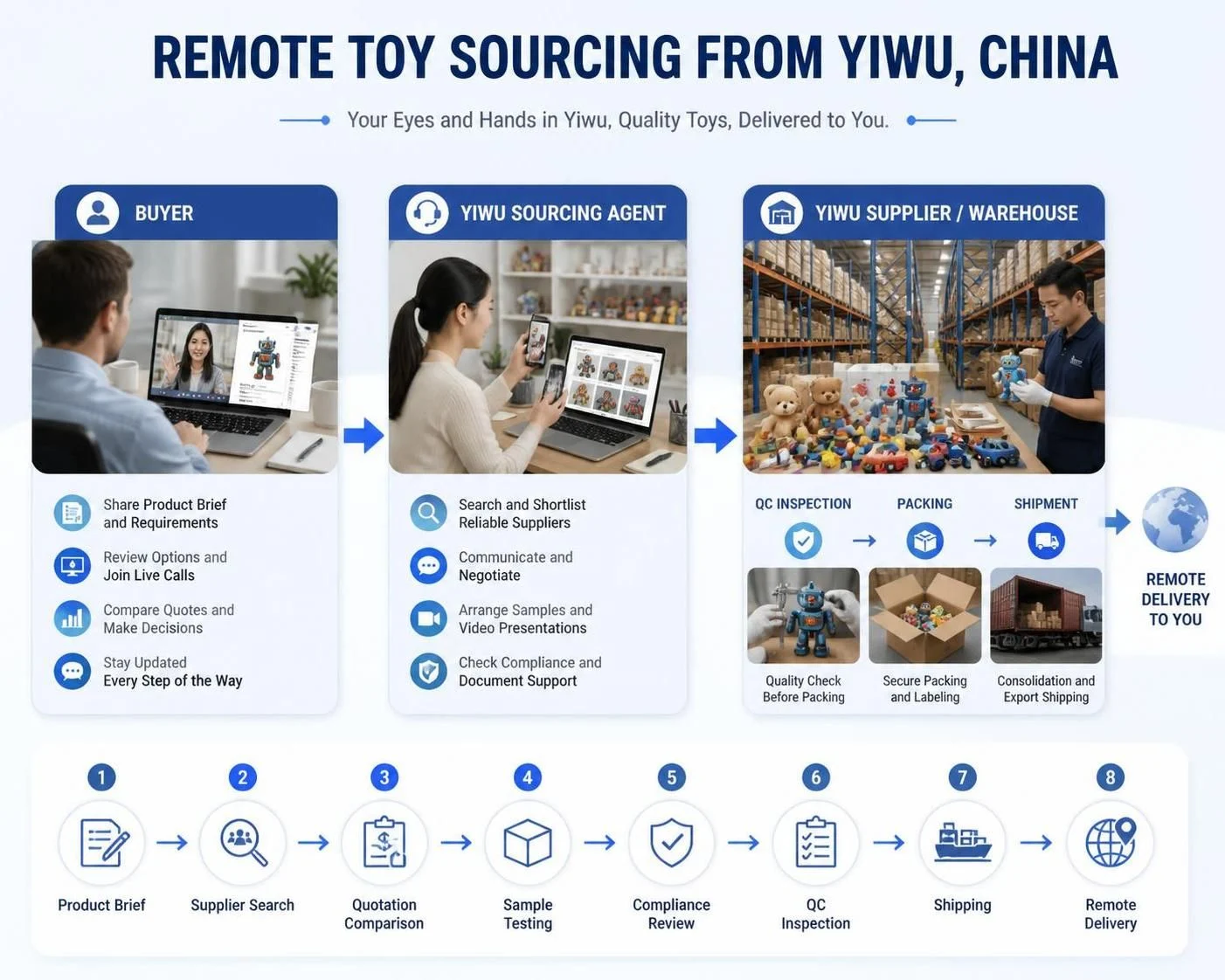
Yes. Remote buying works when every important decision creates evidence: a product brief, supplier comparison, samples, written specifications, test documents, inspection photos, and shipping paperwork.
Use this remote workflow:
- Send a product brief with destination, target quantity, packaging, age grade, and target cost.
- Ask a local contact or sourcing agent to identify and compare several suppliers.
- Review video, photos, catalog information, and written quotations.
- Receive and test samples before approving production.
- Confirm compliance documents and final packaging artwork.
- Review QC results before shipment and approve the loading records.
Union Service’s Yiwu sourcing agent service and company information describe the support available for supplier search, samples, QC, warehousing, and freight coordination. Confirm the current scope, fees, and service terms before starting an order. The buyer remains responsible for confirming the requirements of the destination market.
For a product-specific estimate, review our sourcing services.
What mistakes should first-time toy buyers avoid?
The most expensive mistakes usually happen before production starts. Use this checklist before approving a deposit:
- Buying from a photo without approving a sample. Photos do not show smell, finish, strength, function, or packaging quality.
- Treating a generic certificate as product approval. Check the exact product, materials, sample, standard, date, and destination.
- Leaving age grading until the end. Age range changes warnings, testing, design, and packaging.
- Choosing the lowest unit price. Compare landed cost, not only the supplier’s first number.
- Changing materials after testing. A different plastic, paint, battery, or magnet can change the compliance position.
- Paying an unverified account. Match the legal entity, contract party, and payment details.
- Skipping pre-shipment inspection. A problem discovered after arrival costs more to correct.
- Underestimating carton volume. Dimensional weight and CBM can change freight costs significantly.
- Ignoring seasonal lead time. Toys often need packaging, testing, production, and shipping time before a selling season.
- Ordering too many products at once. Test a focused range before committing cash to slow-moving inventory.
For a first order, clarity matters more than size. You should understand the product, supplier, documents, cost, and customer demand well enough to decide whether to reorder.
Frequently asked questions
Is Yiwu good for toy wholesalers and retailers?
Yiwu suits buyers who want broad choice, existing designs, low-to-medium MOQs, and mixed-category purchasing. It may be less suitable for complex engineering or very large custom production. Compare Yiwu suppliers with factory-direct options after you define the product and target quantity.
Which Yiwu market district sells toys?
Use the current District 4 information as a starting point for toy enquiries. Confirm the building, floor, and booth information before travelling rather than relying only on an old PDF.
What is the minimum order quantity for toys in Yiwu?
MOQ depends on the product, existing stock, packaging, logo printing, materials, tooling, and customization. Ask each supplier for separate quantities for a standard product, a product with new packaging, and a fully customized version. Compare the total cost at each quantity.
Do toys from China need CE or ASTM certification?
Requirements depend on the destination and the product. The EU may require CE marking and documentation under applicable toy-safety rules. In the United States, applicable toys are subject to federal toy-safety requirements that incorporate ASTM F963. A supplier’s generic document does not replace a product-specific compliance review.
Can I source toys from Yiwu without travelling to China?
Yes. Remote buyers need a detailed brief, supplier screening, samples, written specifications, compliance documents, inspection evidence, and a clear shipping plan. A local sourcing agent can coordinate these steps, but the importer must still confirm destination-market responsibilities.
How long does it take to buy and ship toys from Yiwu?
Timing depends on product availability, sample revisions, testing, packaging, production, inspection, shipping method, customs, and destination delivery. Ask for a dated schedule with separate milestones. Do not use a single generic transit-time number as the full order timeline.
How do you calculate the landed cost of Yiwu toys?
Add the product, packaging, tooling, testing, local transport, consolidation, agent fee, freight, insurance, customs clearance, duty, VAT/GST, delivery, and an allowance for defects or returns. Divide the total by sellable units, not the original order quantity.
What does a Yiwu toy sourcing agent do?
A sourcing agent can help identify suppliers, compare quotations, coordinate samples, translate requirements, arrange QC, consolidate goods, and organize freight. Ask what the fee includes, who contracts with the supplier, how quality disputes are handled, and which documents you receive before shipment.
Final checklist: Are you ready to order?
Before you place a toy order from Yiwu, confirm that you have:
- A product brief with age range, materials, function, and destination.
- Several comparable supplier quotations.
- A verified legal entity and payment account.
- An approved sample and written specification.
- A compliance plan for the exact product and market.
- Final packaging, warnings, barcode, and language approval.
- A sampling and QC plan.
- A landed-cost calculation.
- A shipping method, Incoterm, and customs document list.
- A written schedule with approval milestones.
Yiwu gives toy buyers many options. The result depends on how well you define, approve, and inspect the order before it ships. Start with the product brief, make every approval measurable, and check the goods before they leave China.
To compare suppliers or build a toy sourcing plan, request a free quote or speak with a local sourcing agent.
Compliance and source notes
This guide gives general sourcing information. It is not legal, customs, product-safety, or tax advice. Confirm requirements for the exact product, destination, sales channel, and final packaging with the relevant regulator, testing laboratory, customs adviser, or qualified compliance professional before placing an order.
- eCFR: 16 CFR Part 1250, Safety Standard Mandating ASTM F963 for Toys
- EUR-Lex: Directive 2009/48/EC on the safety of toys
- European Commission: Toy safety
- UK legislation: The Toy Safety Regulations 2011
- GOV.UK: Product safety advice for businesses
- International Chamber of Commerce: Incoterms rules
- Confirm Yiwu market locations and category allocations in the current market directory before travel.
- The landed-cost example is fictional and illustrative; it is not a quotation or market average.
- Official regulatory sources last checked August 20, 2026. Regulations and market locations can change.