




To consolidate orders from multiple Yiwu suppliers, send each seller the same warehouse delivery instructions, but give every order a distinct reference. The warehouse should log each arrival, record shortages or damage, keep goods traceable to the original purchase order, and measure the final export cartons. Release the shipment only when the buyer, warehouse and forwarder agree on the cargo list and documents.
Imagine buying kitchen tools from one booth, stationery from another and seasonal decorations from a factory outside the market. Each supplier finishes on a different day. The challenge is not simply putting their boxes together. You need to know which cartons arrived, what is inside them, what changed during inspection or repacking, and which documents describe the goods that actually leave China.
Key takeaways
- Give every supplier one warehouse address and a unique purchase-order reference.
- Record carton count and visible condition at receiving; agree separately on product inspection.
- Hold unexplained shortages or damaged cartons until the buyer approves a resolution.
- Prepare the export packing list from final measured cartons, then reconcile it with the invoice and booking.
What does Yiwu order consolidation actually involve?
Yiwu order consolidation means receiving purchases from several sellers at one warehouse and preparing them for a coordinated shipment. A useful process has five stages: plan expected cargo, receive and identify it, resolve exceptions, prepare final export cartons, and release the cargo with matching documents. Each stage needs a record and a named decision-maker.
- Plan: list each supplier, purchase order, product and expected delivery.
- Receive: match each domestic delivery to that list and record its condition.
- Check: carry out the level of counting or inspection the buyer ordered.
- Prepare: repack or combine cartons when approved, keeping their contents traceable.
- Release: reconcile final cartons, documents and freight instructions.
Consolidating supplier orders is different from less-than-container-load shipping, usually called LCL. Consolidation is the work of bringing your suppliers’ goods under one cargo plan. LCL is a way to ship cargo in a container shared with other shippers. Your consolidated order might move as LCL, a full container, air cargo or another suitable service.
Agree on the warehouse scope before goods arrive. Receiving cartons does not automatically include opening every box, counting every unit, product quality control, repacking or customs clearance. Ask for those services explicitly and identify who pays for storage, materials and corrections.
What should you record before consolidating Yiwu supplier orders?
Start one master order register before the first supplier dispatches. Give it one row per purchase order and, where needed, one row per SKU. The register lets the warehouse recognize arriving cartons and tells the buyer which supplier is late. Without it, a delivery note may identify a seller but fail to identify the buyer’s order.
Record the supplier’s name and contact, purchase-order number, SKU, ordered quantity, expected carton count, ready date, domestic carrier and tracking number. Add the agreed delivery place and trade term, destination country, any special handling, and the person responsible for the invoice. Keep expected and received values in separate columns; don’t overwrite the original order when a shortage appears.
Illustrative register: The quantities below show how the fields fit together. They are an example, not a Union Service customer shipment.
| Supplier / PO | SKU and ordered units | Expected cartons | Ready date | Receiving status |
|---|---|---|---|---|
| A / YW-101 | KT-01 kitchen tools × 240 | 8 | Nov 23 | Awaiting dispatch |
| B / YW-102 | ST-02 notebooks × 360 | 6 | Nov 25 | Awaiting dispatch |
| C / YW-103 | DC-03 decorations × 180 | 9 | Nov 27 | Awaiting dispatch |
Choose a receiving deadline and a decision date for late cargo. For example, decide in advance whether you will wait, ship the ready goods, or replace a missing item. The best choice depends on the order’s value, freight booking and your customer’s deadline. If you are still selecting sellers, use our guide to finding reliable Yiwu suppliers before creating this register.
Copyable supplier instruction: “Deliver to [warehouse address] by [date and local time]. Mark every outer carton with [buyer code], [PO number], [supplier name] and [carton X of Y]. Email the delivery note, SKU quantities, carton count and tracking number to [contact] before dispatch. Tell us about any shortage or carton-count change before shipping.” Replace the brackets with your actual details, and send the same format to every seller.
How should each supplier mark and deliver cartons?
Send every supplier one written delivery instruction, then assign a distinct purchase-order code. Include the warehouse address, contact, receiving hours, delivery deadline and notice procedure. Ask the seller to put the agreed code on each outer carton and include a delivery note showing the PO, SKU, quantity and number of cartons.
A simple carton mark might read Buyer YW / PO YW-102 / Carton 2 of 6 / SKU ST-02. This is only an example for warehouse identification, not a claim about a country’s mandatory shipping marks. Confirm destination and carrier requirements separately. If a carton contains several SKUs, the delivery note should say so clearly.
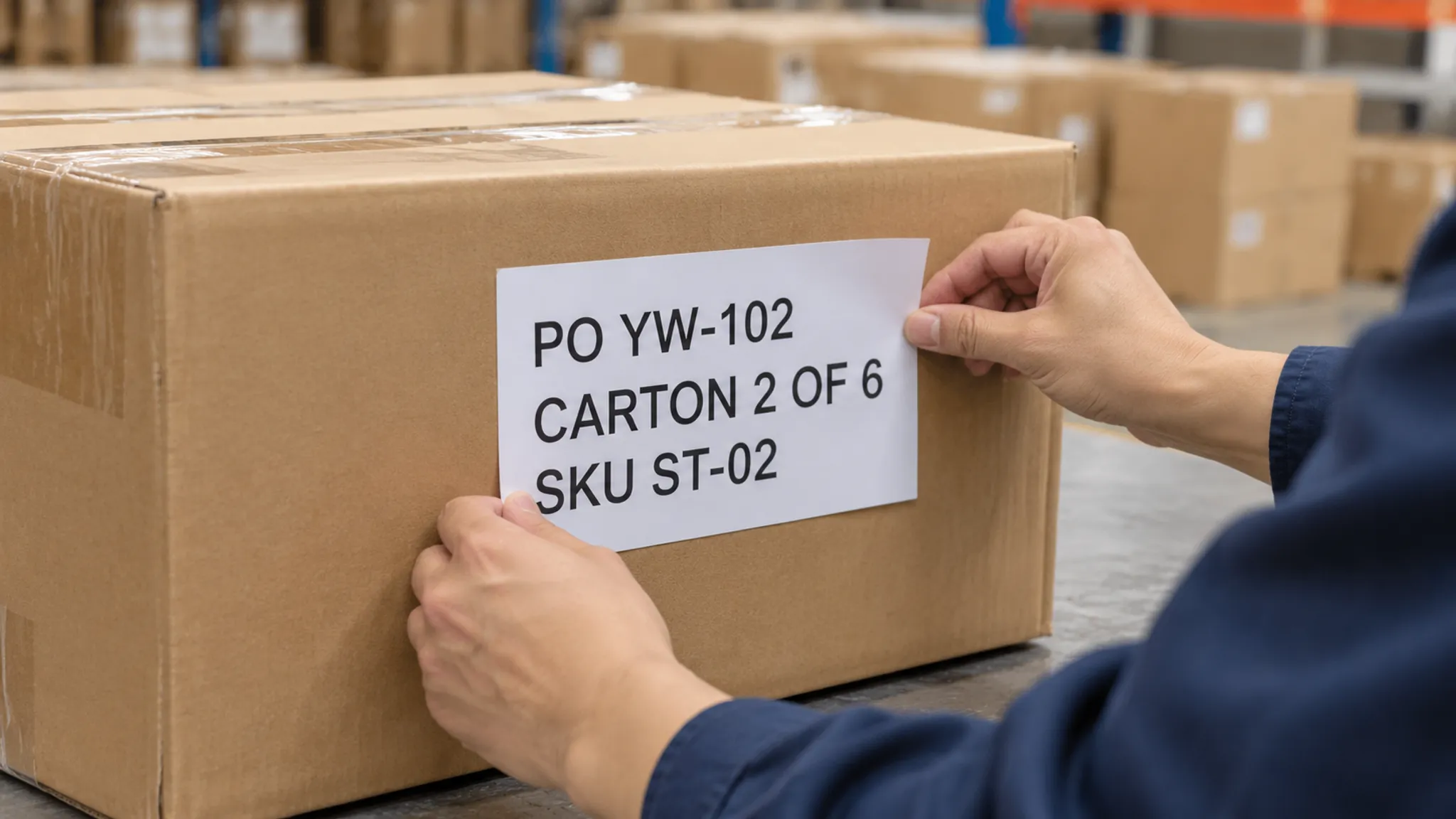
Ask suppliers to tell the warehouse before dispatch and share the domestic tracking number. They should also report any change in carton count or ready date. A carton count estimated during production is not the final export count: the warehouse may later reinforce, split or combine packages. Clear carton identification protects the link between an incoming package and the final shipment.
If you are new to the market, the broader guide to buying from Yiwu Market explains the earlier purchasing stages. This article begins once purchase orders have been placed and deliveries are being coordinated.
What should the warehouse check when goods arrive?
At receiving, the warehouse should first identify the delivery, count its outer packages and record visible condition. Log the arrival time, carrier, supplier, PO, carton marks and received carton count. Photograph damaged sides, open seals and unclear marks before the goods are moved or repacked. These checks create a receiving record; they are not a full product inspection.

If the buyer requested piece counting or product quality control, set a separate scope. State which cartons may be opened, which SKUs are checked, the inspection method, the approved sample or specification, and the report format. Our quality inspection and warehousing service page explains the service area; agree on the exact checks for your order in writing.
Unknown cartons, visible damage or shortages should receive an exception status. Don’t silently change the ordered quantity to match what arrived. Keep the original PO, the warehouse observation, the supplier’s response and the buyer’s decision in one log. That record helps prevent a short shipment from appearing “complete” merely because all cartons in the warehouse have been packed.
For the illustrative YW-103 order, the register expects nine cartons and the delivery note lists nine, but the warehouse counts eight. Record expected: 9; received: 8; difference: 1. Keep that PO on hold while the supplier checks the missing carton. If the buyer later approves shipping the eight received cartons, mark the ninth as an approved balance for a later shipment; do not change the original expected count to eight. This preserves the reason that the final cargo differs from the order.
| PO / carton | Observed issue | Evidence | Owner | Decision and status |
|---|---|---|---|---|
| YW-102 / 2 of 6 | Outer corner crushed | Arrival photo | Warehouse checks contents | Hold; buyer review pending |
| YW-103 / expected 9 | Only 8 cartons received | Delivery note and count | Supplier confirms balance | Open; do not release |
When should you inspect, repack or hold the goods?
Decide what to do from the evidence, not from the assumption that all supplier cartons are export-ready. An intact, identified carton may need only the agreed receiving check. A damaged carton, mixed SKU or quantity mismatch may need opening, product inspection, repacking or a hold. Record the buyer’s approval before a change affects the final cargo list.
| Finding | Typical action | Record to keep |
|---|---|---|
| Carton and documents match | Release after agreed checks | Receiving record and photo |
| Outer damage | Hold, open or reinforce with approval | Before-and-after photos |
| Wrong or mixed SKU | Identify contents and correct records | Count sheet and revised carton ID |
| Short delivery | Ask supplier for the balance or buyer decision | Exception log and approval |
| Special handling product | Check product, route and destination rules | Broker/carrier instructions |
When repacking changes the outer carton, assign a new export carton ID and keep a cross-reference to the inbound cartons and supplier POs. One final carton may contain items from more than one supplier; the contents still need to remain identifiable. Food, batteries, liquids and other restricted goods may require separate handling or documentation. Ask the carrier and destination specialist before combining them.
How do you prepare the final packing list and freight quote?
Build the export packing list from the cartons that will actually ship, after all approved repacking. Measure each final carton and record its ID, contents, quantity, dimensions, net and gross weight, and marks. Then compare totals with the purchase-order register, commercial invoice and freight booking. Estimated supplier carton dimensions should not replace measured export-carton data.
The U.S. International Trade Administration describes an export packing list as a detailed record of packages, weights, marks and dimensions. It also states that the packing list does not replace the commercial invoice. The European Commission’s Access2Markets guidance notes that a packing list accompanies invoice and transport documents and may be used for customs clearance. The exact paperwork depends on the importing country and products.
Here’s a useful cross-reference for the illustrative order: supplier PO YW-102 delivered inbound cartons 2–6; after approved repacking, some contents moved into export carton EX-014. The final packing list lists EX-014 with its actual contents and measurements. The warehouse log preserves the link back to YW-102. Those codes are examples, not real customer data.
Before booking freight, run a three-way check on each SKU: approved shipping quantity = counted export-carton quantity = quantity shown on the commercial documents. Keep a separate column for any ordered but unshipped balance. For instance, if YW-103 is approved as a partial shipment, its shipment documents should reflect only the units actually packed, while the order register retains the outstanding balance. The warehouse count supports the document check; it does not decide invoice ownership or customs treatment.
Use the CBM calculator to estimate volume from final dimensions. Freight may also depend on chargeable weight, route, handling and destination charges. When you compare estimated freight costs, ask forwarders to price the same cargo and the same service scope: pickup, storage, repacking materials, export handling, main transport, destination charges and final delivery. Consolidation can simplify coordination, but it does not guarantee a lower total cost.
Who approves release and handles export responsibilities?
The buyer should approve the release gate after unresolved exceptions, final carton data and document ownership are clear. The warehouse can prepare cargo, while the seller, exporter, forwarder, customs broker and importer may hold different responsibilities. A shared warehouse address does not settle who arranges export formalities or carries the risk during transport.
Check the trade term and named place in each supplier contract. The U.S. International Trade Administration’s Incoterms guide lists seven rules usable for any transport mode and four mode-specific rules. The chosen rule and named place affect where delivery occurs and which party handles export formalities. Have the forwarder and broker confirm the actual arrangement for your shipment.
Before pickup, confirm these seven items:
- Every supplier PO has a received, short, cancelled or approved partial-shipment status.
- Every exception has an owner and buyer decision.
- Final export carton IDs trace to inbound cartons and SKUs.
- Final dimensions and weights reflect the packed cargo.
- The packing list and invoice describe the same goods and quantities.
- The forwarder has the final document versions and cargo-handling instructions.
- The buyer has approved the release and knows who handles export and import formalities.
Which mistakes cause the most avoidable confusion?
Most preventable problems begin when a handoff has no common reference or a record is treated as final too early. One supplier may send anonymous boxes; another may revise its carton count after booking. A warehouse might count packages while the buyer expects piece-level QC. The fix is a written scope and a versioned cargo record.
| Mistake | Safer control |
|---|---|
| Cartons arrive without a PO mark | Use a unique supplier/PO reference on each carton and delivery note. |
| Supplier estimates become the final packing list | Measure and record export cartons after repacking. |
| Receiving is mistaken for full product QC | Specify counting and inspection scope in the work order. |
| One late supplier holds every order indefinitely | Set a cutoff and obtain the buyer’s partial-shipment decision. |
| Documents retain old carton counts | Version the packing list and send the final copy to all parties. |
If you sell through Amazon, read the separate Amazon FBA shipping guide after consolidation. That channel has additional shipment and labeling steps. For other sales channels, use the receiving and release controls here, then check your destination’s requirements with the forwarder.
Frequently asked questions
Can goods from different Yiwu suppliers go in one export shipment?
Often, yes. The warehouse must identify the goods, confirm the buyer’s chosen inspection and packing scope, and build accurate final shipment documents. Product compatibility, carrier restrictions and destination rules still matter. Ask the forwarder and broker before combining goods with different handling or regulatory requirements.
Is order consolidation the same as LCL shipping?
No. Order consolidation combines goods from your suppliers under one cargo plan. LCL is a transport arrangement that places your cargo in a container shared with other shippers. A consolidated order can travel as LCL, full-container freight or another suitable mode.
Does the warehouse inspect every product when cartons arrive?
Only if you have agreed to that scope. Basic receiving usually records package identity, count and visible condition. Piece counting, sample inspection and product testing require their own instructions and reporting method. Confirm what will be opened and checked before the first delivery arrives.
What if one supplier is late or delivers fewer units?
Record the difference against the original PO and ask the supplier for a revised delivery date or correction. The buyer then decides whether to wait, ship the available goods or remove the item from this shipment. Update the cargo and document versions only after that decision is recorded.
Who prepares the commercial invoice and final packing list?
The parties must assign those jobs in the purchasing and freight arrangements. The warehouse can provide measured carton data, while the invoice must reflect the commercial transaction and the relevant exporter or seller. A packing list cannot substitute for an invoice. Ask the customs broker to confirm destination-specific requirements.
Bring the orders together before booking freight
One controlled shipment begins with clear supplier instructions and ends with final cartons that match the records. Keep every export carton traceable to its purchase order, settle exceptions before release, and give the forwarder the document version that describes the cargo on hand. If you need help arranging receiving, inspection and shipment preparation, send the supplier count, SKU list, carton estimate, ready dates and destination to our Yiwu sourcing agent team for a scoped quote.