


Food sourcing from China can work well for tea, snacks, sauces, dry staples, ingredients, and other packaged products. But a factory quote answers only one question: price. Before you pay a deposit, you also need to know whether the exact product can enter your market, carry the right label, survive the route, and clear under the importer’s name.
This guide gives importers a practical order of work. It covers supplier checks, documentation, labels, samples, testing, inspection, landed cost, and freight. It is written for wholesalers, retailers, private-label teams, food distributors, and e-commerce sellers buying from China for the first time or expanding a range.
Key Takeaways**
- Use 8 pre-deposit checks: product, market, factory, documents, label, sample, QC, and freight.
- U.S. food-import requirements can include FDA facility registration, prior notice, and foreign-supplier verification responsibilities. Confirm the current rule for the product and importer before ordering.
- A visual inspection cannot prove microbiological safety, allergen control, or legal import eligibility.
Important: This is a sourcing overview, not legal, customs, labeling, or food-safety advice. Confirm requirements for the exact product with the destination-country regulator, importer of record, customs broker, and qualified adviser before ordering.
Can you import food from China in 2026?
Yes, many importers can buy food from China, but the answer changes with the product and destination. U.S. food-import requirements can include FDA facility registration, prior notice, and foreign-supplier verification responsibilities. Confirm the current requirements for the product and importer before ordering. Start with the product-market route, not a supplier search.
That first decision sorts your order into four practical paths:
| Product path | Typical examples | Main question before sourcing |
|---|---|---|
| Shelf-stable packaged food | Tea, dry snacks, sauces, noodles, confectionery | Can the formula and label meet market rules? |
| Ingredients | Spices, extracts, beverage inputs, baking ingredients | Can you document composition, allergens, and permitted use? |
| Temperature-controlled food | Chilled or frozen goods | Can the route hold the required temperature through clearance and delivery? |
| High-control food | Meat, dairy, seafood, infant food, alcohol, products with health claims | Does the product need product-specific market-access, permits, or specialist review? |
The importer of record usually carries responsibility for compliance at destination. A sourcing company can collect documents, compare suppliers, arrange samples, and coordinate inspection. It cannot replace your legal responsibility or a regulator’s decision. That distinction matters. A product may be easy to buy in China and still be unsuitable for your sales market.
Use eight gates before a food order moves from idea to deposit: product, market, factory, documents, label, sample, QC, and freight. The sequence prevents a familiar waste of time: weeks spent refining a product that cannot be sold in the intended market.
If you need help collecting evidence from suppliers, see our Yiwu sourcing agent service and import agent services. Keep the destination-market decision with the people qualified to make it.
Which food products are practical to source from China?
The best first food order is a product whose formula, shelf life, packaging, storage conditions, and destination requirements you can document before production. European food-information rules require specific consumer information and allergen disclosure for prepacked food. That makes product selection a documentation exercise as much as a buying exercise. Check the current consolidated rule and the destination country’s language requirements before approving artwork.
Many buyers begin with shelf-stable products because they usually avoid the logistics pressure of a continuous cold chain. Possible product groups include tea, dry snacks, confectionery, sauces, condiments, noodles, canned goods, spices, bakery ingredients, and beverage ingredients. “Usually” is doing important work here. Ingredients, additives, sweeteners, colours, allergens, and claims can still create restrictions.
Use a short scorecard before you request quotations:
- Shelf life: Can the product reach the customer with a viable remaining life after production, transit, clearance, and warehousing?
- Temperature: Does it need chilled, frozen, or humidity-controlled handling?
- Composition: Can the factory provide a stable ingredient and allergen declaration?
- Label complexity: Which languages, nutrition fields, warnings, and importer details must appear?
- Control level: Does the category involve animal origin, plant health, alcohol, infant food, supplements, or health claims?
- Freight-to-value ratio: Will cartons, breakage protection, and temperature control erase the unit-price advantage?
Fresh produce, meat, dairy, seafood, infant food, alcohol, supplements, and foods making therapeutic claims are not good “learn as you go” categories. They may be viable. They simply need specialist review before a factory receives your purchase order.
How do you find and verify food suppliers in China?
Approve a food supplier only after the legal entity, manufacturing scope, product evidence, and production sample line up. The FDA’s Foreign Supplier Verification Programs guidance describes risk-based foreign-supplier verification for U.S. food importers. Confirm exemptions and modified requirements for the exact product before relying on the rule. Supplier verification is a documented process, not a quick check of a marketplace rating.
Start with a product brief. Include the product name, full ingredient requirements, allergen position, target market, shelf life, pack size, packaging material, label language, order estimate, target price, and launch date. Send the same brief to every supplier. Otherwise, you cannot compare quotes fairly.
Then shortlist eight to twelve candidates. Ask each one to identify the manufacturer, trading company, contracting party, and bank-account holder. Request its business licence, relevant production approvals, product specification, ingredient statement, allergen statement, available test reports, traceability examples, and export experience in your destination market. A document is useful only if its company name, product scope, date, and issuing body match the proposed order.
Red flags that deserve a pause
- The invoice company, factory name, and receiving bank account do not match.
- A “certificate” has no product model, validity date, laboratory, or scope.
- The supplier cannot state ingredients, allergens, lot coding, or storage conditions in writing.
- The sample differs from the production specification.
- The seller suggests a formula or packaging change after label approval.
- The supplier pressures you to pay a personal account.
An unusually low quotation needs evidence before it looks like a saving. Compare the ingredient statement, pack size, carton specification, lot-code format, shelf-life statement, and contracting entity with the sample and quotation. If any detail changes, pause and ask the supplier to explain the difference in writing. The comparison does not prove food safety, but it catches avoidable mismatches early.
Use our guides on how to verify suppliers in China and check a supplier’s legal identity for the commercial checks. For food, add the product and regulatory checks on top.
What documents, registrations, and certificates should you check?
The right document set is product- and market-specific, so no single certificate proves that food can be imported everywhere. FDA food-facility registration has a recurring renewal process. Check FDA’s current renewal instructions before relying on any date window. This is why buyers must check the exact rule, status, and scope rather than accept a generic “FDA certificate.”
Build an evidence pack with a clear purpose for every document:
| Evidence | What it helps confirm |
|---|---|
| Business licence and contract entity | Who you are buying from and paying |
| Product specification | Ingredients, pack format, storage, shelf life, and agreed limits |
| Ingredient and allergen declaration | What the product contains and what needs label review |
| Certificate of analysis or test report | A defined product, lot, or test result—not universal approval |
| Lot/date records | Traceability and shelf-life control |
| Commercial invoice and packing list | Customs and shipment details |
| Product-specific official certificate | Controlled-category evidence where the importing market requires it |
Do not treat any GACC-related document as a universal certificate for a Chinese food export. Confirm what the document covers, which country’s import route it applies to, and whether the current rule covers your product. Check the destination country’s requirements before stating that any registration is required.
For a U.S. order, confirm facility registration, prior notice, foreign-supplier verification responsibility, and any product-specific FDA or USDA rules. For the EU, review food-information rules, official controls, and any animal-origin or plant requirements with the European Commission and destination authority. Great Britain, Canada, Australia, GCC markets, and other destinations have separate import and labeling routes. Use the current destination authority’s commodity-specific guidance, and distinguish Great Britain from Northern Ireland where relevant.
How do you control ingredients, allergens, labels, and claims?
Lock the formula and label before mass production. EU food-information law includes consumer-information and allergen-disclosure rules for prepacked food. Other markets use different label rules, but the operating principle remains the same: the artwork must describe the actual product, in the required form for the place of sale.
Approve the following fields in writing before the factory prints packaging:
- Product name and pack size.
- Ingredient list and allergen statement.
- Nutrition information, where required.
- Country of origin, manufacturer, and importer details.
- Lot or batch code, best-before or use-by date, and storage conditions.
- Required languages, preparation instructions, warnings, and barcode.
- Any marketing, nutrition, organic, or health claim.
A supplier’s domestic Chinese label is not automatically suitable abroad. Do not translate it word for word and hope for the best. Also, do not approve artwork before the formula is fixed. A substitute oil, sweetener, flavour, colour, net weight, pouch material, or factory can change the label review and the buyer’s risk.
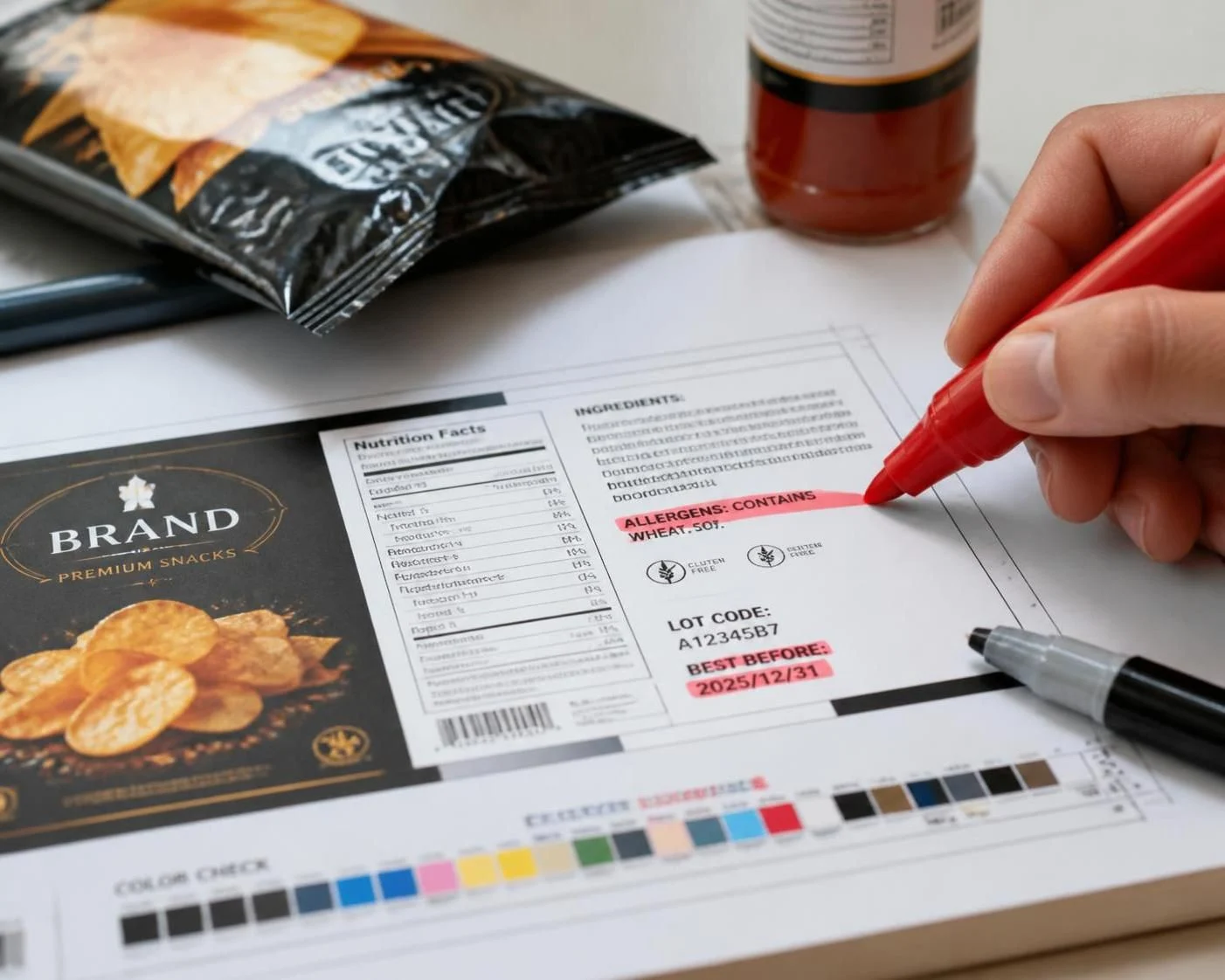
If you need help preparing photography or pack files after regulatory approval, our product photography and design service can support the commercial artwork process. It is not a substitute for label compliance review.
How should you sample, test, and inspect food orders?
Approve a retained sample and written specification before production, then inspect against that reference. An inspector can check visible and documented conditions; visual QC alone cannot establish microbiological safety, allergen absence, or regulatory eligibility. When those issues matter, set a product-specific testing and regulatory-review plan before production.
Use this sequence:
- Approve the product specification and a production-route sample.
- Confirm label artwork, product documents, and any required testing route.
- Keep the sample and final artwork as the inspection reference.
- Inspect pre-shipment quantities, pack integrity, labels, date and lot coding, carton marks, and visible condition.
- For chilled or frozen goods, document temperature requirements, logger use, loading conditions, and handover points.
- Keep photos, inspection records, lot references, and corrective actions with the order file.
Keep QC, testing, documentation, and import approval separate. QC compares the order with your specification. Laboratory work answers defined analytical or safety questions. Documents establish identity and traceability. The destination authority decides whether the product may enter and be sold. None of these controls replaces another.
Ask for food quality inspection support when you need an independent check on quantities, packaging, labels, cartons, and shipment evidence. Agree the inspection scope in advance so a report can give a true pass-or-fail result.
What do food MOQ, cost, and payment terms look like?
Food MOQ and total cost depend on the recipe, ingredients, packaging, production-line time, testing, storage conditions, and shipment route. For sea freight, cargo volume is commonly measured in cubic metres; use a CBM calculator before comparing shipping options. That one figure can change which order size and transport mode make commercial sense.
Do not compare only the ex-factory unit price. Calculate landed cost per sellable unit:
(product + samples + artwork + testing + inspection + China logistics + freight + insurance + duty/tax + clearance + delivery + expected loss) ÷ saleable units received
Your order budget may include:
- Samples and courier charges.
- Product price, recipe adjustments, artwork, plates, or packaging changes.
- Label review, translation, testing, inspection, and document handling.
- Domestic transport, consolidation, export packing, freight, insurance, duty, VAT/GST, clearance, and delivery.
- An allowance for damage, delay, short shelf life, rejected stock, or claims.
Choose the quotation that lets you model the whole order. Ask each supplier to state its Incoterm, currency, MOQ, production lead time, shelf-life guarantee at dispatch, carton dimensions, gross weight, and what exactly is included. Then use our sourcing cost calculator, freight estimate, and import duty lookup to test the commercial case.
How should you ship food from China?
Choose the shipping mode only after you know the product’s storage tolerance, remaining shelf life, shipment volume, destination clearance process, and document set. U.S. food shipments may require prior notice; check the current FDA instructions and product-specific exceptions before booking freight. Freight speed does not fix a missing notice, an unapproved label, or a product that cannot enter the market.
For shelf-stable food, air, courier, sea, and in some routes rail may be possible. Compare cost, transit time, handling points, and the practical shelf life remaining after delivery. For chilled or frozen food, use a specialist temperature-controlled route with agreed handovers, equipment, temperature records, and contingency plans. Some categories also need permits or official controls before arrival.
Check these details before booking:
- The Incoterm and who acts as importer of record.
- Correct product classification and destination duties.
- Clean, suitable cartons, pallets, and container condition.
- Packing list, commercial invoice, product certificates, and lot records.
- Container seal, loading photos, insurance, and handover evidence.
- Temperature data where the route requires it.
Avoid treating DDP as a universal answer for food. It can obscure who carries the import and tax responsibility. The buyer should understand the customs route, documents, and party named on the import entry. Use the freight estimate and CBM calculation already linked above before you agree a delivery promise.
Can you source food from China without visiting?
Yes, remote food sourcing is possible when the approval trail is stronger than a video call. Union Service can coordinate commercial sourcing steps from Yiwu, but commercial sourcing capacity is not food-factory certification. For every food order, the exact manufacturer and product still need separate checks.
Use a six-step remote process:
- Send a written product and destination-market brief.
- Identify the factory, trading company, contract party, and receiving bank account.
- Review documents and ask focused questions about formula, allergens, shelf life, labels, and lot coding.
- Receive and approve samples from the intended production route.
- Complete required label, test, and import-route checks before paying a deposit.
- Approve an inspection plan, shipping documents, and loading evidence before dispatch.
For remote orders, keep one approval folder for each product and supplier. Store the brief, supplier identity documents, product specification, ingredient and allergen information, approved label, retained sample photos, testing plan, inspection report, packing list, and shipping approval together. The folder gives the importer a dated record of what was approved and makes a later formula, label, or shipment change easier to detect.
If you cannot visit China, a Yiwu sourcing agent can coordinate quotes, samples, inspection, warehouse handling, and shipping. You should still retain every approval in writing and use qualified destination-market advice where needed.
What mistakes cause food imports to fail?
The most expensive errors happen before the deposit. Destination authorities can inspect, analyze, hold, relabel, rework, or reject food that does not meet the applicable route. A lower unit price cannot compensate for that outcome. Check the current commodity-specific route with the importing authority before production.
Avoid these common mistakes:
- Choosing a product before checking destination-market entry requirements.
- Selecting a supplier on price, photos, or a marketplace badge alone.
- Treating a generic certificate as approval for the exact formula and market.
- Approving packaging before the formula and importer details are final.
- Ignoring allergen, ingredient, date-code, and language controls.
- Using a visual inspection as a substitute for testing or regulatory review.
- Booking freight before the clearance route and documents are confirmed.
- Ignoring shelf life, humidity, temperature, or handling exposure.
- Paying an entity that does not match the contract and factory evidence.
- Failing to retain samples, lot records, and approval emails.
Before the deposit, run the eight-gate list once more. Confirm the product, market, factory, evidence pack, label, sample, QC plan, and freight route. If one gate remains open, pause the deposit.
Frequently asked questions
Can I import packaged food from China?
Yes, packaged food can often be imported from China, but the exact product must meet the rules of its destination market. In the U.S., requirements can include facility registration, prior notice, and foreign-supplier verification responsibilities. Confirm the current rule for your category and importer before ordering.
Do Chinese food manufacturers need GACC registration?
Do not treat GACC-related paperwork as a universal export certificate for a Chinese food factory. Confirm what the document covers, which country’s import route it applies to, and whether it applies to your exact product. For food leaving China, check the destination country’s rules and the importer’s responsibilities.
What documents do I need to import food from China?
The document set varies by food and destination, but it often includes an invoice, packing list, product specification, ingredient and allergen declaration, lot records, and product-specific certificates where required. EU consumer-food-information rules include allergen-disclosure requirements; your market may require different evidence and a different label format.
Do I need laboratory testing before I import food?
Sometimes. The need, scope, method, and laboratory depend on the product and destination-market rules. A pre-shipment inspection can check packaging, labels, quantity, and lot codes, but it cannot prove microbiological safety or allergen absence. Confirm testing requirements with the regulator, qualified adviser, and, where needed, an accredited laboratory.
What must appear on an imported-food label?
Food labels usually need product identity, ingredients, allergens, quantity, lot/date information, storage instructions, and importer or manufacturer details, but the exact format and language are country-specific. EU food-information law is Regulation (EU) No 1169/2011; U.S., UK, Canadian, Australian, and GCC rules differ. Approve the final artwork before production.
Can a sourcing agent handle food compliance?
A sourcing agent can collect supplier documents, arrange samples, coordinate inspection, and help with freight evidence. The agent does not replace the importer of record, a customs broker, a food lawyer, or the destination regulator. Keep the compliance decision with qualified people and keep a written record of every approval.
Start with the first eight checks
Food sourcing from China is manageable when the buyer clears the product and compliance questions before the commercial commitment. Verify the product route first. Then verify the factory and evidence pack. Approve the exact sample and label. Finally, agree the QC and freight plan.
This process takes longer than accepting the first low quote. It is usually faster than correcting a label, a held shipment, or a failed product after production. If you want a team in Yiwu to coordinate supplier quotes, samples, inspection, warehousing, and shipping evidence, get a free quote.